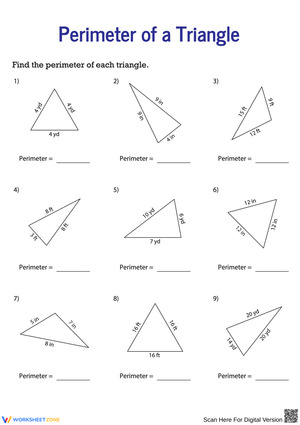
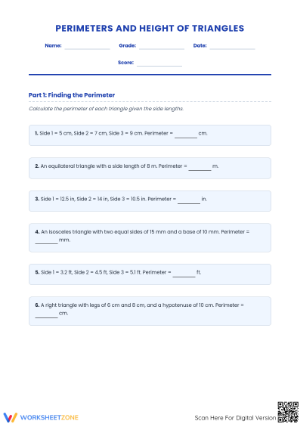
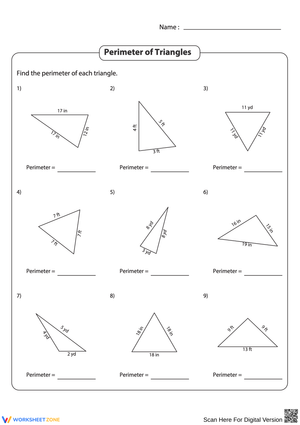
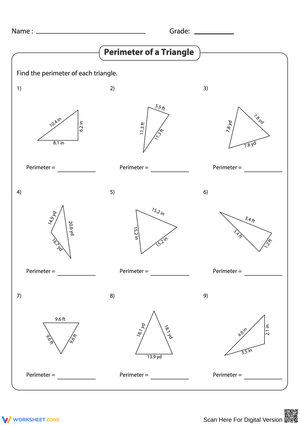
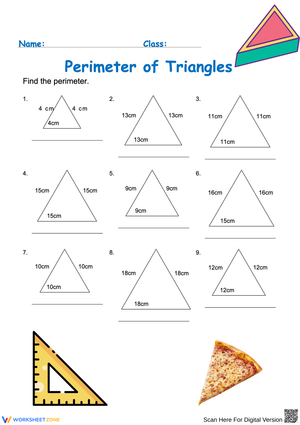
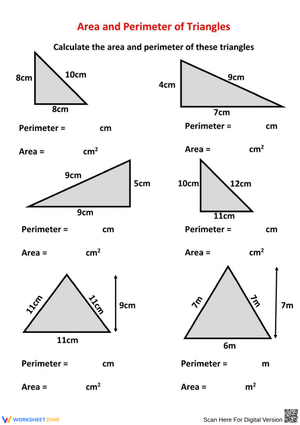
These perimeter of triangles worksheets cover every triangle type students encounter from third grade through early middle school — equilateral, isosceles, scalene, and right triangles with missing-side problems — giving teachers a single organized set they can pull from on any day of the geometry unit.
The Specific Skills These Perimeter of Triangles Worksheets Target
The core formula, P = a + b + c, takes about thirty seconds to introduce. What takes weeks is building the fluency to apply it accurately across triangle types, with decimals, in word problem contexts, and in reverse. These worksheets build each layer:
- Equilateral triangles serve as the entry point. Because all three sides are equal, students work with a single measurement and multiply by 3. The arithmetic is minimal, which keeps working memory available for focusing on what perimeter actually means.
- Isosceles triangles add a second distinct value — the base and one leg. Students who confuse "two equal sides" with "two sides" get that corrected in context, through diagrams that label which sides match.
- Scalene triangles require adding three different measurements. These problems surface careless addition errors and teach students to track every labeled value in the diagram before writing a number sentence.
- Missing-side problems give students the total perimeter and two side lengths; they find the third. This format targets CCSS.MATH.CONTENT.3.MD.D.8, which explicitly asks students to find unknown side lengths in polygon problems. The underlying operation is subtraction, but students often don't recognize that until someone points it out — more on this below.
- Word problems embed the triangle in a context: the border of a yield sign, the frame of a triangular picture, the fencing around a triangular plot. These require students to identify which measurements are sides and which are distractors, a skill that straight diagram problems don't build.
Standards Alignment
CCSS.MATH.CONTENT.3.MD.D.8 is where triangle perimeter first appears formally: students find the perimeter of polygons and solve for unknown side lengths. By fourth grade, perimeter problems appear within multi-step contexts, often combined with area. The fifth-grade standards move toward decimal and fractional measurement, which is why the intermediate worksheets use those number types — the geometry is review, but the arithmetic is grade-level work. Teachers in grades 4 and 5 often get the most mileage from these pages as review and fluency practice while the core instructional focus is on something else, using a worksheet as a ten-minute warm-up block rather than as the lesson itself.
Where These Fit in the Geometry Units
The most efficient use of a single worksheet page is as a focused warm-up — three equilateral triangle problems projected while students settle in takes about six minutes and keeps the formula active without cutting into new instruction. That routine works especially well on the day after introducing isosceles triangles, when students need low-stakes retrieval before the harder classification work begins.
For guided practice, the mixed-type pages work well with a gradual release structure: teacher models the first problem by reading the diagram aloud, naming the triangle type, writing the formula, and substituting — then pairs handle the second, then students finish the rest independently. The missing-side and word-problem pages are better positioned toward the end of the unit, after students have seen enough variation to recognize what kind of problem they're looking at before they calculate.
As an exit ticket, a single word problem from the set does the job. A student who correctly sets up the equation for the perimeter of a triangular garden plot — and gets the arithmetic right — has shown both conceptual understanding and procedural fluency. That's more diagnostic than three routine diagram problems.
The Inverse-Operation Problem Most Teachers Hit
Missing-side problems consistently trip students up, but the stumbling block is rarely the geometry — it's the framing. Students who fluently add three sides together will stare at a missing-side problem as if it belongs to a different subject. The shift that unlocks it: when the teacher names the operation explicitly. "You already know how to go forward — add the three sides. This problem runs the same equation backward." Students who hear that connection stop treating missing-side problems as a new procedure and start applying subtraction they already own. A short class discussion before releasing students to the missing-side worksheet — maybe five minutes, with one worked example on the board — dramatically reduces the frustration that otherwise shows up mid-page.
Scaling the Pages for Different Learners' Levels
The introductory pages use whole-number side lengths and large, clearly labeled diagrams. These work for third graders meeting perimeter for the first time and for fourth or fifth graders who need a confidence-building entry point before more demanding problems. The intermediate pages introduce decimal and fraction side lengths and mix triangle types on a single page, which asks students to re-identify the triangle before calculating — a meaningful additional step. The advanced pages for grades 5 and 6 include algebraic expressions as side lengths and some combined area-and-perimeter problems, where students calculate both measures for the same triangle. Those combined pages are efficient for review days because they cover two skills without requiring two separate worksheets.
For students who need more scaffolding, starting exclusively with equilateral triangles before moving to isosceles is a reliable sequence. The cognitive load is genuinely lower — one number, one operation — and that reduction in demand is what allows the concept of perimeter to register clearly before the arithmetic gets harder.
Frequently Asked Questions
When students get the wrong answer on a missing-side problem, what's usually causing it?
Almost always one of two things: they added all three values instead of subtracting, or they subtracted only one known side instead of both. Looking at the wrong answers quickly tells you which error is in play. If the answer is too large, they added. If the answer is still too large but less so, they only subtracted one side. Both errors point back to the same fix — making the inverse-operation relationship explicit before students work independently.
Do these work for students who haven't memorized triangle classifications yet?
Yes, with a small adjustment. The diagrams include tick marks on equal sides, so a student who doesn't yet have the vocabulary can still use the visual cues to identify which sides share a measurement. The classification vocabulary develops naturally through the repeated exposure on these pages — students who do enough isosceles problems start using the word correctly because it keeps appearing in context.
Is there a version appropriate for a third-grade introduction versus a fifth-grade review?
The introductory pages — whole numbers, single triangle type per page, large diagrams — are written for third grade and early fourth. The intermediate and advanced pages assume students already know what perimeter is and are adding complexity in the numbers or the problem type. Using an intermediate page as a third-grade introduction usually produces frustration; using an introductory page as a fifth-grade review usually produces boredom. Matching the page to the purpose matters more than matching it to the grade label.













 Interactive Worksheet Maker
 Quiz Maker
 Word Search Maker
 Crossword Puzzle Maker
 Word Scramble Generator
 Sentence Scramble Generator
 Handwriting Worksheet Generator
 Name Tracing Generator
 Fill In The Blank Generator