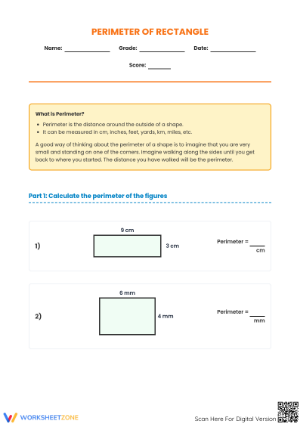
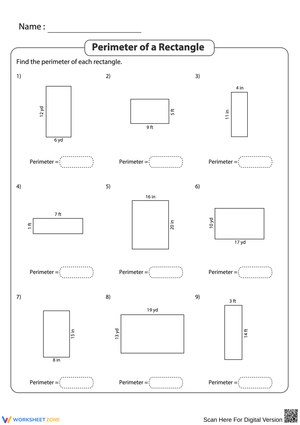
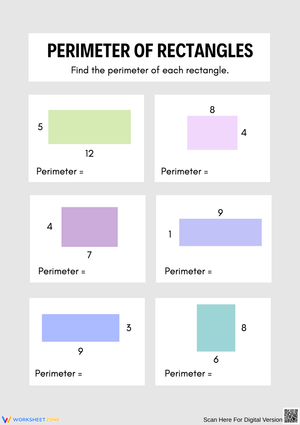
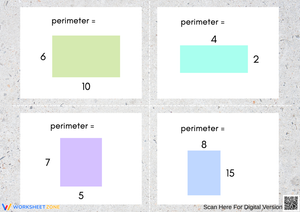
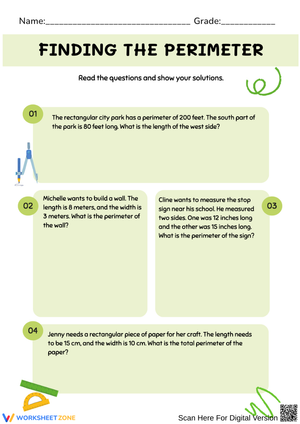
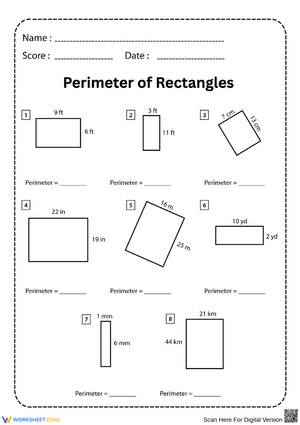
These perimeter of rectangles worksheets give third and fourth graders repeated, structured practice with one of the most commonly misunderstood measurement concepts in elementary geometry — and they do it across a range of problem types that move students from counting grid segments to solving for missing side lengths.
What's Inside these Perimeter of Rectangles Worksheets
These worksheets cover four distinct problem formats.
- The first has students count unit segments along the boundary of rectangles drawn on grid paper — a format that keeps the focus on the outer edge rather than the interior, which matters most when students are still sorting out the difference between perimeter and area.
- The second format presents labeled rectangles where students apply P = 2l + 2w or P = 2(l + w), working with measurements in inches, centimeters, feet, and meters so the formula feels consistent regardless of unit.
- The third format gives the total perimeter and one side length; students work backward to find the unknown dimension, which introduces the inverse reasoning that shows up again in pre-algebra.
- The fourth format uses word problems — fencing a garden plot, framing a classroom bulletin board, laying out a floor border — where students have to identify the relevant dimensions before computing anything.
Standards Alignment
Perimeter of rectangles lands at CCSS 3.MD.D.8, which asks students to find the perimeter of polygons given side lengths, find an unknown side length given the perimeter, and compare rectangles that share a perimeter but differ in area. The grid-counting and basic formula pages address the first two expectations directly.
By fourth grade, CCSS 4.MD.A.3 moves students into applying area and perimeter formulas within real-world and mathematical contexts — which is where the word problem pages earn their place. That standard explicitly asks students to solve for missing dimensions when total perimeter is known, so the reverse-formula pages aren't enrichment; they're on-grade expectation by mid-year in grade four.
Error Patterns For Teachers To Notice
The most persistent mistake at the third-grade level isn't formula confusion — it's incomplete addition. Students who correctly identify the length and width will add those two values and stop, writing down the sum as if it were the perimeter. The rectangle has four sides, but students see two labeled dimensions and work with two numbers. The resulting answer is exactly half the correct perimeter, which means it rarely triggers a "that seems wrong" reaction because it looks like a reasonable measurement. These worksheets build in a step where students label all four sides before computing, which interrupts that shortcut.
A second error appears when students move from grid counting to formula work: they start counting squares rather than segments. A rectangle that is 4 units long by 3 units wide has 12 square units of area, but students who counted squares on earlier assignments will write 12 as the perimeter. Requiring students to mark tick marks on each side segment — rather than counting interior boxes — catches this before it calculates into a wrong formula answer.
Classroom Lesson Planning With These Worksheets
The grid-counting pages work well as a Monday warm-up in the week perimeter is introduced, or as a re-entry activity after a weekend when the formula hasn't settled yet. Two problems take about five minutes and re-anchor the concept before the lesson moves forward. The labeled-rectangle pages suit independent practice after direct instruction, or as a math center task during small-group rotations. The missing-side-length pages are best reserved for teacher-led practice first — students need to see the inverse reasoning modeled before they attempt it independently — then released to pairs before moving to solo work.
The word problem pages pay off most when students work them in pairs and narrate their setup aloud before writing anything. The common failure point isn't the arithmetic; it's students plugging numbers into the formula before they've identified which measurement is the length and which is the width, or before they've noticed that the problem gives a side length in feet and asks for an answer in inches. Pair talk surfaces those misreadings faster than a worksheet alone.
Frequently Asked Questions
My students mix up perimeter and area every time. Will more worksheets actually fix that?
More worksheets alone won't fix it, but worksheets that require students to mark the boundary first — physically tracing or coloring the outer edge before writing any numbers — help anchor the distinction. The confusion is conceptual, not computational: students don't yet have a reliable mental model for "distance around" versus "space inside." Any worksheet format that keeps the outer edge visible and separate from the interior is doing more work than one that just presents labeled dimensions and asks for a number.
At what point should students stop using the grid-counting pages?
When they can consistently articulate why they're counting segments rather than squares, and when they can transition that reasoning to a rectangle with labeled dimensions without prompting. Some students make that transition in a day; others need the grid available through the first week. The grid pages are a scaffold, not a crutch — there's no harm in a student who understands the concept using them for accuracy while the formula is still new.
How do I use these for a student who already knows the formula cold?
The missing-side-length and word problem pages will still offer challenge if you require written work that shows the reasoning, not just the answer. Ask that student to write the equation they used, check their answer by plugging it back into the perimeter formula, and — for word problems — restate what the answer means in context. A student who can do all of that with clean, correct work is genuinely ready to move on; a student who gets the right answer but can't explain the check usually has a procedural shortcut that will break down on a harder problem.













 Interactive Worksheet Maker
 Quiz Maker
 Word Search Maker
 Crossword Puzzle Maker
 Word Scramble Generator
 Sentence Scramble Generator
 Handwriting Worksheet Generator
 Name Tracing Generator
 Fill In The Blank Generator