


























Views
Downloads

Essential Perimeter Practice Worksheet | Grade 4-5 Printable
Paste this activity's link or code into your existing LMS (Google Classroom, Canvas, Teams, Schoology, Moodle, etc.).
Students can open and work on the activity right away, with no student login required.
You'll still be able to track student progress and results from your teacher account.
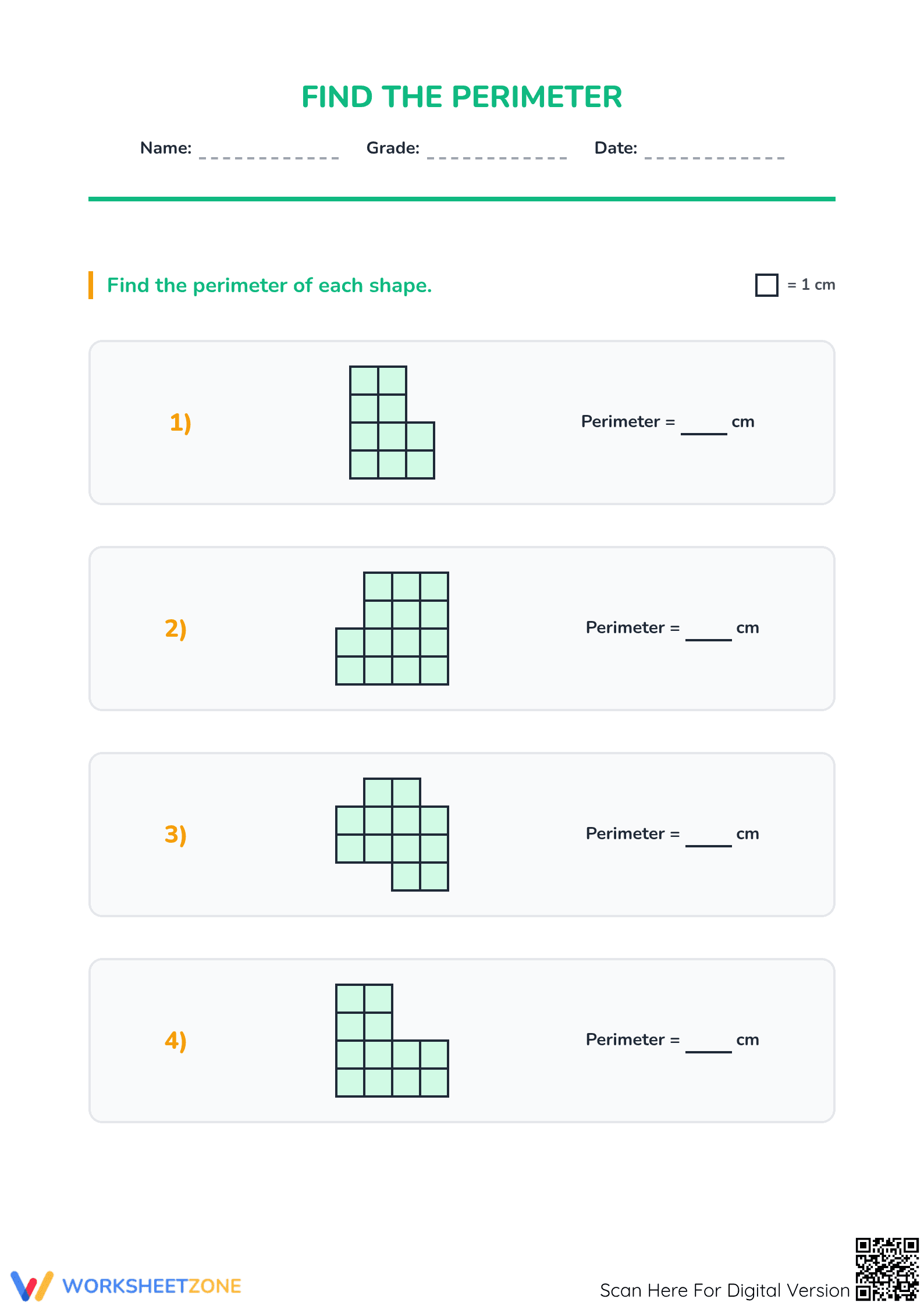
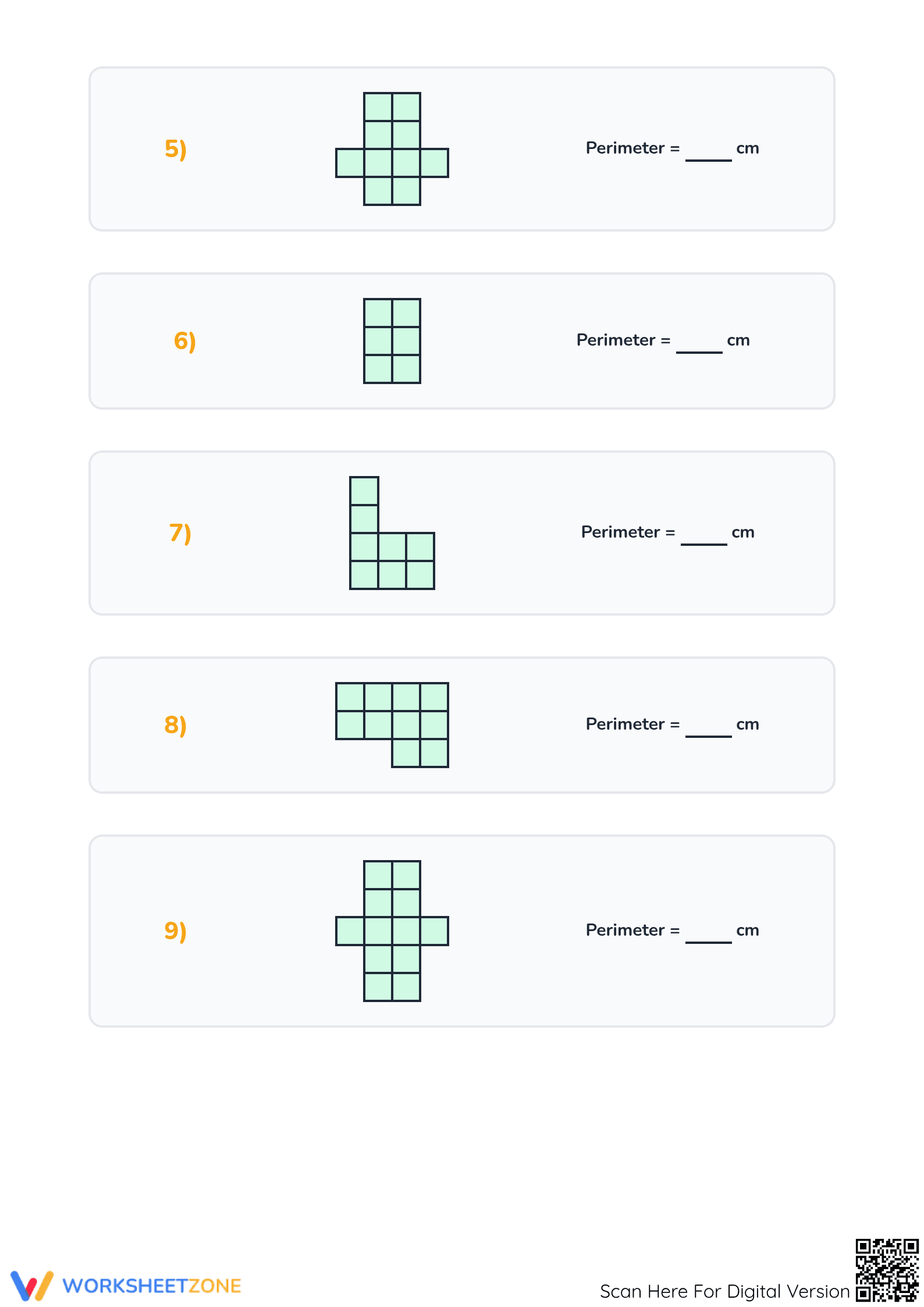
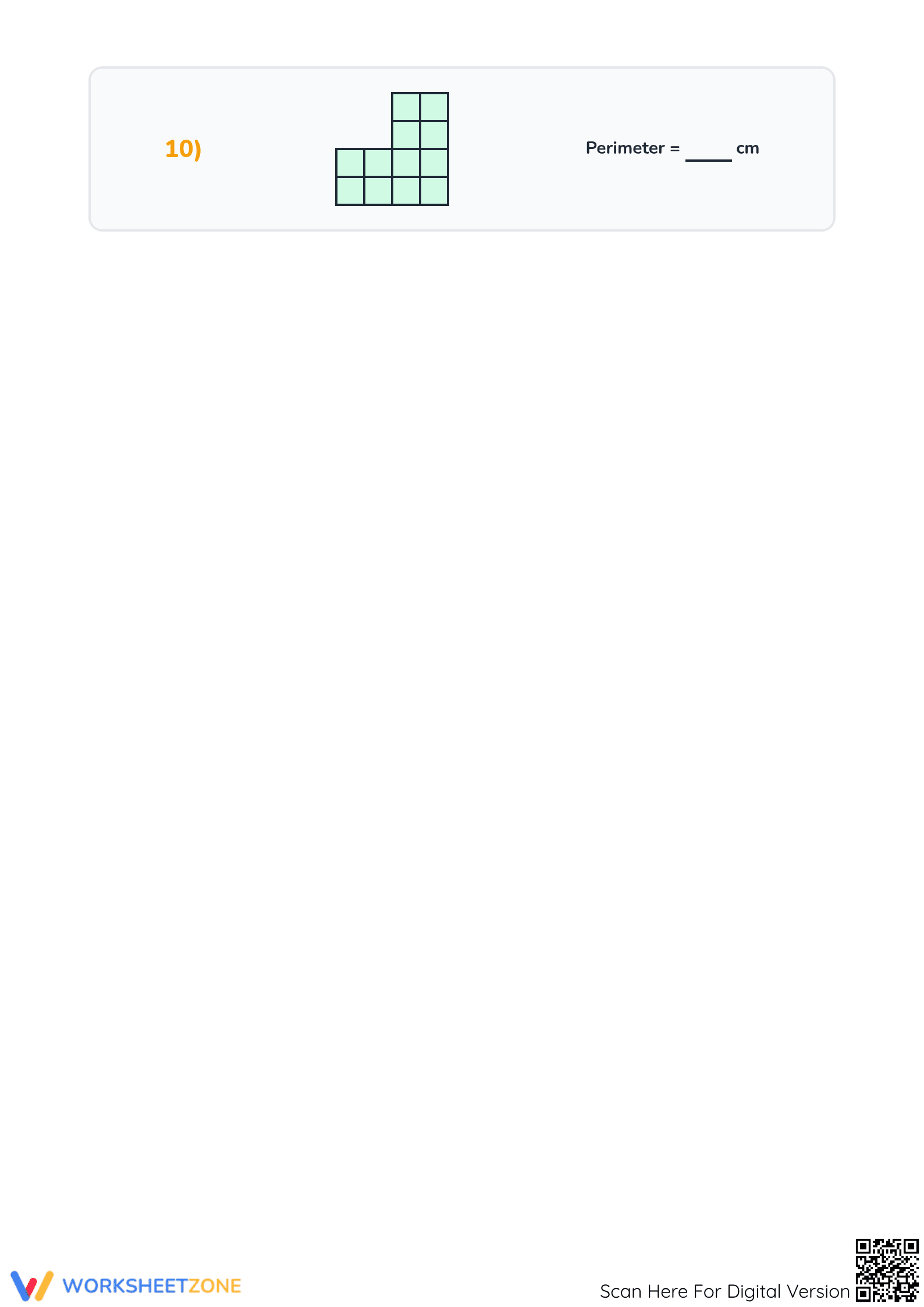
This comprehensive three-page worksheet helps students master the foundational concept of perimeter by calculating the total distance around composite rectilinear shapes. Instead of relying on abstract formulas, students engage in concrete practice by counting unit square edges. This visual approach ensures a deep understanding of boundary measurement before transitioning to complex geometric calculations and real-world applications.
At a Glance
- Grade: 4–5 · Subject: Math
- Standard:
CCSS.MATH.CONTENT.4.MD.A.3— Apply area and perimeter formulas for rectangles in real-world problems- Skill Focus: Perimeter of rectilinear shapes
- Format: 3 pages · 30 problems · Answer key included · PDF
- Best For: Independent practice and formative assessment
- Time: 20–30 minutes
This resource features 30 distinct problems spread across three printable pages. Each problem presents a unique shape constructed from 1cm unit squares, challenging students to determine the perimeter by tracking the outer boundary. The layout is clean and spacious, providing ample room for students to mark their counts. A complete, three-page answer key is included, allowing for rapid grading or self-directed student correction.
The "Print-and-Go" design of this perimeter worksheet minimizes teacher workload while maximizing student engagement. Educators can prepare this lesson in three simple steps: first, print the three-page PDF; second, distribute the materials to students with a brief verbal reminder to count only the exterior edges; and third, utilize the provided answer key for immediate feedback or grading in under two minutes. This workflow makes the worksheet ideal for substitute plans.
This worksheet is explicitly aligned to `CCSS.MATH.CONTENT.4.MD.A.3`, which requires students to "Apply the area and perimeter formulas for rectangles in real world and mathematical problems." By counting unit lengths of 1cm, students build the conceptual bridge between linear measurement and standard formulas. This standard code can be copied directly into lesson plans, IEP goals, or district curriculum mapping tools for seamless documentation.
Use this worksheet as a focused practice session immediately following direct instruction on linear measurement. It serves as an excellent formative assessment tool; teachers should observe whether students remember to count all corners or if they accidentally skip edges in concave sections. Expected completion time is 20 to 30 minutes, making it a perfect fit for a math center rotation or a structured homework assignment.
This resource is designed for Grade 4 and Grade 5 students who are refining their understanding of geometric properties. It is particularly effective for visual learners and students who benefit from tactile-style counting tasks. It pairs naturally with anchor charts illustrating "distance around" vs. "space inside" to prevent the common confusion between perimeter and area during early geometric instruction.
Effective math instruction requires a balance of conceptual understanding and procedural fluency, a principle underscored by the RAND AIRS 2024 report on elementary mathematics pedagogy. This worksheet addresses CCSS.MATH.CONTENT.4.MD.A.3 by providing repeated, structured exposure to perimeter calculation through unit square analysis. By counting the 1cm edges of composite rectilinear shapes, students internalize the definition of perimeter as a linear boundary before being asked to apply multiplicative formulas. Research from Fisher & Frey (2014) highlights that such scaffolded visual tasks are critical for moving students toward independent mastery of geometric concepts. This resource provides exactly thirty opportunities for such practice, ensuring that the student outcome is a durable, transferable skill. Teachers can confidently integrate this into a larger unit on measurement knowing it meets the rigorous demands of standards-aligned curriculum frameworks and supports evidence-based instructional practices.


