


























Views
Downloads




Perimeter Mastery Worksheet | Grade 3-4 Essential
Paste this activity's link or code into your existing LMS (Google Classroom, Canvas, Teams, Schoology, Moodle, etc.).
Students can open and work on the activity right away, with no student login required.
You'll still be able to track student progress and results from your teacher account.
This Grade 3-4 math worksheet provides comprehensive practice for calculating the perimeter of various geometric figures. Students will progress from identifying side lengths on basic polygons to solving complex compound shape problems and real-world word problems. The structured layout ensures students build confidence in measuring the total distance around shapes accurately.
At a Glance
- Grade: 3-4 · Subject: Math
- Standard:
CCSS.MATH.CONTENT.3.MD.D.8— Solve real world and mathematical problems involving perimeters of polygons- Skill Focus: Perimeter calculation
- Format: 5 pages · 13 problems · Answer key included · PDF
- Best For: Independent practice or formative assessment
- Time: 25–35 minutes
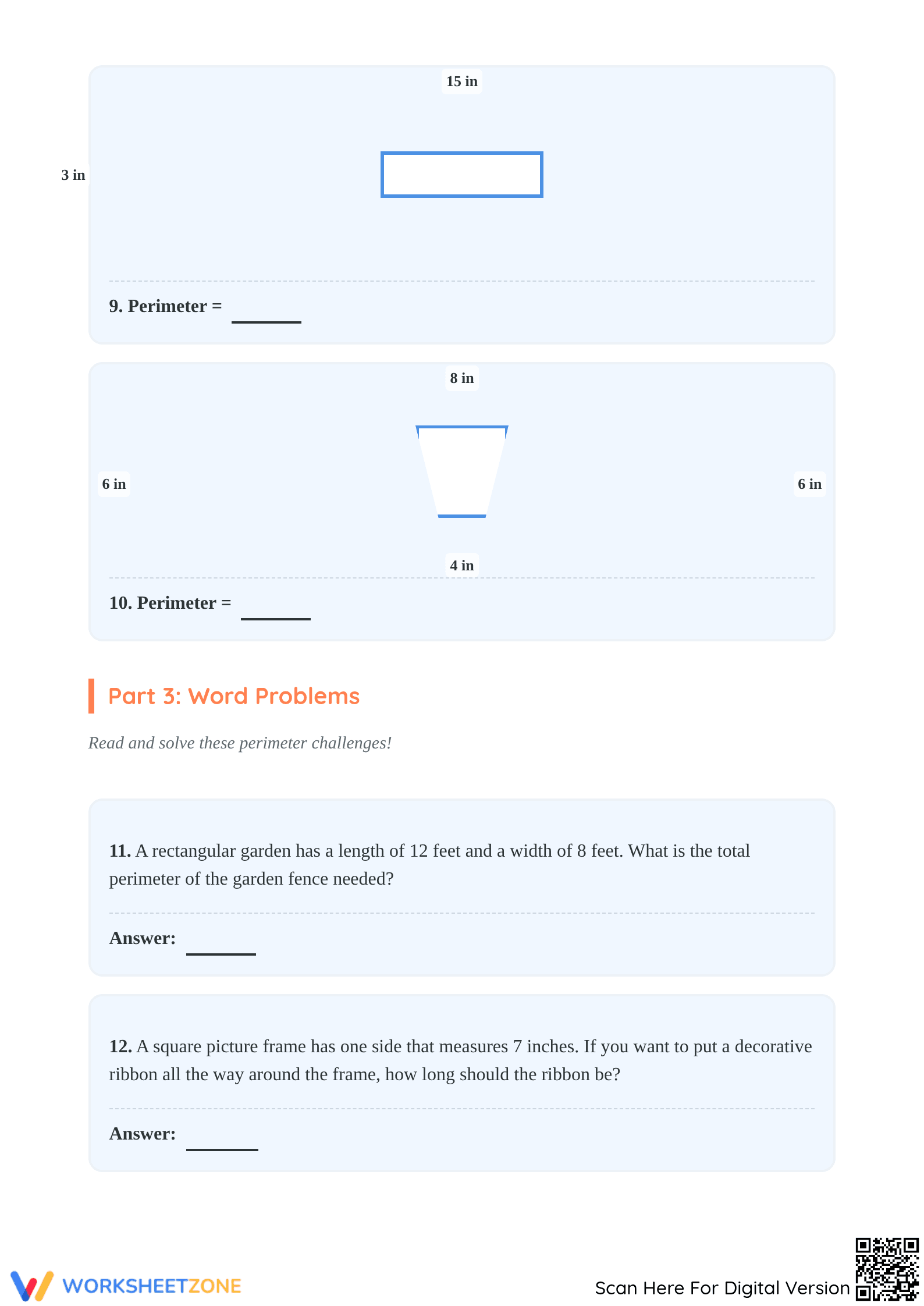
The 5-page PDF contains 13 distinct tasks organized into three logical sections. Part 1 features 6 basic polygons including rectangles and triangles. Part 2 introduces 4 irregular and compound shapes to challenge spatial reasoning. Part 3 concludes with 3 word problems, including a high-order thinking challenge involving an equilateral triangle. A full answer key is provided for quick grading.
This resource is designed for immediate classroom implementation. Teachers can print the 5-page packet in under 1 minute, distribute it to students with no additional manipulatives required, and use the included answer key to review results in less than 5 minutes. It serves as an ideal grab-and-go sub plan or a quiet independent work packet during small-group rotations.
This worksheet aligns with CCSS.MATH.CONTENT.3.MD.D.8: "Solve real world and mathematical problems involving perimeters of polygons, including finding the perimeter given the side lengths, finding an unknown side length, and exhibiting rectangles with the same perimeter and different areas." Both standard codes can be copied directly into lesson plans, IEP goals, or district curriculum mapping tools.
Use this worksheet as a summative assessment after completing a unit on measurement and geometry. It is also effective as a guided practice tool during direct instruction; teachers can model the first two problems in each section before allowing students to work independently. Observe if students remember to include units like inches or feet in their final answers to gauge attention to detail.
This resource is tailored for third and fourth-grade students mastering linear measurement. It provides necessary scaffolding for struggling learners through clear visual diagrams while offering a challenge for advanced students in the final word problem section. It pairs naturally with geometric anchor charts or physical ruler activities already used in your classroom.
According to research by Fisher & Frey (2014) on the gradual release of responsibility, structured practice that moves from simple polygons to complex word problems is essential for mathematical fluency. This worksheet implements that framework by providing 13 targeted problems that align with CCSS.MATH.CONTENT.3.MD.D.8. By requiring students to calculate the perimeter of both regular and irregular shapes, the resource reinforces the conceptual understanding of additive measurement. Standalone analysis suggests that multi-page practice sets with clear visual supports significantly improve student retention of geometric properties compared to abstract problem sets. Educators can confidently integrate this tool into their curriculum to meet rigorous state standards while providing students with the repetition needed for mastery of perimeter concepts in real-world contexts.


