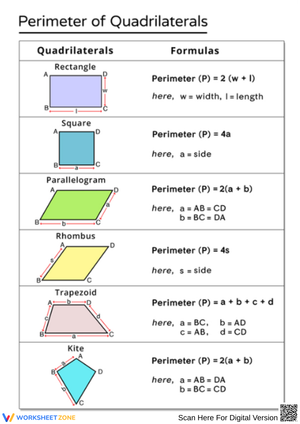
These perimeter of quadrilaterals worksheets cover every major shape in the family — squares, rectangles, parallelograms, rhombuses, and trapezoids — and move students through a deliberate progression: labeled diagrams first, then formula application, then missing-side problems that require working backward from a known total. Teachers get a set that spans the full instructional arc rather than clustering around one problem type.
What's on These Perimeter of Quadrilateral Worksheets
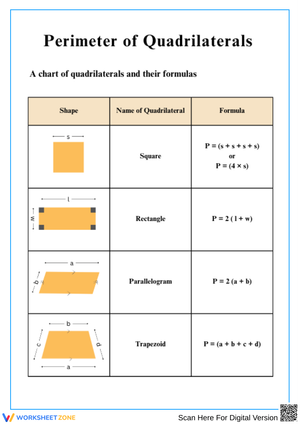
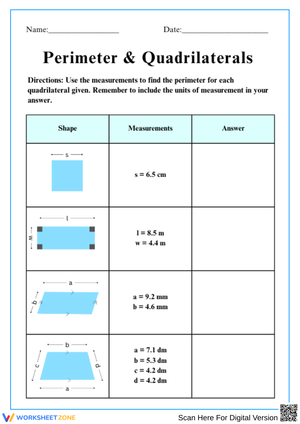
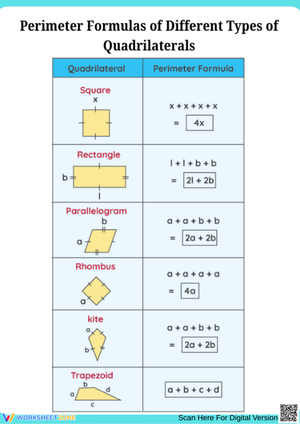
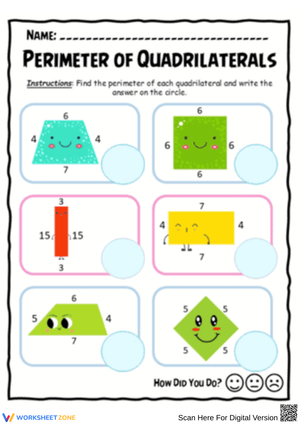
The set addresses five core skills. Problems at the entry level ask students to add all four labeled side lengths and write a total — straightforward enough that the shape's properties, not the arithmetic, carry the cognitive load. The next tier introduces shape-specific formulas: P = 4s for squares, P = 2(l + w) for rectangles, and the four-term addition P = a + b + c + d for irregular quadrilaterals and trapezoids. A third category presents problems on coordinate grids where students derive side lengths before they can calculate anything — a step that trips up more students than the computation itself. Word problems form their own section: fencing a rectangular backyard, framing a photo, adding border trim to a bulletin board. The final group gives the perimeter and three sides and asks for the fourth, which requires a different problem-solving sequence entirely.
Trapezoids earn their own cluster of problems because students frequently treat them like rectangles — assuming parallel sides are equal — and need repeated, targeted exposure to break that habit. Parallelogram problems are paired with rhombus problems so students confront the one-property-different comparison directly.
The Skill That Actually Causes Problems
Missing side problems consistently generate the most errors, and the errors follow a recognizable pattern. A student who knows the total perimeter is 36 cm and can see that three sides measure 8, 10, and 6 cm will frequently write the answer as 36 − 8 = 28, stopping after subtracting only one side. The multi-step nature of the calculation — add the known sides, then subtract — doesn't fully register as a two-part operation. A different breakdown happens on rectangle problems: students who are told the perimeter is 26 and one side is 9 will often write the missing side as 26 − 9 − 9 = 8, skipping the final division by two because they lose track of the fact that opposite sides come in pairs.
A classroom intervention that consistently reduces both errors: ask students to mark every known side directly on the figure before writing a single number in their work. Using two colors — one for given lengths, one for the unknown — forces the visual separation that slows the impulsive subtraction. It's a simple annotation habit, but it changes how students read the problem.
Where These Pages Fit in Your Lesson Plans
The labeled-diagram pages work well during the first independent practice block of a new shape type — typically the day after a guided lesson where you modeled the property. Because students are still consolidating, keeping the problem type narrow on day one reduces cognitive load and lets them succeed with the new formula before mixing shape types.
Mixed-shape pages — where squares, rectangles, and trapezoids appear in the same problem set — belong later in the unit, after students have worked each shape separately. These are natural choices for the review day before an assessment or for a Friday warm-up block during the weeks that follow the unit, when spaced retrieval keeps the skill from eroding.
Word problem pages run well as pair work. The reading demand is high enough that two students working together catch each other's misreadings of the scenario — one student will correctly identify the shape as a rectangle while their partner has already started adding four different numbers from the problem text.
Math station rotations work cleanly with this set: one station for grid-based problems, one for formula application on drawn figures, one for word problems. Rotating in 12–15 minute intervals keeps momentum and lets you station yourself at the grid table, where students typically need the most guided support.
Standard Alignment
Standard 3.MD.D.8 introduces perimeter — including finding unknown side lengths — at third grade because students at that stage can handle multi-step addition reliably but are still developing the algebraic reasoning required for later work with equations. The missing-side problem is the developmental bridge: it asks students to reason backward from a total, which is informal inverse thinking without requiring formal variable notation. Teachers sometimes rush past that bridge toward area, but students who haven't firmly separated the two concepts — boundary measurement vs. interior measurement, linear units vs. square units — will confuse them on every standardized assessment through fifth grade.
Frequently Asked Questions
Do students need to know the formulas before using these worksheets, or are the formulas provided?
The formula pages include the formula at the top of the page. The reasoning: at third grade, the goal is conceptual fluency with the operation, not formula memorization under pressure. Students who see P = 2(l + w) on the page while practicing will internalize it through repeated use. Pulling the formula and asking students to recall it cold belongs in the review phase, not the initial practice phase.
My students keep confusing perimeter and area — will these pages help?
They help if you use them alongside area work rather than sequencing the two units so far apart that students never compare them directly. The most durable intervention is pairing one perimeter problem and one area problem about the same figure on the same page, then asking students to explain in writing why the answers are different numbers with different units. That comparison — rather than separate, isolated practice — is what builds the distinction that sticks.
Are there problems appropriate for fourth or fifth grade review?
The coordinate-grid problems and irregular quadrilateral pages work for fourth grade review and as fifth grade fluency maintenance. At those grades, the perimeter calculation itself isn't the challenge — what matters is whether students can extract the necessary measurements from a more complex geometric context and execute the computation without scaffolding.













 Interactive Worksheet Maker
 Quiz Maker
 Word Search Maker
 Crossword Puzzle Maker
 Word Scramble Generator
 Sentence Scramble Generator
 Handwriting Worksheet Generator
 Name Tracing Generator
 Fill In The Blank Generator