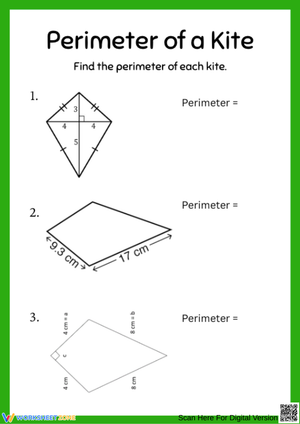
These perimeter of kites worksheets give students in grades 6–10 structured practice with one of the more conceptually interesting quadrilaterals in the middle and high school geometry sequence. The set moves from direct substitution into P = 2(a + b) all the way through problems that require the Pythagorean theorem first — so a single collection covers the range from initial instruction to rigorous challenge.
The Geometry Behind the Formula
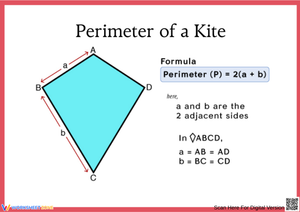
A kite has two pairs of equal sides, but unlike a parallelogram, the equal sides are adjacent rather than opposite. That structural distinction is what makes the formula work: because each of the two distinct side lengths appears exactly twice, the perimeter reduces to doubling their sum. Students who understand this property can reconstruct the formula from a diagram rather than reciting it from memory, which matters when the formula sheet isn't in front of them on a test.
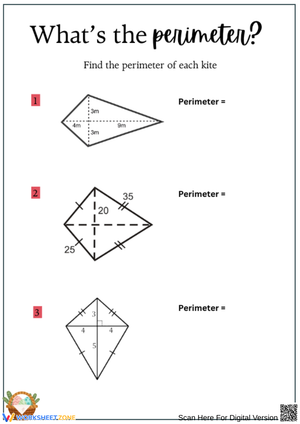
Where the concept trips students up is in the diagram-reading, not the arithmetic. A kite drawn at an oblique angle — tilted so the longer diagonal runs horizontally — causes students to misidentify which sides are paired. They label by position (top left, bottom right) rather than by the defining property of the shape. Worksheets in this set include kites in multiple orientations specifically to expose and correct that habit before it calculates into wrong answers on assessments.
What's Inside the Perimeter of Kites Worksheets
Problems are organized into three tiers. At the foundational level, both side lengths are labeled directly on the diagram and students substitute into the formula. These work well for sixth and seventh graders first encountering quadrilateral properties, or for any student who needs the scaffolding of a visible diagram before working abstractly.
At the intermediate level, one or both side lengths are expressed as algebraic expressions — something like 3x + 4 and 2x − 1 — and the perimeter is given. Students set up and solve an equation before the geometry calculation even begins. This is where the kite becomes genuinely useful as a vehicle for algebra practice: the two-pair structure constrains the problem enough that the equation stays manageable, but the setup still requires real reasoning.
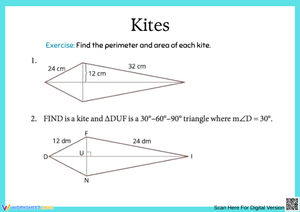
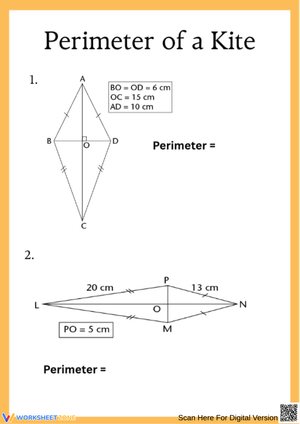
The advanced tier withholds the side lengths entirely and provides only the diagonal measurements. Since a kite's diagonals are always perpendicular, they produce right triangles inside the figure. Students use half of each diagonal as the legs, apply the Pythagorean theorem to find the hypotenuse — which is one side of the kite — and then return to the perimeter formula. That integration of two major geometry standards in a single problem is what makes these pages appropriate for grades 8 through 10.
Standards Alignment
Kite properties appear within the broader 7.G cluster of the Common Core State Standards, where students reason about the attributes of two-dimensional shapes. The algebraic side of these worksheets also draws on 7.EE.4, which addresses using equations to solve problems involving unknown quantities — making this a natural cross-domain problem set for seventh and eighth grade. The Pythagorean theorem problems connect directly to 8.G.7, the standard for applying the theorem to find unknown lengths. Using kite perimeter as the vehicle for that application gives the theorem a geometric home beyond the typical ladder-against-a-wall context.
Where These Fit in Your Lesson Plans
The foundational pages work cleanly as guided practice immediately after a direct-instruction lesson. Walking through the first two problems together, then releasing students to work in pairs on the rest, gives the teacher time to circulate and catch misidentifications before they become habits. The whole routine fits in about 15 minutes.
The intermediate and advanced pages are well-suited to the Friday review block or the Monday warm-up after a weekend gap — moments when spaced retrieval is the instructional goal rather than new learning. A five-problem exit ticket drawn from the intermediate tier also functions as a clean formative check before a unit test: if most students are mishandling the equation setup rather than the perimeter calculation, that's a different reteaching conversation than if the formula itself isn't landing.
For teachers running math stations, the tiered structure maps directly onto differentiated rotations. The foundational page goes to one station, intermediate at another, advanced at a third. While students rotate, the teacher pulls a small group for targeted instruction without the rest of the class sitting idle.
Frequently Asked Questions
Can these worksheets be used with students who haven't studied the Pythagorean theorem yet?
Yes — the foundational and intermediate tiers require no prior knowledge of the Pythagorean theorem. The advanced tier does, so those pages are better saved for students in grade 8 or above, or for an accelerated seventh-grade group that has already covered right triangles.
Is there a version for students who struggle with diagram interpretation?
Several pages in the foundational tier label each side with a letter and provide a separate key identifying which letters represent the two distinct lengths. That removes the visual parsing step and lets a struggling student focus on the formula itself. Once the formula is solid, reintroducing unlabeled diagrams works better as a second pass.
Do the worksheets include answer keys?
Every page in the set includes a complete answer key. For the algebraic and Pythagorean theorem problems, worked solutions show each step rather than just the final value — which makes the keys useful for students doing self-correction, not only for teacher grading.













 Interactive Worksheet Maker
 Quiz Maker
 Word Search Maker
 Crossword Puzzle Maker
 Word Scramble Generator
 Sentence Scramble Generator
 Handwriting Worksheet Generator
 Name Tracing Generator
 Fill In The Blank Generator