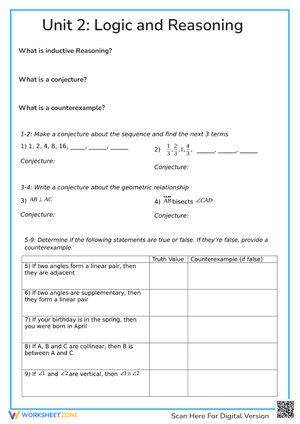
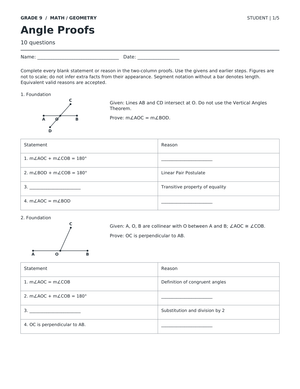
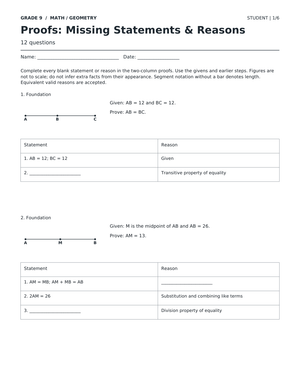
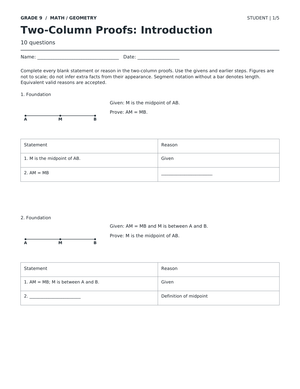
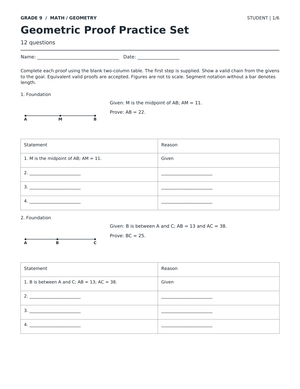
Proof instruction rarely works as a single unit taught in isolation. Students need repeated, scaffolded practice that builds from simpler reasoning chains to more complex multi-step arguments. A worksheet set that starts with angle relationships, moves into triangle congruence, and finishes with quadrilateral properties mirrors how proof reasoning actually develops in a typical geometry course.
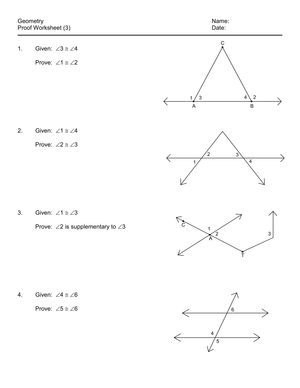
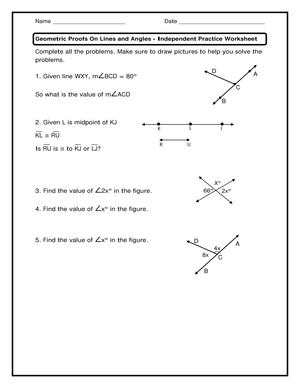
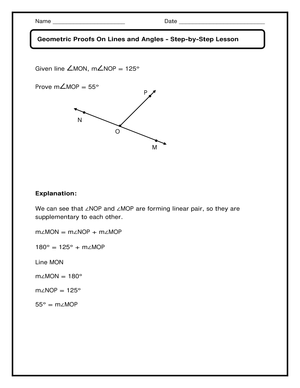
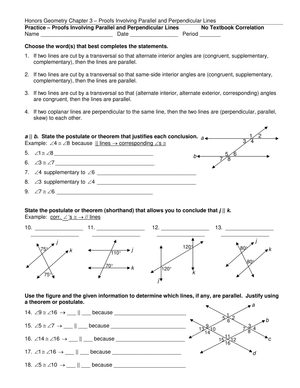
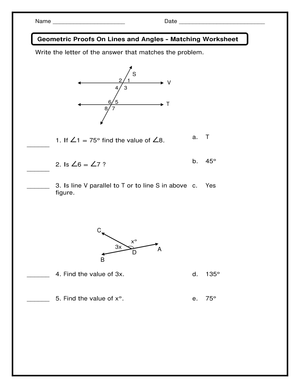
Starting with vertical angles and parallel-line transversal relationships gives students low-stakes practice with the statement-reason format before congruence criteria enter the picture. Once that structure feels familiar, triangle congruence proofs introduce a new layer: choosing which criterion applies and explaining why the given information supports it.
Aligning Worksheets to Congruence Standards
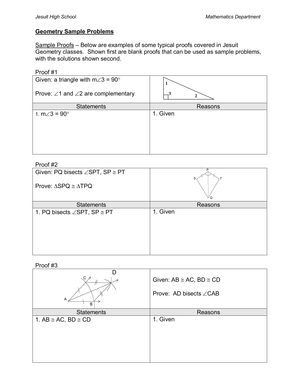
CCSS HSG-CO.B.7 asks students to use the definition of congruence in terms of rigid motions to show two triangles are congruent when corresponding sides and angles match. HSG-CO.B.8 extends this by requiring students to explain how ASA, SAS, and SSS actually follow from that rigid-motion definition, rather than treating the criteria as memorized shortcuts.
Many geometry pacing guides underestimate how much practice time is needed between introducing rigid motions and expecting students to write independent two-column proofs. Worksheets that explicitly connect a congruence statement back to a translation, rotation, or reflection give students the conceptual bridge that HSG-CO.B.7 and HSG-CO.B.8 require, rather than skipping straight to criterion-matching drills.
HSG-CO.C.9 and HSG-CO.C.10 round out the standards most proof worksheets target. HSG-CO.C.9 covers theorems about lines and angles, including vertical angles congruence and the angle relationships formed by a transversal crossing parallel lines. HSG-CO.C.10 covers triangle theorems such as the triangle sum theorem and the base angles of isosceles triangles. Sequencing worksheets to hit C.9 before C.10 keeps the angle-relationship foundation in place before triangle-specific proofs begin.
Two-Column Proofs vs. Paragraph Proofs
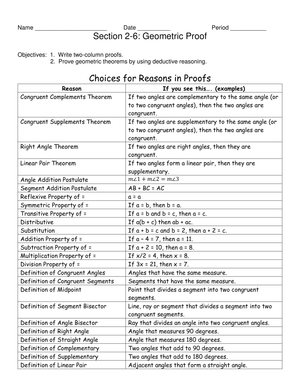
Two-column proof worksheets work well for guided practice because the statement-reason format makes each logical step visible and easy to check. Students can see exactly where their reasoning breaks down, which makes these worksheets useful for whole-class modeling and partner practice early in a unit.
Paragraph proofs serve a different purpose. They ask students to communicate the same logical chain in prose, which tests whether they actually understand the reasoning or were simply filling in a template. Save paragraph proof worksheets for later in the unit, once students are comfortable with the underlying logic, and use them as a check for conceptual understanding rather than a first introduction to proof writing.
Flowchart proofs offer a middle ground worth including in a worksheet rotation. The visual branching structure can help students who understand the logic but struggle with the linear format of two-column proofs, giving another lens on the same standards.
Classroom Implementation
Use short proof worksheets as formative checkpoints throughout the unit rather than saving all proof practice for a single cumulative assignment. A five-minute warm-up proof at the start of class, tied to the previous day's lesson, surfaces misunderstandings before they compound.
For homework, pair a two-column proof worksheet with one paragraph proof covering the same content, so students practice both formats without doubling the cognitive load of new material. In whole-class settings, project a worksheet proof and have students justify each step aloud before writing, which builds the verbal reasoning that paragraph proofs later require. For enrichment, extend a triangle congruence worksheet into a quadrilateral proof using the same rigid-motion reasoning from HSG-CO.B.7, giving advanced students a natural next step without introducing an entirely new standard.
Frequently Asked Questions
1. What grade level typically covers geometric proofs under Common Core?
Geometric proofs are primarily a high school geometry topic, usually taught in grades 9-10, and are addressed directly under the CCSS HSG-CO congruence cluster.
2. What is the difference between a two-column proof and a paragraph proof worksheet?
A two-column proof worksheet separates statements and reasons into parallel columns, making each logical step explicit and easy to check. A paragraph proof worksheet asks students to write the same reasoning in prose, which tests deeper understanding of the logic rather than template completion.
3. Which CCSS standards do geometric proofs worksheets align to?
Most geometric proof worksheets for high school align to HSG-CO.B.7 and HSG-CO.B.8, which cover congruence through rigid motions and triangle congruence criteria, along with HSG-CO.C.9 and HSG-CO.C.10, which cover theorems about lines, angles, and triangles.
4. How can teachers scaffold geometric proofs for struggling students?
Partially completed proofs and statement-reason frames with a bank of possible reasons both reduce the cognitive load of proof writing, letting students practice one part of the process at a time before attempting a full independent proof.
5. How should teachers use geometric proofs worksheets for review or enrichment?
For review, short single-proof worksheets work well as formative checkpoints before a unit test. For enrichment, extend triangle congruence worksheets into quadrilateral proofs using the same rigid-motion reasoning, giving advanced students more complexity without introducing a new standard.













 Interactive Worksheet Maker
 Quiz Maker
 Word Search Maker
 Crossword Puzzle Maker
 Word Scramble Generator
 Sentence Scramble Generator
 Handwriting Worksheet Generator
 Name Tracing Generator
 Fill In The Blank Generator