What Algebraic Proofs Worksheets Actually Teach
Algebraic proofs worksheets ask students to do something they have rarely been graded on before: justify every move, not just find the answer. Instead of racing to isolate x, students write a reason beside each line, naming the exact property that permits the step. For US high school teachers, this is the quiet turning point where arithmetic fluency becomes formal reasoning.
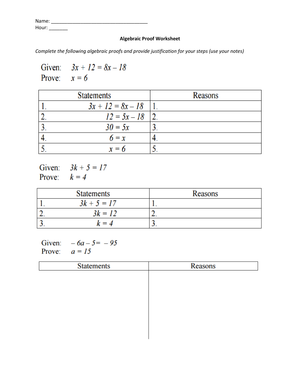
Most students meet these worksheets at the start of Geometry, right before two-column geometric proofs. The equations look familiar, which lowers anxiety, but the expectation is new. A page that once said solve for x now says prove that x equals four, and defend each step. That shift from computation to justification is the whole point, and it is why these worksheets carry so much weight in the opening weeks of the course.
Because the equations themselves are easy, students can spend their attention on the reasoning rather than the arithmetic. That is a deliberate design choice, not an accident. The worksheet keeps the math simple on purpose so the new skill, naming a property for every line, gets full focus.
Properties of Equality vs. Properties of Operations
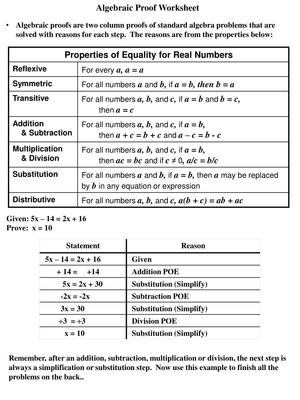
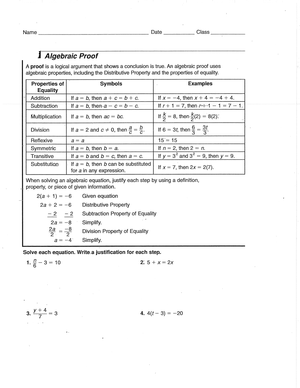
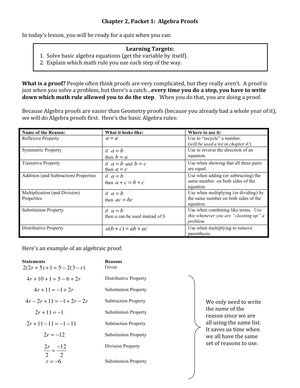
The single biggest source of confusion is the difference between properties of equality and properties of operations. Properties of equality, the Addition, Subtraction, Multiplication, and Division Properties, describe what you can do to both sides of an equation while keeping it balanced. Properties of operations, like the Distributive Property, describe how you can rewrite one expression without changing its value.
Students routinely blur these. They will cite the Distributive Property when they actually subtracted the same number from both sides, or invoke multiplication when they mean the Multiplication Property of Equality. Worksheets that force a named reason on every line make the distinction visible. A strong set also cycles in the Reflexive, Symmetric, and Transitive Properties, plus the Substitution Property, so students see the full toolkit rather than a handful of favorites.
One classroom-ready framing that sticks: properties of equality change the equation, properties of operations change the expression. When students can sort each step into one of those two buckets, their justifications tighten almost immediately.
A Two-Column Proof Walkthrough
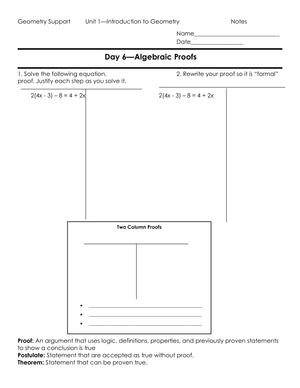
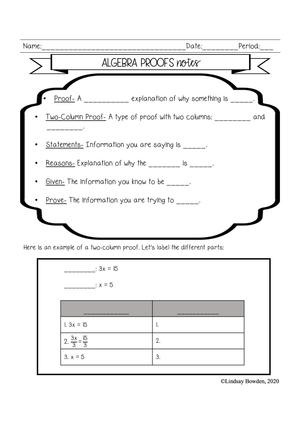
Modeling one clean proof does more than a page of rules. Take a multi-step equation like 3(x minus 2) equals 9. In the left column, students list statements; in the right, the reason for each. Line one: 3(x minus 2) equals 9, Given. Line two: 3x minus 6 equals 9, Distributive Property. Line three: 3x equals 15, Addition Property of Equality. Line four: x equals 5, Division Property of Equality.
Walking through this aloud shows students that Given is a legitimate first reason, that the Distributive Property acts on one side, and that each equality property names the operation applied to both sides. Then ask students to cover the reason column and regenerate it from the statements alone. That reverse move, reconstructing the justification, is what the worksheet is really rehearsing.
According to CCSS.MATH.CONTENT.HSA.REI.A.1, students should explain each step in solving a simple equation, justifying the method by the equality of numbers asserted at the previous step. That one standard is the backbone of every algebraic proof worksheet, converting routine solving into defensible, step-by-step reasoning that transfers straight into geometric proof.
The Simplify Problem: Naming the Real Property
Watch a stack of student work and one habit jumps out: vague justifications. Words like simplify, solve, basic math, and combine show up where a property name belongs. These describe what the student did mentally, not the rule that licenses it. Left unchecked, the habit follows students straight into geometry, where simplify is never an acceptable reason.
Here is the pattern worth naming for your class: nearly every vague justification hides a specific property the student already knows. Simplify after distributing is the Distributive Property; simplify after clearing a constant from both sides is usually the Addition or Subtraction Property of Equality. When teachers treat simplify not as wrong but as incomplete, a placeholder waiting for its real name, students stop feeling corrected and start hunting for the precise property. That reframing typically turns a class of guessers into a class of namers within a week of daily practice.
A quick fix is a banned-words list posted near the board: simplify, solve, math, and combine are off-limits as reasons. Students must replace each with a named property. The constraint feels strict for a day, then becomes second nature.
Classroom Implementation
Algebraic proof worksheets work best when they are talked through before they are written. Pair students and have each partner justify every step aloud before anyone records a reason. Speaking the property first, Division Property of Equality because I divided both sides by three, catches errors that silent solving hides.
Structure a session in three passes. First, students solve the equation normally so the arithmetic is settled. Second, they annotate each line with a property from a reference list. Third, partners trade papers and challenge any reason they cannot defend. This solve, name, defend rhythm keeps the cognitive load manageable and mirrors the discipline of a two-column proof.
Keep a visible reference chart of the core properties for the first two weeks, then remove it and let students work from memory. Fading the scaffold on a schedule prevents dependence while still giving beginners a safety net during the hardest stretch.
Using Worksheets for Quick Formative Checks
Because each line carries a named reason, these worksheets are unusually easy to assess at a glance. A thirty-second scan of the reason column tells you whether a student can distinguish equality properties from operation properties, a far sharper signal than a single right-or-wrong final answer.
Try an exit ticket with just two lines of a proof and a blank reason column. If most of the class names both properties correctly, move on to geometric proofs. If simplify reappears, spend one more day on justification. Worksheets that isolate reasoning let you make that call with evidence instead of a hunch, which is exactly what formative assessment is for.
Frequently Asked Questions
1. What grade level typically covers algebraic proofs?
Algebraic proofs usually appear at the start of a high school Geometry course, most often in ninth or tenth grade. They are placed there deliberately, right before two-column geometric proofs, so students practice justification on familiar equations before applying it to unfamiliar diagrams.
2. What is the difference between an algebraic proof and a geometric proof?
An algebraic proof justifies each step of solving an equation using properties of equality and operations. A geometric proof justifies claims about figures using definitions, postulates, and theorems. The two-column format and the habit of naming a reason for every statement carry directly from one to the other.
3. Which properties of equality should students memorize first?
Start with the Addition, Subtraction, Multiplication, and Division Properties of Equality, since they cover the moves students already make when solving. Layer in the Reflexive, Symmetric, Transitive, and Substitution Properties, along with the Distributive Property, once those first four feel automatic.
4. How can teachers help students stop writing vague justifications like solve?
Ban the vague words outright and require a named property on every line. Treat simplify or solve as an incomplete answer that still needs its real property name. Partner talk, where students defend each reason aloud, makes the missing precision obvious fast.
5. How do algebraic proof worksheets prepare students for two-column geometric proofs?
They rehearse the exact structure, statements on one side and reasons on the other, using equations students can already solve. That lets learners focus entirely on justification. Once naming a reason feels routine, the leap to geometric proofs is about new content, not a new format.













 Interactive Worksheet Maker
 Quiz Maker
 Word Search Maker
 Crossword Puzzle Maker
 Word Scramble Generator
 Sentence Scramble Generator
 Handwriting Worksheet Generator
 Name Tracing Generator
 Fill In The Blank Generator