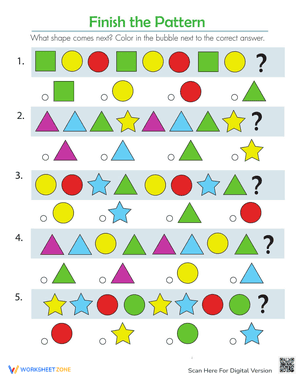
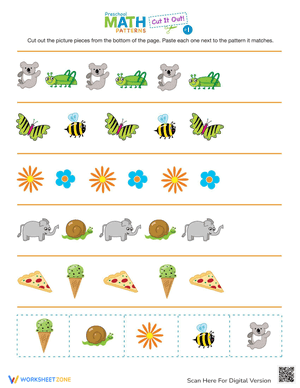
These shape patterns worksheets give Pre-K through 4th grade teachers a ready-to-use set of pages that move students from recognizing a repeating core to generating patterns by rule — covering the full progression from simple AB sequences to growing geometric arrangements that lay the groundwork for algebraic reasoning.
Skills Practiced via These Shape Pattern Workshets
The worksheets cover four distinct pattern types, sequenced by cognitive demand. Repeating patterns — AB, ABC, and AABB structures — make up the bulk of the early pages, because that is where most Kindergarten and 1st grade students begin. Students look at a sequence, identify the core unit, and mark where it repeats, then extend the sequence two or three elements further. From there, the pages shift to growing patterns: arrangements where the number of shapes increases by a consistent amount at each step, which is meaningfully different from repetition and requires students to track change rather than just cycle recognition. A smaller set of pages addresses shrinking sequences, and the most demanding pages present multi-attribute arrangements where shape, size, and orientation all vary simultaneously — asking students to hold several variables in mind at once.
Across all types, three task formats recur: identify the rule in a completed sequence, extend a partially built sequence, and create an original sequence given a stated rule. That third task — building from a rule — is the most telling. A student who can extend a pattern by copying what they see can still fail to produce one from scratch, and the gap between those two performances tells you a great deal about conceptual understanding versus procedural imitation.
Standards Alignment
CCSS 4.OA.C.5 is the formal anchor, but the instructional work starts in Kindergarten under the CCSS Operations and Algebraic Thinking domain and runs through the early grades. The placement of pattern generation under Operations and Algebraic Thinking — rather than Geometry — signals something important about instructional intent: the goal is not shape recognition but rule-governed reasoning. Teachers who frame pattern tasks around the rule ("what would the tenth shape be, and how do you know without drawing all ten?") are teaching toward the standard's actual demand. Teachers who frame them around correctness ("did you get the next shape right?") are teaching toward the surface of it. These worksheets build in the rule-identification step specifically to push instruction in the right direction.
Where These Fit in Your Lesson Plans
The half-page format is intentional. These work as arrival tasks: one page face-down on every desk means students have something purposeful to do in the first five minutes while you handle morning logistics. The tight scope — usually a single row or a short sequence — keeps the task from sprawling into the lesson block.
Math centers are another natural home. Pair a worksheet with a set of pattern blocks and ask students to complete the page first, then rebuild the same pattern physically. That second step is not redundant — recreating a pattern with manipulatives after drawing it on paper forces a kind of double-encoding that reinforces the rule rather than just the image. Students who sketch a pattern correctly but fumble with the blocks reveal that they were copying shape, not tracking structure.
Exit tickets are where the single-row extension strips earn their keep. Four shapes on a strip, ask students to add two more and write the rule in one sentence — that takes ninety seconds and gives you immediate sorting data before the next day's grouping decisions.
Errors That Show Up in Student Work
The most reliable mistake on repeating pattern pages is core-unit confusion: a student who sees circle-square-triangle-circle-square-triangle reads the rule as "circle, then square, then triangle" but cannot identify that the three shapes together form a single repeating unit. When asked to extend the pattern, they extend it correctly but cannot answer "what is the pattern rule?" — because they are tracking positions, not chunks. These worksheets address that directly by including a "circle the core" step before the extension task on several pages. Physically enclosing the repeating unit with a drawn oval changes how students look at the sequence the next time.
On growing pattern pages, the frequent error is additive miscounting: a student sees one triangle, two triangles, three triangles and extends to five rather than four — skipping a step because they are accelerating the growth intuitively rather than measuring it. Asking the student to write the count beneath each step before predicting what comes next catches this before it becomes a habit.
Adjusting the Work for Different Students' Levels
The simplest differentiation move is page selection — AB patterns for students still solidifying the concept of a repeating core, ABC or AABB pages for students working at grade level, growing and multi-attribute pages for students who need the ceiling raised. No student needs to know which stack their page came from.
For students who freeze at an unfamiliar sequence, color coding helps as a transitional scaffold: lightly shade every instance of Shape A in one color before asking them to identify the rule. This makes the chunk structure visible before the student has to construct it mentally. Pull the scaffold after two or three sessions, not after one — some students internalize it faster than you expect, but removing it before they are ready sends them back to position-tracking.
For students who are well ahead, the more demanding task is not a harder pattern but a harder explanation. Ask them to describe the rule in a complete sentence, then ask: "Is there anything true about this pattern that your rule doesn't mention?" That second question — pressing for features beyond the generating rule — is exactly the thinking CCSS 4.OA.C.5 names, and it stretches students who have mastered extension tasks into genuine algebraic generalization.
Frequently Asked Questions
How do I know when a student is ready to move from repeating to growing patterns?
The clearest signal is fluency with core-unit identification, not just extension accuracy. If a student can extend an ABC pattern correctly and immediately name the three-shape core without circling or counting, they are ready for growing patterns. If they are still counting positions to figure out what comes next, give them more repeating pattern practice first — moving on too early creates confusion between the two pattern types that is hard to untangle later.
Do these work for students with limited fine motor control who struggle to draw shapes?
Several pages use stamps, stickers, or pre-cut shape tiles as alternatives to drawing — but even on the drawing pages, the shapes are simple enough that a rough circle or triangle communicates the answer. If fine motor difficulty is significant, the better modification is having the student point and verbalize rather than draw: say the next three shapes aloud and explain the rule. That still surfaces the same mathematical thinking and avoids the frustration of a task that becomes an art exercise.
Are these appropriate for use as assessment, or only for practice?
The extend-the-pattern and create-a-pattern pages work as formative assessment when used as exit tasks — they give a quick, scorable snapshot of where each student is. For summative purposes, the create-a-pattern pages are the strongest evidence of mastery, because a student who produces a correct original sequence with a written rule has demonstrated understanding at the highest level of the progression.
















 Interactive Worksheet Maker
 Quiz Maker
 Word Search Maker
 Crossword Puzzle Maker
 Word Scramble Generator
 Sentence Scramble Generator
 Handwriting Worksheet Generator
 Name Tracing Generator
 Fill In The Blank Generator