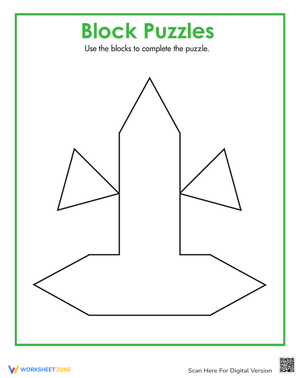
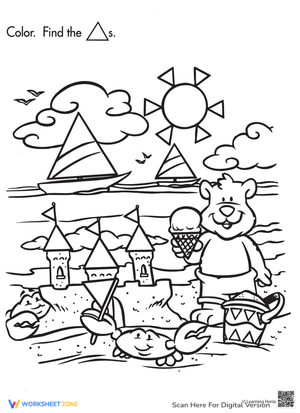
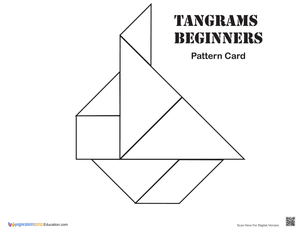
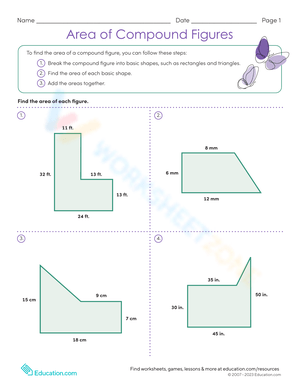
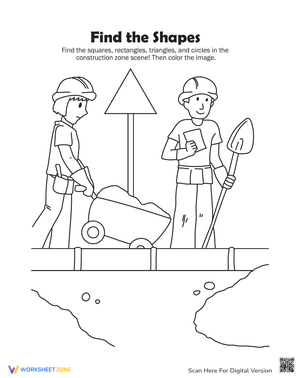
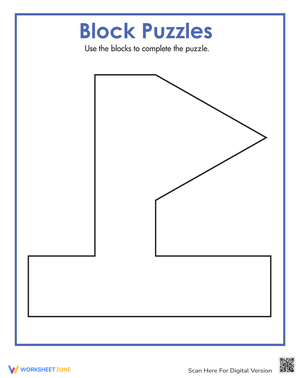
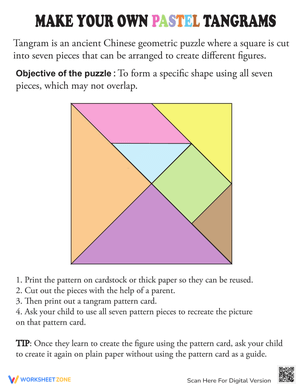
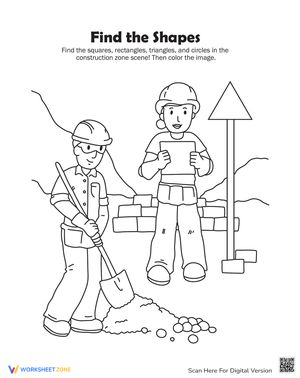
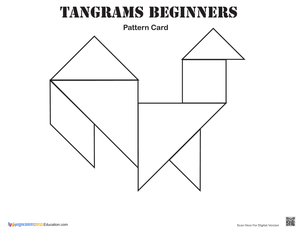
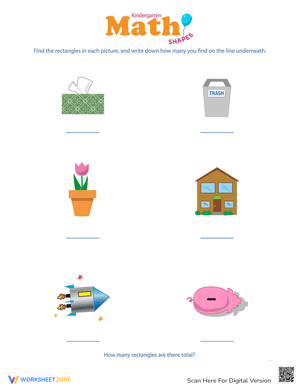
These decomposing shapes worksheets give teachers a structured practice set that covers the full arc of this skill — from a first grader tracing partition lines inside a composite figure to a sixth grader deciding on their own where to cut an irregular polygon before applying area formulas. Each page is printable as a PDF, includes clear diagrams with labeled dimensions, and comes with an answer key so it can function as guided practice, independent work, or a quick formative check.
How the Skills Develop Across Grade Levels
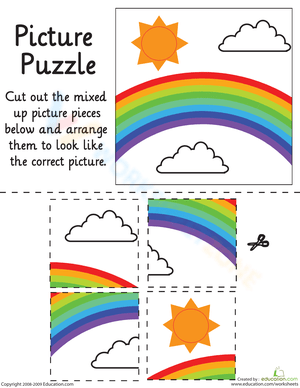
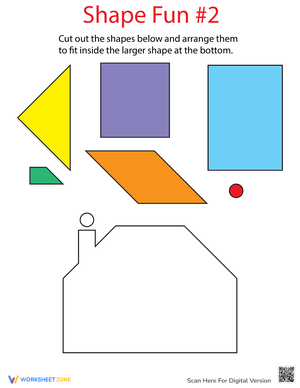
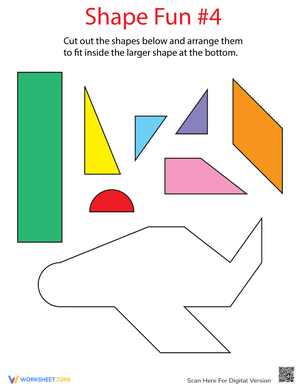
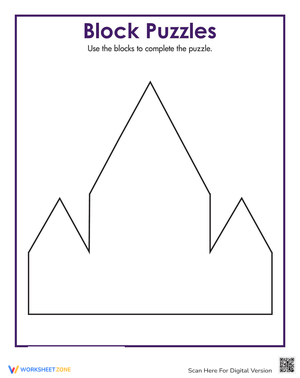
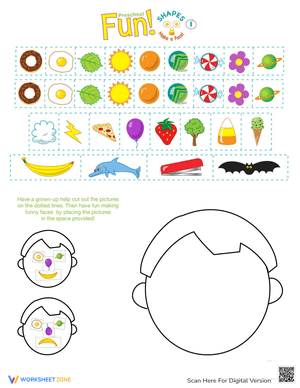
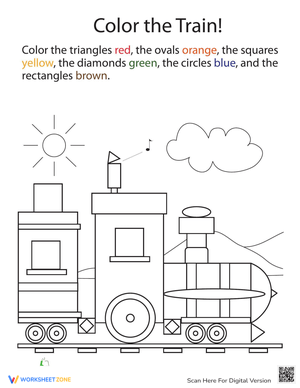
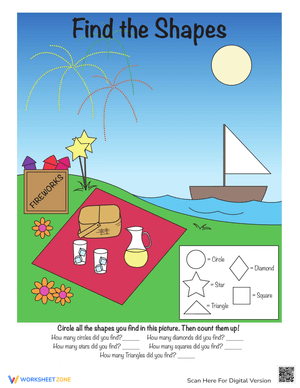
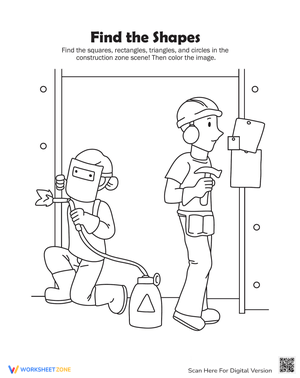
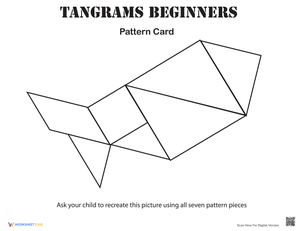
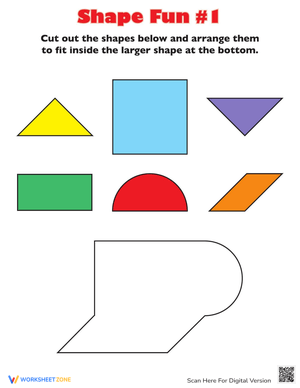
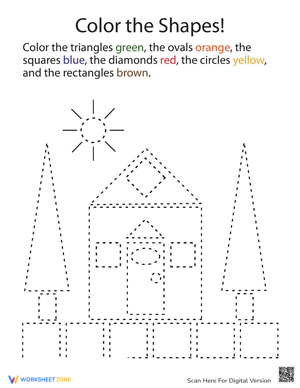
Decomposition looks very different depending on where students are in their mathematical development, and the worksheets reflect that range. In kindergarten and first grade, the work is almost entirely visual: students trace outlines, place pattern block shapes inside a composite figure, or follow dotted lines that partition a hexagon into triangles. The cognitive task is recognizing that a larger shape is made of smaller ones — which sounds simple until you watch a five-year-old stare at a trapezoid and fail to see the triangle hiding inside it.
By second and third grade, the spatial work begins connecting to measurement. Students draw lines to split an L-shape into two rectangles, then count unit squares in each section. That counting-then-adding sequence is doing important groundwork: it builds the additive reasoning students will need when they stop counting squares and start multiplying side lengths.
Upper elementary and middle school pages focus on composite area. Students receive an irregular polygon with dimensions labeled, identify where to draw partition lines, calculate the area of each resulting rectangle or triangle, and sum the parts. The harder pages in this set remove the dashed guides entirely — students must choose their own decomposition strategy, which is where genuine problem-solving begins. Standard 6.G.A.1 addresses exactly this: finding areas of polygons by composing and decomposing them into triangles and quadrilaterals.
Concepts on Each Worksheets
Across the full set, students work with the following:
- Visual decomposition of composite shapes into triangles, rectangles, squares, and trapezoids, with and without guide lines provided
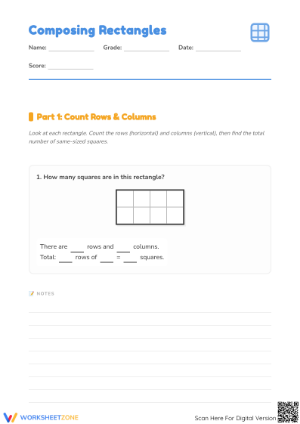
- Partitioning rectangles into equal rows and columns of unit squares as a foundation for area reasoning (grades 2–3)
- Drawing partition lines independently on L-shapes, T-shapes, U-shapes, and notched rectangles
- Applying area formulas to each sub-region and summing for the total composite area
- Problems where one or more dimensions are missing and must be derived from the labeled measurements before decomposing
- Extension tasks that ask students to write a brief explanation of their decomposition strategy — useful when you want to see the reasoning behind the answer, not just the answer
Where These Pages Fit in the Lecture/Lesson
The scaffolded pages — the ones with dashed lines already drawn — work well as a guided practice during initial instruction, particularly when you follow a concrete-representational-abstract sequence. Students who have just spent ten minutes with tangrams or pattern blocks on their desks move more successfully to a page with dotted partition guides than they do to an open blank polygon. The hands-on phase builds a mental model; the guided worksheet asks them to use it on paper before that model fades.
The open-ended pages, where no partition lines are given, belong later in the sequence. A productive place for them is two or three days after initial instruction, as a retrieval practice warm-up or a Monday review. That spacing is deliberate — students who complete these pages the same day they learned the skill will often succeed just by copying what the teacher modeled. Students who return to the skill after a gap have to reconstruct their thinking, which consolidates learning more durably.
For the composite area pages specifically, a quick real-world framing increases engagement noticeably. Telling students they are calculating the square footage of an oddly shaped storage room — or showing a simplified floor plan of the school library — gives the task a purpose that "find the area of this figure" does not. The math is identical; the willingness to work through it is not.
Error Patterns Worth Noticing in Student Work
The most consistent error at the upper elementary level is over-counting shared edges. When a student decomposes an L-shape into two rectangles, they sometimes include the interior partition line as a side of both rectangles when calculating perimeter-adjacent tasks, or they calculate dimensions that don't account for how the two regions share a boundary. This shows up as an answer that is slightly too large — often by an amount equal to one of the interior segment lengths. It's worth doing one whole-class example where you explicitly trace the boundary of each sub-region with a colored marker before writing any numbers.
At the second- and third-grade level, a different error appears: students split an L-shape correctly but then count only the squares in one of the two rectangles and stop. They've done the decomposition accurately and lost the thread at the addition step. This isn't a geometry misunderstanding — it's a procedural reminder that needs to be built into the routine. Having students circle each region in a different color before counting helps.
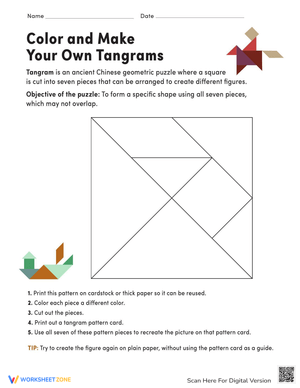
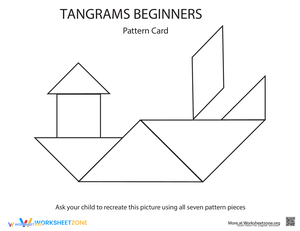
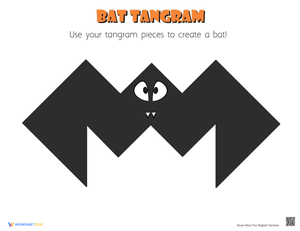
A third pattern, more developmental than mathematical, shows up in early grades: students who can assemble a tangram puzzle will still struggle to look at a composite shape drawn on paper and see the components inside it. The move from working with physical pieces to reading a two-dimensional diagram requires spatial visualization that some students have not yet internalized. For those students, the cut-and-paste format — where they actually cut apart a printed composite shape and rearrange the pieces — closes that gap faster than more tracing does.
Adjusting for the Varied Levels of Learners in the Room
The scaffolded structure of the set already does some of this work, but within a single class period there are additional levers worth knowing about. Students who freeze when shown an unfamiliar polygon shape — no guide lines, no hint about where to start — sometimes respond well to a single anchor question written at the top of their page: Can you find a rectangle hiding inside this shape? That question doesn't give away the solution, but it starts the visual search and reduces the paralysis of a blank figure.
On the opposite end, students who decompose quickly and correctly can be pushed toward recomposition: given the same irregular polygon, can they find a different way to split it and still arrive at the same total area? That task surfaces a deeper understanding — that the total area is invariant regardless of which valid decomposition strategy you choose — and it generates productive argument when students compare methods in pairs.
Frequently Asked Questions
Do students need to know area formulas before using the composite area pages?
For the rectangle-based pages, students need to know that area equals length times width — that's the only formula required through most of the set. The pages involving triangles, which appear in the upper-grade section, assume students have already seen the triangle area formula. Those pages aren't the right starting point for students encountering triangles for the first time; they work best as reinforcement once the formula is established.
How do these fit with a unit on area and perimeter rather than a standalone geometry unit?
Cleanly. Most teachers reach for the composite area pages during the area portion of a measurement unit rather than during a shapes-and-geometry unit. The earlier visual decomposition pages belong in geometry; the composite area pages belong in measurement. The set is designed to be used across both contexts rather than pulled out all at once.
What if a student's decomposition is different from the answer key?
If the student's final area is correct, their method is valid — and worth acknowledging. There are usually multiple ways to decompose an irregular polygon, and students who find an alternative approach have demonstrated stronger understanding than students who followed a prescribed path. The answer keys show one method; they are not the only method.













 Interactive Worksheet Maker
 Quiz Maker
 Word Search Maker
 Crossword Puzzle Maker
 Word Scramble Generator
 Sentence Scramble Generator
 Handwriting Worksheet Generator
 Name Tracing Generator
 Fill In The Blank Generator