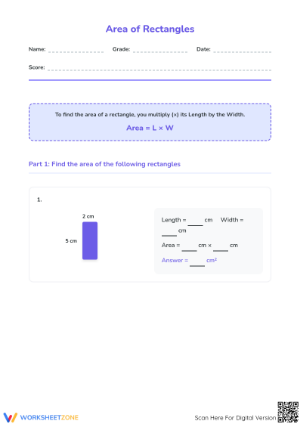
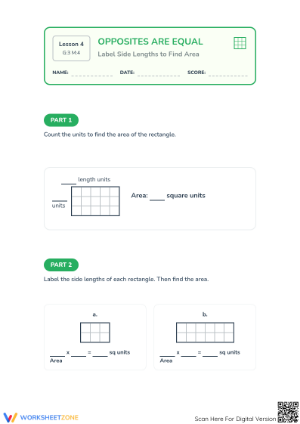
These area of a rectangle worksheets move students through the full arc of area instruction — from counting unit squares on a grid to applying A = l × w with fractional side lengths — giving teachers a set of pages they can pull at any point in the unit without assembling materials from scratch.
How the Skill Develops Across Grade Levels
Area of a rectangle enters the curriculum in third grade not as a formula but as a counting task. Students tile rectangles with unit squares and count what's inside. The goal at that stage is building the mental image of area as covered surface — not boundary, not length, but interior. That distinction matters because students who skip the tiling phase and go straight to multiplying side lengths frequently end up conflating area with perimeter by fifth grade, because they never internalized what area actually represents.
By fourth grade, students apply the formula to whole-number dimensions and begin using it across measurement contexts — finding the area of a garden plot, a bedroom floor, a sheet of construction paper. Standard 4.MD.A.3 formalizes this, and it's worth knowing that the standard sits inside the measurement domain, not geometry, which signals that area is being taught as a measurement skill, not an abstract shape property. In fifth grade, side lengths extend to decimals and fractions, and the arithmetic demand increases sharply. A student multiplying 3.4 cm by 2.7 cm needs both decimal fluency and the presence of mind to attach square centimeters to the answer.
What's Inside the Worksheet Set
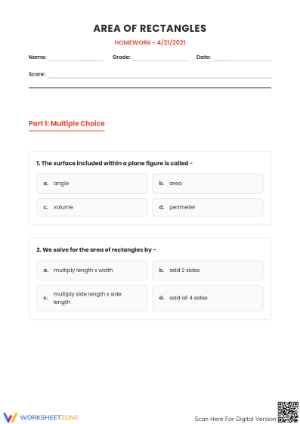
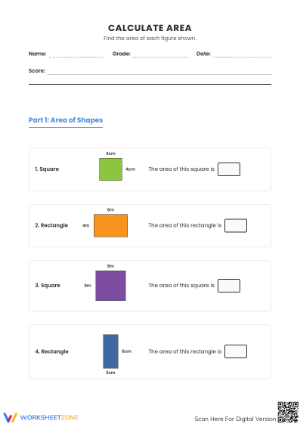
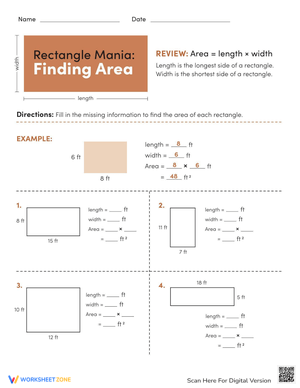
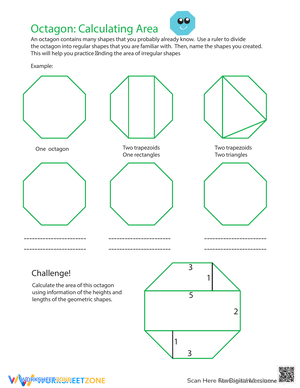
The pages distribute across four formats, each targeting a distinct point in the developmental sequence.
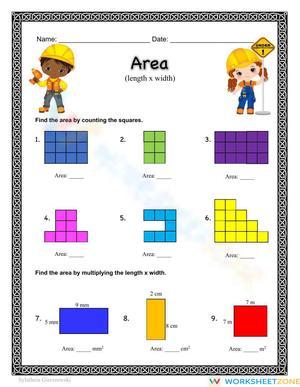
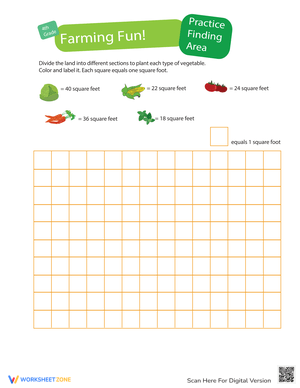
- Grid-based counting sheets show rectangles drawn on dot or square grids. Students count unit squares to find area. No formula prompt appears on the page — the goal is letting the multiplication relationship emerge from the count, not from an instruction to multiply.
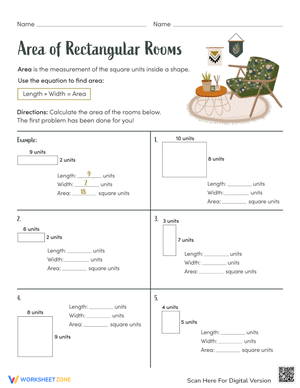
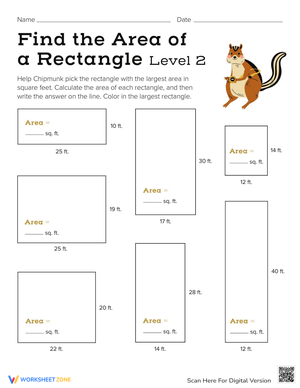
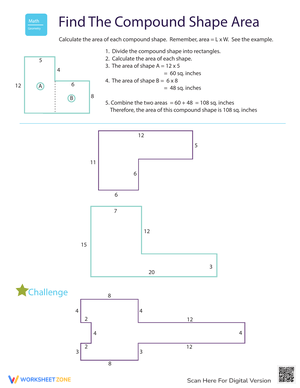
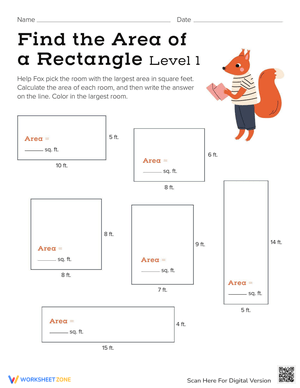
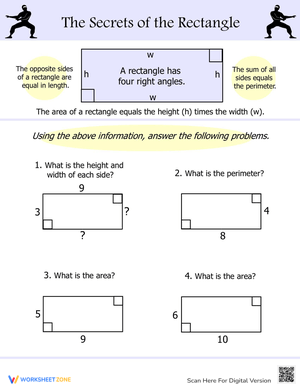
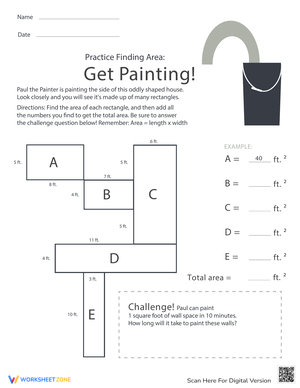
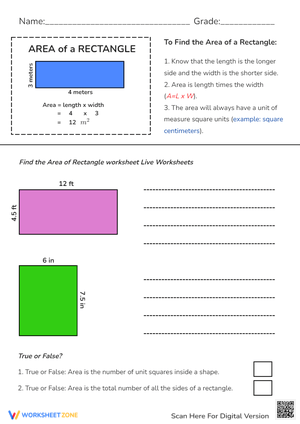
- Formula practice pages present labeled rectangles with whole-number dimensions. Problems mix orientations — some rectangles are wider than tall, some taller than wide — to prevent students from developing a fixed sense of what a "typical" rectangle looks like.
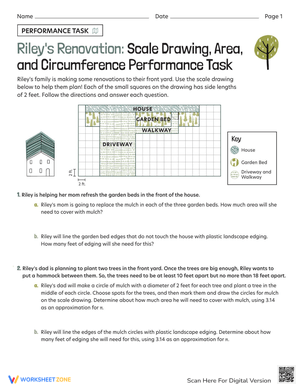
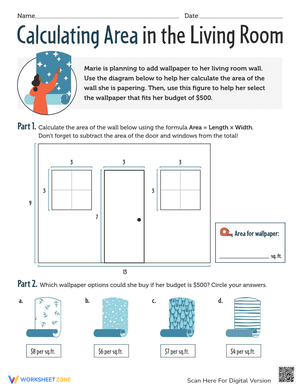
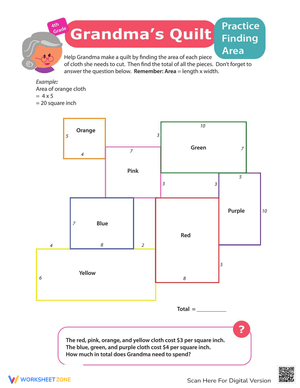
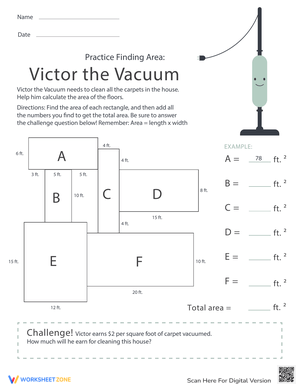
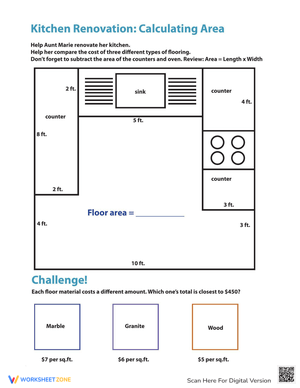
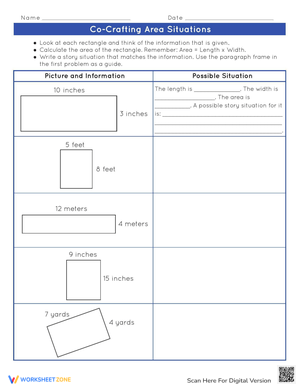
- Word problem pages set dimensions inside a real context: a rectangular tabletop, a patch of garden, a hallway runner. Students identify the relevant measurements, apply the formula, and label the answer with squared units. These pages also require students to decide which numbers in a problem are dimensions and which are irrelevant — a step the formula-only pages skip entirely.
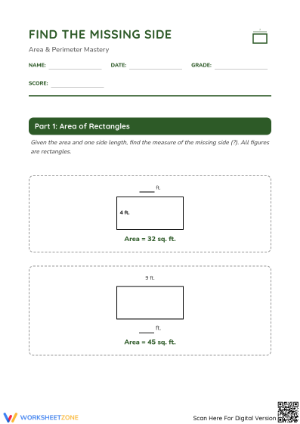
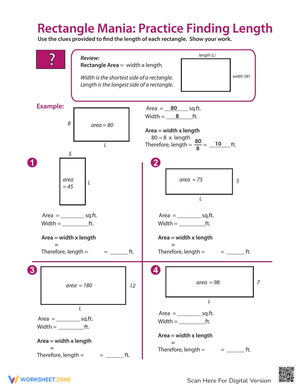
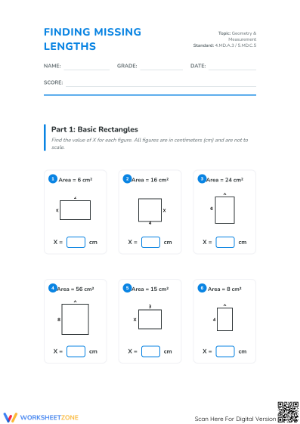
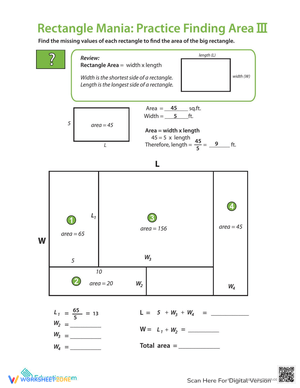
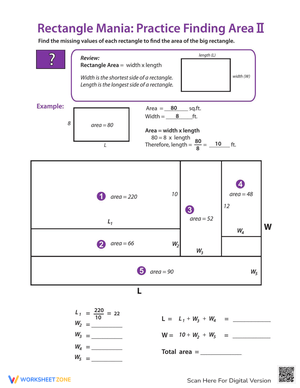
- Missing dimension pages give the area and one side length; students solve for the unknown. This format introduces the inverse relationship and is the first time many students use division in a geometric context.
Standards Alignment
The grid-counting and formula-introduction pages align to 3.MD.C.7, which asks third graders to relate area to multiplication and to find areas of rectangles through tiling. The core formula pages target 4.MD.A.3, which expects students to apply A = l × w to solve real-world problems with whole-number measurements. The fraction and decimal extension pages connect to 5.NF.B.4b, which explicitly addresses finding the area of a rectangle with fractional side lengths as a context for fraction multiplication. Knowing these placements helps when selecting pages for intervention — a fifth grader who can't handle decimal side lengths may actually need 4.MD.A.3 work first, not additional fifth-grade practice.
Where These Fit in the Instructional Day
A half-page formula sheet works well as a Monday warm-up after morning meeting — enough problems to activate the formula without burning the first twenty minutes of instruction. The word problem pages work better mid-unit, once students are fluent with the formula and ready to apply it under conditions where the operation isn't pre-decided for them. Missing-dimension pages are worth holding until students have shown solid formula fluency; introduced too early, they generate frustration rather than productive challenge.
One classroom move worth building into the routine: after students finish a worksheet, ask two or three of them to write their own rectangle problem on an index card, specifying dimensions and a real-world context. Trade the cards. This reversal — from solving a given problem to authoring one — surfaces whether a student understands the relationship between dimensions and area or is pattern-matching to a memorized procedure. The students who write "a rectangle is 6 feet long and 4 feet wide, what is the area?" have the concept. The students who write "find the area of a rectangle with dimensions 12" have borrowed surface language without the underlying meaning.
Errors That Show Up Repeatedly in Student Work
The most durable confusion is area versus perimeter. Students who have both formulas in front of them will still reach for the wrong one if the problem context doesn't trigger a clear distinction. Side-by-side problems — one rectangle, two questions, one asking for area and one for perimeter — force students to make the distinction explicit rather than relying on context to do it for them. Shading the interior of the rectangle in the area question and tracing the border in the perimeter question gives a visual anchor that survives across several problem sets before it needs refreshing.
The unit-labeling error is almost universal in early instruction: students write "24 inches" when they mean "24 square inches." The word "square" in square inches does real semantic work — it tells the reader that you are measuring two-dimensional coverage, not one-dimensional length — but students drop it because no one marked it wrong on the first five worksheets. Including a small labeled box after each answer line ("Area = ___ square ___") prompts students to write the unit every time, not just when they remember.
With decimal side lengths, a different error appears: students correctly multiply but misplace the decimal point, arriving at 9.18 square centimeters when the actual product is 91.8. These aren't geometry errors — they're decimal multiplication errors wearing a geometry disguise. Catching them on area worksheets is actually useful because the rectangular dimensions provide a quick reasonableness check: if a rectangle is roughly 9 cm by 10 cm, an answer of 9.18 square centimeters is clearly wrong without any calculation.
Frequently Asked Questions
Should I introduce the formula before students have spent time with grid counting?
The research on this is fairly consistent: students who count unit squares first develop a more durable understanding of what area measures. The formula is a shortcut that only makes sense once students know what they're shortcutting. A few days on grid-counting pages before any formula appears is time well spent, even in fourth grade if students missed or don't remember that foundation from third.
How do I handle students who know the formula but can't explain what area means?
Return them to the grid pages briefly — not as remediation, but as sense-making. Ask them to tile a rectangle, count, then multiply and compare. The goal is closing the gap between the procedure they can execute and the concept it represents. Word problems help here too, because they require students to identify what they are actually measuring before they calculate.
Do the word problem pages provide enough scaffolding for struggling readers?
The problems are written at grade level, which means students with reading difficulties may need the problem read aloud or may benefit from having the key dimensions underlined before they begin. The worksheet format itself doesn't address reading scaffolds — that's a delivery decision the teacher makes based on knowing the students in the room.













 Interactive Worksheet Maker
 Quiz Maker
 Word Search Maker
 Crossword Puzzle Maker
 Word Scramble Generator
 Sentence Scramble Generator
 Handwriting Worksheet Generator
 Name Tracing Generator
 Fill In The Blank Generator