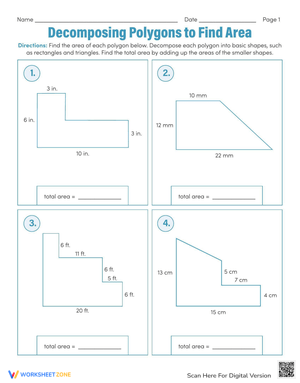
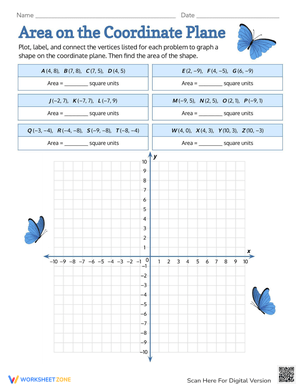
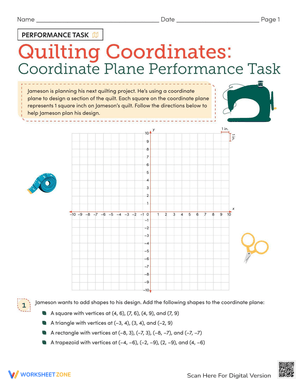
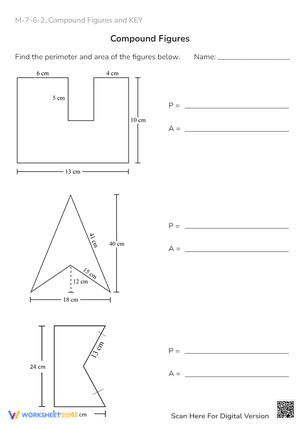
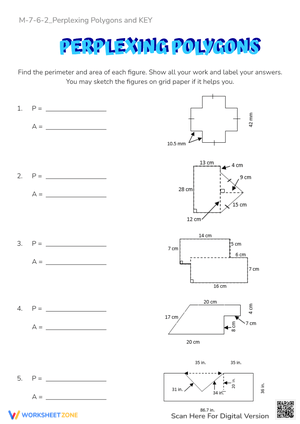
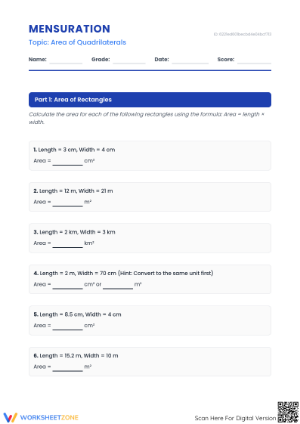
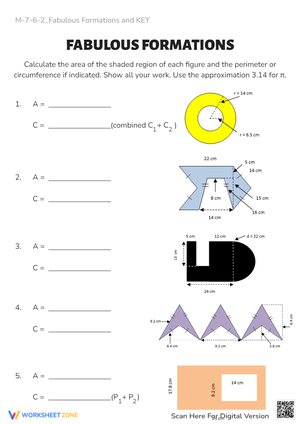
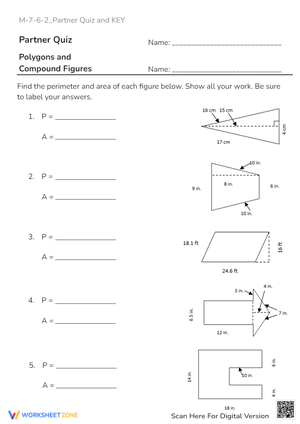
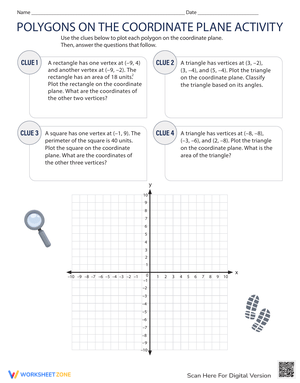
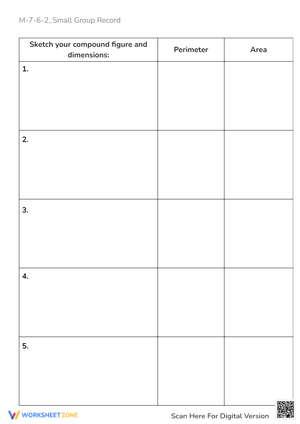
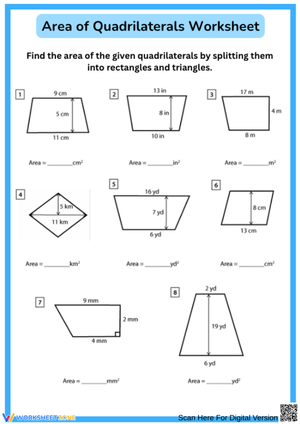
These area of quadrilaterals worksheets cover the four shapes that give sixth graders the most trouble — parallelograms, trapezoids, rhombuses, and rectangles — with problem types that move from labeled diagrams to mixed-identification challenges to multi-step word problems. Teachers get a ready-to-use set organized by shape and difficulty, so pages drop into a lesson sequence without adaptation work.
Formulas and Where Students Get Them Wrong
Each quadrilateral type has a formula students can memorize, but the errors rarely come from forgetting the formula itself. They come from misreading the diagram.
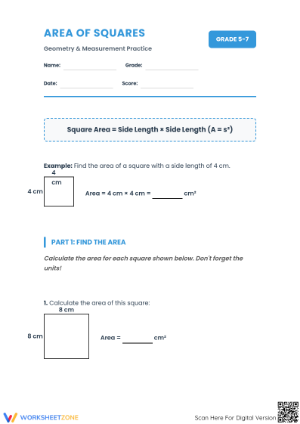
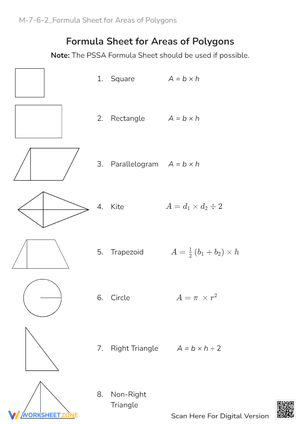
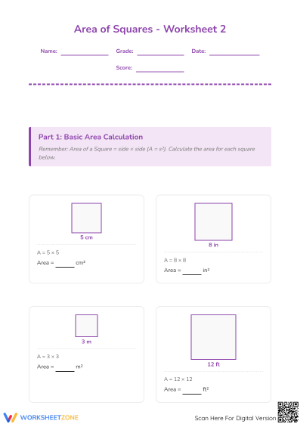
- Rectangle: A = base × height. Students handle this one reliably unless dimensions are given as fractions or decimals — then careless multiplication errors multiply, too.
- Parallelogram: A = base × height. The most consistent mistake at this level: students use the slant side instead of the perpendicular height. A student who gets 35 square units when the answer is 28 has almost always done this. These worksheets label both the slant side and the true height on parallelogram diagrams precisely because that confusion is so predictable.
- Trapezoid: A = ½(b₁ + b₂) × h. Students who understand the formula arithmetically still stumble on the order of operations — they multiply one base by the height before adding the second base. Showing the formula as "average the bases first, then multiply by height" cuts this error rate noticeably in practice.
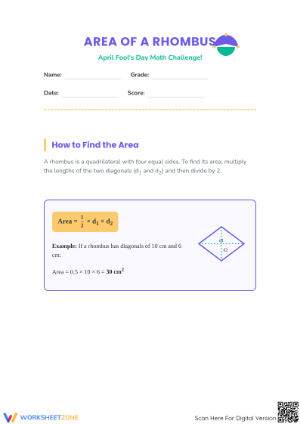
- Rhombus: Two methods apply here — base × height, or ½(d₁ × d₂) using the diagonal lengths. Introducing both is worth the extra class time: it gives students a check against their own arithmetic and surfaces the connection between a rhombus's diagonals and its area in a way that sticks.
Worksheets that print the formula alongside a labeled diagram give students a visual anchor without removing the cognitive work of applying it correctly. Students still have to identify which measurement serves as the height — the diagram just makes the question harder to sidestep.
Standards Alignment
Common Core 6.G.A.1 is the direct target: finding area of special quadrilaterals by composing and decomposing into triangles and rectangles. This standard appears at grade 6 because students at this level have enough fraction and decimal fluency to handle non-whole-number dimensions, and because the decomposition reasoning required — breaking unfamiliar shapes into known ones — is the same logical structure that underpins surface area and volume work in grades 7 and 8. Area of quadrilaterals worksheets aren't just formula practice; they're building the decomposition habit that makes three-dimensional geometry feel manageable later.
What's on the Worksheets
The set includes several distinct problem formats. Grid-based pages come first: students count unit squares to verify that their formula-based answer makes sense before the grids disappear. This matters most for visual learners who treat area as an abstraction rather than a measurable quantity — counting first gives them a concrete reference point.
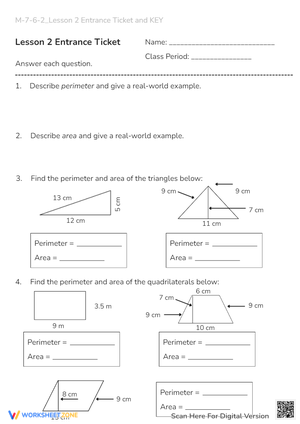
Mixed-identification pages present four or five different quadrilaterals on one sheet. Students name the shape, write the appropriate formula, substitute the given values, and compute. The mixed format prevents the mechanical pattern that develops when an entire worksheet covers only one shape — students start reading the diagram rather than just reaching for yesterday's formula.
Decomposition problems, aligned to 6.G.A.1, ask students to break an irregular polygon into familiar pieces, calculate each part, and sum the results. These are harder than they look. A student who can find the area of a trapezoid in isolation will sometimes freeze when that trapezoid is embedded in a composite figure and the height isn't labeled as prominently. The decomposition pages build exactly the flexibility that later geometry — and the standardized assessment — will require.
Word problems close out the harder pages. Room layouts, trapezoidal garden beds, parallelogram-shaped panels — problems that require students to extract the relevant measurements from a description and decide which formula applies. The real-world framing isn't decorative; it removes the visual scaffolding students have been relying on and asks them to construct the diagram mentally.
Where These Fit in a Unit
The most natural use is gradual release across several days. Open with grid pages as a warm-up or as guided practice while you work through the formula together. Move to single-shape formula pages for independent practice on the same day or as homework that evening. Introduce the mixed-identification sheets after students have seen all four quadrilateral types — typically day three or four of the unit — and save decomposition and word-problem pages for the back half of the week or as review before assessment.
Exit tickets are worth mentioning specifically. A half-page with two problems — one straightforward, one that requires identifying the correct height — takes students four or five minutes to complete before the bell. It tells you immediately which students are using the slant side on parallelograms and which students are skipping the "average the bases" step on trapezoids. Catching those errors at the end of day one is far less painful than uncovering them on the unit test.
Station rotations work well here too. Four stations, one quadrilateral type each, with the formula card posted at the station. Students rotate every eight minutes. By the end of the block they've touched all four shapes, and you've had time to park yourself at whichever station is generating the most confusion.
Patterns You'll Recognize in Student Work
Beyond the slant-height error on parallelograms, a few other mistakes appear reliably enough that it's worth scanning for them specifically when you review papers. Students who correctly apply the trapezoid formula with whole numbers will often make a fraction error when the height is a decimal — they compute ½(b₁ + b₂) correctly but then multiply by 0.6 as if it were 6. It reads like carelessness, but it's usually a sign that the student hasn't internalized decimal multiplication as a procedure separate from the formula steps.
On rhombus problems that provide diagonal lengths, some students apply the formula but reverse the operation — they add the diagonals rather than multiply them, then halve the result. The answer looks plausible if the dimensions are small, which is why these errors survive to the final check. Having a reference diagram on the page that shows the diagonals bisecting each other helps, but the error still appears. Flagging it during class discussion ("here's an answer that's close but wrong — what happened?") tends to clear it more reliably than any diagram.
Decomposition problems produce a third distinct error: students find the areas of the component shapes correctly but then add an extra piece they drew in the wrong place, double-counting a region. Pairing the worksheet with a physical cut-and-reassemble step — students literally cut the printed polygon, rearrange the pieces, and calculate — makes the double-counting visible in a way that pencil work alone doesn't.
Frequently Asked Questions
My students learned rectangle area in 4th grade. Do they need the grid-based pages?
For rectangles, probably not. But the grid pages aren't really about rectangles — they're about establishing that a formula's output corresponds to a real, countable quantity. Students who skip straight to formula work on parallelograms and trapezoids sometimes treat the calculation as abstract symbol manipulation. The grid pages, used briefly, anchor the formula to something students can see and count. One class period with grids is usually enough before removing that scaffold.
Are answer keys included with these worksheets?
Yes. Full answer keys accompany the set. They're formatted to support self-checking stations: answer values appear without worked solutions, which keeps students from reverse-engineering the steps rather than computing independently.













 Interactive Worksheet Maker
 Quiz Maker
 Word Search Maker
 Crossword Puzzle Maker
 Word Scramble Generator
 Sentence Scramble Generator
 Handwriting Worksheet Generator
 Name Tracing Generator
 Fill In The Blank Generator