




























Views
Downloads


Grade 4-5 Angles Worksheet | Essential Printable Practice

Paste this activity's link or code into your existing LMS (Google Classroom, Canvas, Teams, Schoology, Moodle, etc.).
Students can open and work on the activity right away, with no student login required.
You'll still be able to track student progress and results from your teacher account.
This Grade 4-6 math worksheet provides a comprehensive review of calculating missing angles on a straight line. Students reinforce foundational facts before applying the 180-degree rule to solve for unknown variables in geometric diagrams. By combining calculation with a reasoning task, the resource ensures students develop both procedural fluency and conceptual understanding of additive angle measures.
At a Glance
- Grade: 4-6 · Subject: Math
- Standard:
CCSS.MATH.CONTENT.4.MD.C.7— Solve addition and subtraction problems to find unknown angles on a diagram- Skill Focus: Angles on a straight line
- Format: 2 pages · 10 problems · Answer key included · PDF
- Best For: Daily math warm-up or sub plans
- Time: 15–20 minutes
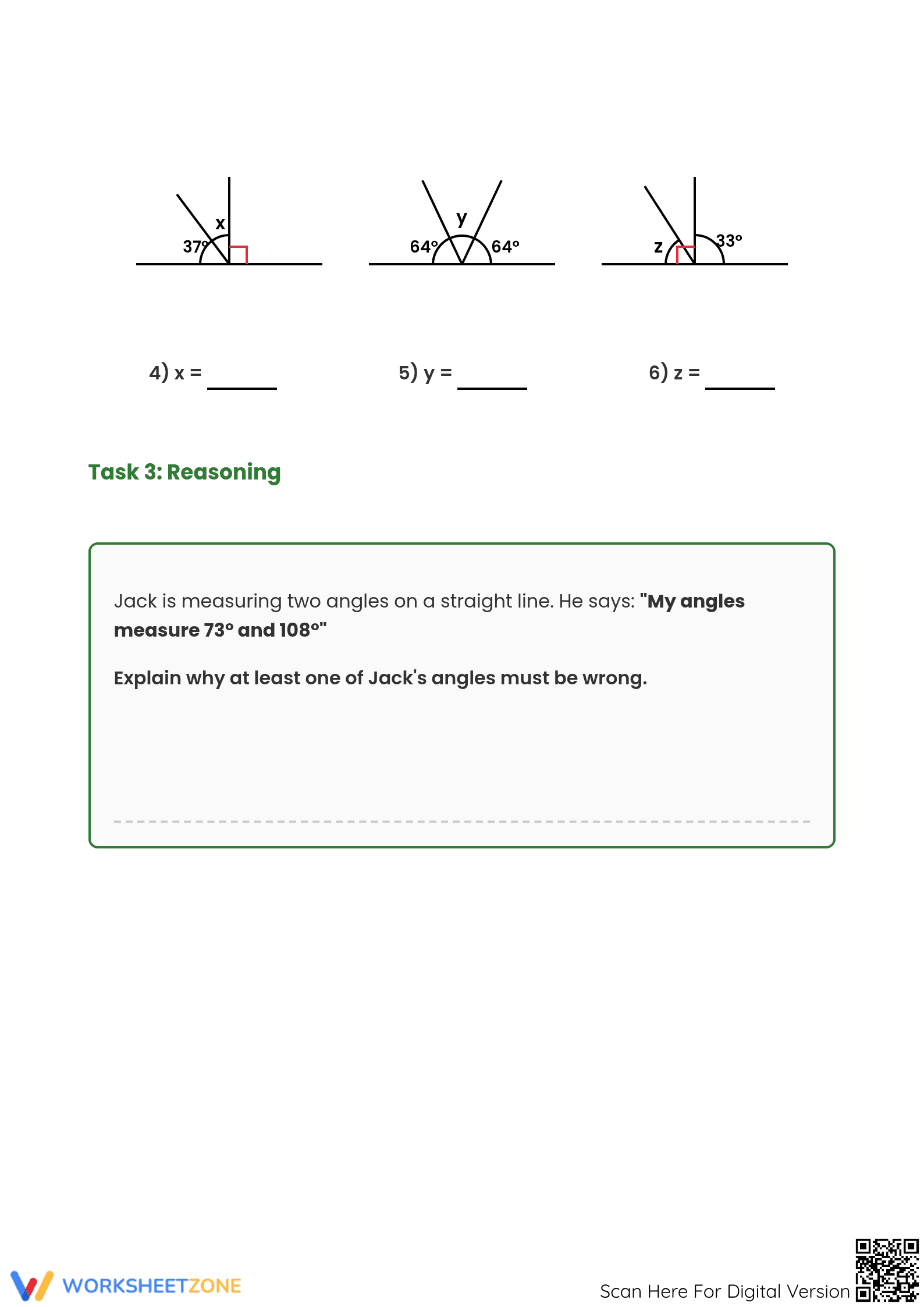
Inside this two-page PDF are three sections designed to scaffold learning. Task 1 features sentence-completion exercises to anchor the concept of right angles and straight lines. Task 2 presents six visual problems where students calculate missing angles using given measurements. Task 3 concludes with a reasoning prompt that asks students to explain a mathematical error. A full answer key is included for rapid grading.
The zero-prep design allows for immediate implementation. Step 1: Print the PDF (30 seconds). Step 2: Distribute as an independent activity or geometry center (1 minute). Step 3: Review using the provided key (30 seconds). This workflow minimizes administrative burden. Because instructions are self-explanatory, this worksheet is also an ideal candidate for emergency sub plans or homework assignments where direct teacher supervision is limited.
This resource is aligned to CCSS.MATH.CONTENT.4.MD.C.7: "Recognize angle measure as additive. When an angle is decomposed into non-overlapping parts, the angle measure of the whole is the sum of the angle measures of the parts." It also supports Grade 5 and 6 geometry standards involving supplementary angles. Both standard codes can be copied directly into lesson plans, IEP goals, or district curriculum mapping tools.
Use this during the independent practice phase of a geometry lesson. It serves as a formative assessment tool; observe students during Task 2 to see if they correctly subtract the known angle from 180. If students struggle with the multi-step problems, provide a protractor to verify their calculations physically. The expected completion time for most students is 15 to 20 minutes.
This worksheet is for students in Grades 4 through 6. It is effective for visual learners who benefit from clear, uncluttered diagrams. Pair this resource with an anchor chart showing a semi-circle protractor to help students visualize why a straight line represents 180 degrees of rotation. It is also suitable for small-group intervention for students struggling with basic geometric properties.
The CCSS.MATH.CONTENT.4.MD.C.7 standard requires students to recognize angle measure as additive, specifically understanding that the total measure of non-overlapping angles equals the sum of their parts. This worksheet facilitates this conceptual leap by applying the 180-degree straight-line constant to various geometric configurations. According to the RAND AIRS 2024 report on mathematics instructional materials, high-quality supplemental resources that combine procedural calculation with conceptual reasoning—such as the "Task 3" explanation included here—significantly improve student retention of geometric properties. By transitioning from simple sentence completion to complex multi-angle calculations, the resource aligns with the gradual release of responsibility model. This specific instructional design ensures that learners move beyond rote memorization of the number 180 and toward a functional understanding of spatial relationships. Educators can utilize this data-driven approach to identify specific misconceptions regarding supplementary angles and additive properties during the middle school transition.


