


























Views
Downloads



Finding Missing Angles Worksheet (3 Levels) | Grade 4 Ready
Paste this activity's link or code into your existing LMS (Google Classroom, Canvas, Teams, Schoology, Moodle, etc.).
Students can open and work on the activity right away, with no student login required.
You'll still be able to track student progress and results from your teacher account.
This Grade 4 math worksheet provides a comprehensive approach to understanding angle relationships. Students progress through tiered challenges to calculate missing parts of additive angles and measure geometric figures using a protractor. By moving from basic subtraction to complex supplementary angle calculations, learners build the spatial reasoning necessary for advanced geometry.
At a Glance
- Grade: 4 · Subject: Math
- Standard:
CCSS.MATH.CONTENT.4.MD.C.7— Solve addition and subtraction problems to find unknown angles on a diagram- Skill Focus: Additive angles and protractor measurement
- Format: 3 pages · 26 problems · Answer key included · PDF
- Best For: Differentiated independent practice or homework
- Time: 30–45 minutes
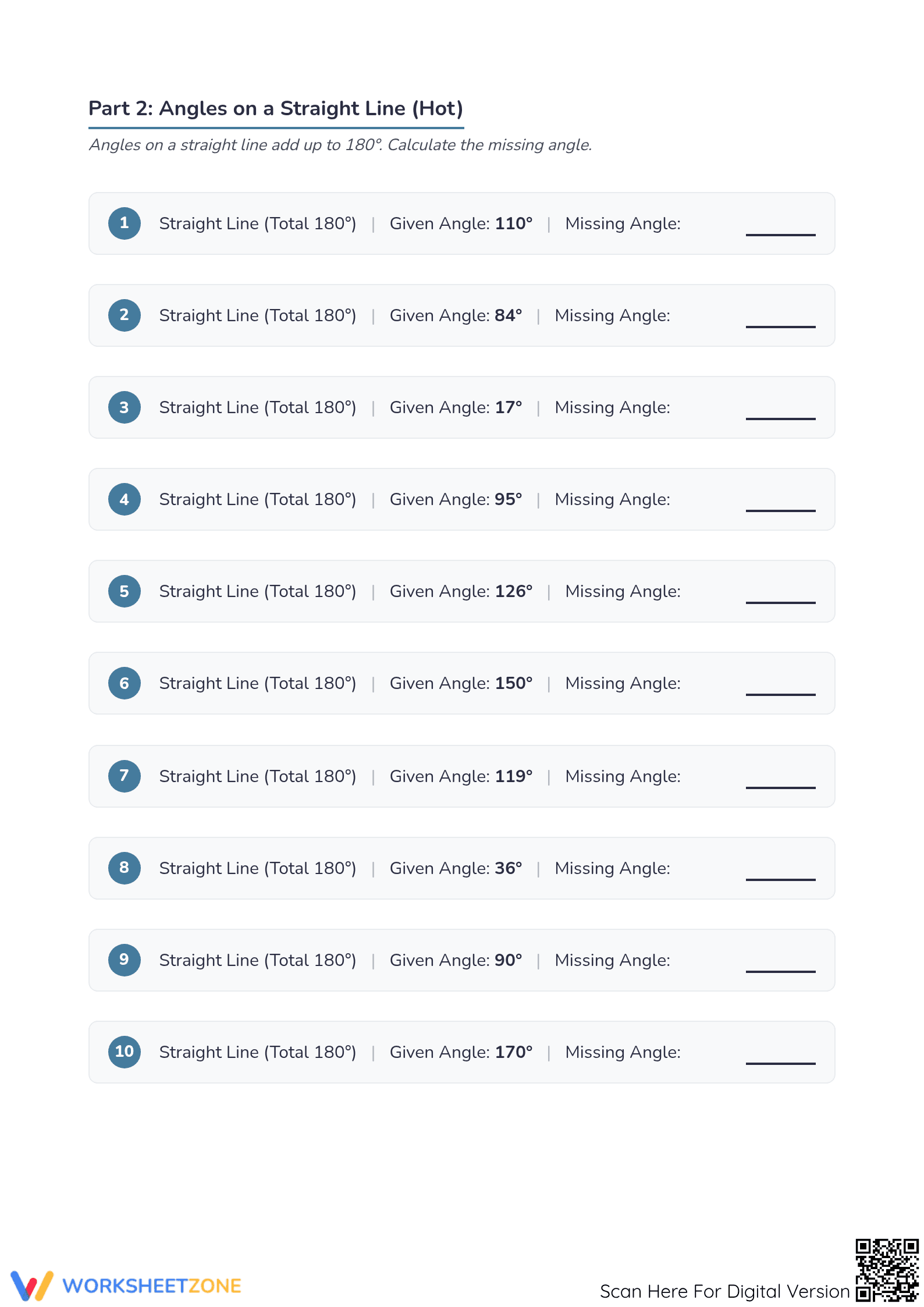
What's Inside: The packet contains three distinct sections across three pages. Part 1 focuses on basic additive angles (Mild), Part 2 addresses angles on a straight line (Hot), and Part 3 requires physical measurement (Spicy). A full three-page answer key is provided for immediate feedback. The layout is clean, with dedicated spaces for student scores and clear instructional headers.
Level Descriptions
- Below Grade (Mild): 10 problems focusing on simple decomposition where the total angle and one part are clearly defined for subtraction practice.
- On Grade (Hot): 10 problems requiring students to apply the knowledge that angles on a straight line sum to 180 degrees to find the missing value.
- Above Grade (Spicy): 6 complex visual tasks requiring the use of a protractor to measure acute, obtuse, and reflex angles with precision.
Standards Alignment
This resource is primarily aligned with `CCSS.MATH.CONTENT.4.MD.C.7`, which requires students to recognize angle measure as additive and solve for unknown angles. It also supports `CCSS.MATH.CONTENT.4.MD.C.6` through the practical application of protractor measurement. Both standard codes can be copied directly into lesson plans, IEP goals, or district curriculum mapping tools.
How to Use It
Use this as a tiered homework assignment where students are assigned specific pages based on their current mastery level. Alternatively, use it as a "choice board" activity during math centers. For formative assessment, observe students during Part 3 to ensure they are correctly aligning the protractor's vertex and baseline. Completion typically takes 30 to 45 minutes.
Who It's For
This is designed for Grade 4 and 5 students mastering geometric measurement. It is particularly effective for inclusive classrooms where students require different entry points into the curriculum. Pair this with a physical anchor chart demonstrating supplementary angles or a digital protractor tutorial for students working on the "Spicy" level.
According to research by Fisher & Frey (2014) on the gradual release of responsibility, tiered tasks like those found in this CCSS.MATH.CONTENT.4.MD.C.7 worksheet allow students to move from supported computation to independent geometric reasoning. By providing "Mild" to "Spicy" levels, the resource addresses the variance in spatial visualization skills often found in upper elementary classrooms. The inclusion of 26 varied tasks ensures that students encounter multiple representations of angle addition, a key requirement for meeting NAEP proficiency standards in geometry. This structured approach to finding missing angles helps solidify the conceptual link between arithmetic operations and geometric properties, ensuring students are prepared for middle school coordinate geometry. The clear progression from 90-degree and 180-degree anchors to free-form measurement provides the necessary scaffolding for mastery.


