




























Views
Downloads

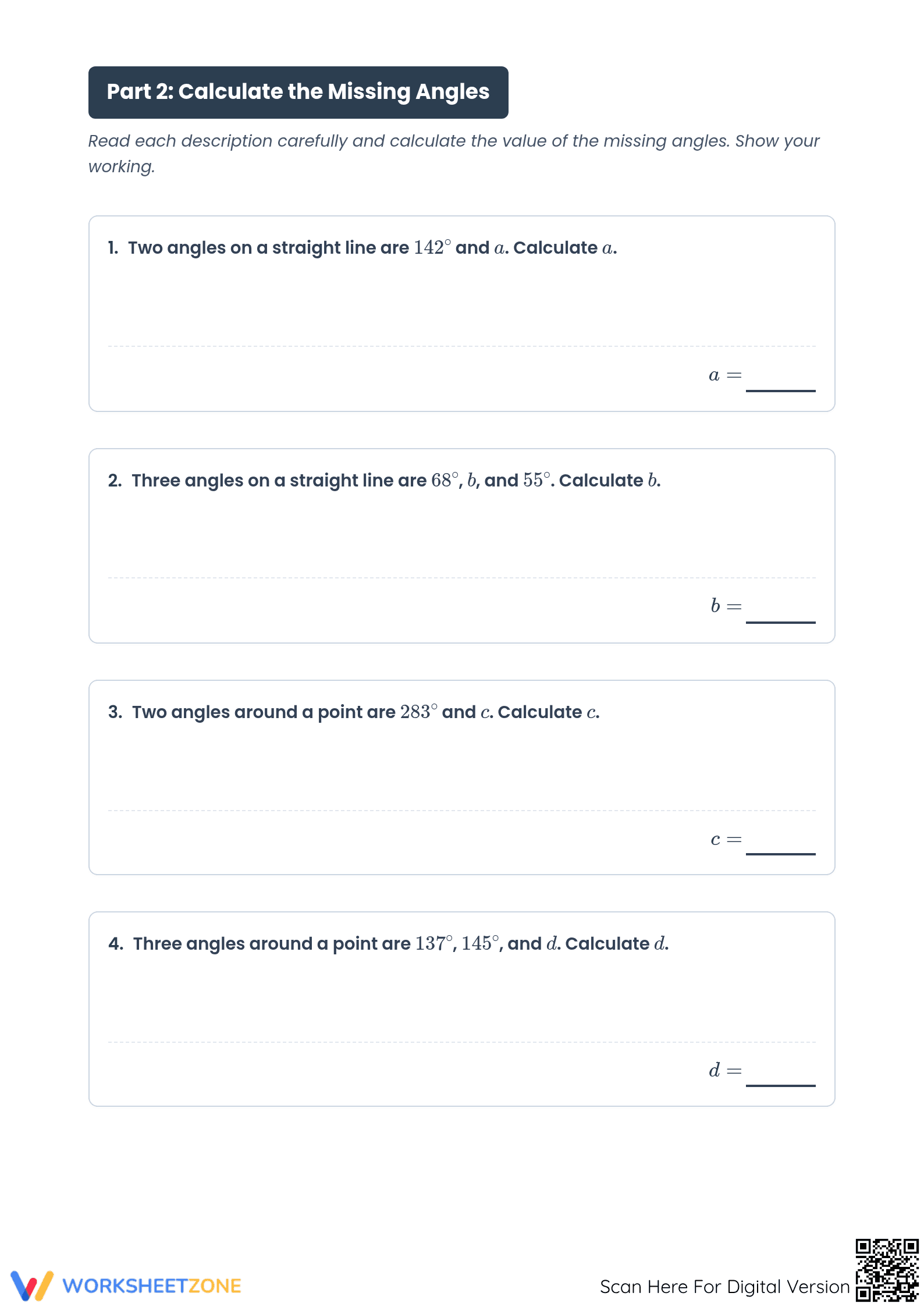



Missing Angles Worksheet | Grade 7 Essential Math

Paste this activity's link or code into your existing LMS (Google Classroom, Canvas, Teams, Schoology, Moodle, etc.).
Students can open and work on the activity right away, with no student login required.
You'll still be able to track student progress and results from your teacher account.
This comprehensive Grade 7 geometry worksheet empowers students to calculate unknown measures using established angle relationships. By applying properties of supplementary, complementary, and vertically opposite angles, learners develop the algebraic reasoning necessary for high school geometry. Students will solve 14 distinct problems that transition from simple two-angle relationships to complex multi-angle configurations around a point.
At a Glance
- Grade: 7 · Subject: Math
- Standard:
CCSS.MATH.CONTENT.7.G.B.5— Use angle facts to write and solve equations for unknown angles in figures- Skill Focus: Missing angle calculation
- Format: 5 pages · 14 problems · Answer key included · PDF
- Best For: Independent practice or homework
- Time: 30–45 minutes
The resource begins with a "Facts to Remember" reference sheet, providing visual anchors for intersecting lines, angles at a point, straight lines, and right angles. The following four pages contain 14 word-problem style tasks where students must interpret descriptions (e.g., "three angles on a straight line") and perform the necessary subtraction or algebraic balancing to find the variable. A full 5-page answer key is included for rapid grading.
This resource is designed for a zero-prep classroom workflow. First, print the 5-page student packet (1 minute). Second, distribute the packets to students for independent or paired work (30 seconds). Finally, use the provided answer key to review solutions as a whole group or for individual grading (under 1 minute). This streamlined structure makes it an ideal candidate for emergency sub plans or Friday review sessions.
This worksheet is primarily aligned with `CCSS.MATH.CONTENT.7.G.B.5`. This standard requires students to use facts about supplementary, complementary, vertical, and adjacent angles in a multi-step problem to write and solve simple equations for an unknown angle in a figure. It also supports 4th and 5th-grade foundations regarding additive angle measurements. Both standard codes can be copied directly into lesson plans, IEP goals, or district curriculum mapping tools.
Use this worksheet during the "You Do" phase of a gradual release lesson on geometry. It serves as an excellent formative assessment tool; observe students on problems 5 and 8 to see if they correctly identify vertically opposite angles versus adjacent ones. Expected completion time is 35 minutes for most middle schoolers, though it can be split across two shorter sessions.
This packet is designed for Grade 7 students but is highly effective for Grade 8 remediation or Grade 6 enrichment. It is particularly helpful for students who benefit from verbal descriptions of geometric figures rather than just diagrams. Pair this resource with a protractor exploration or a digital angle-manipulative tool to reinforce the abstract calculations with physical measurement.
According to the RAND AIRS 2024 report on mathematics instructional materials, high-quality geometry practice must bridge the gap between visual recognition and algebraic computation. This worksheet achieves that by requiring students to translate geometric facts into arithmetic operations. By focusing on the four core angle relationships—supplementary, complementary, vertical, and angles at a point—the resource builds the prerequisite fluency needed for 8th-grade transversal and triangle sum theorems. Research from Fisher & Frey (2014) emphasizes that providing a "Facts to Remember" scaffold, as seen in Part 1 of this document, significantly reduces cognitive load during the initial independent practice phase. This allows students to focus on the logic of the calculation rather than struggling with rote memorization of definitions. The 14-task sequence ensures sufficient repetition for mastery while maintaining a high level of rigor through multi-step problem solving.


