


























Views
Downloads
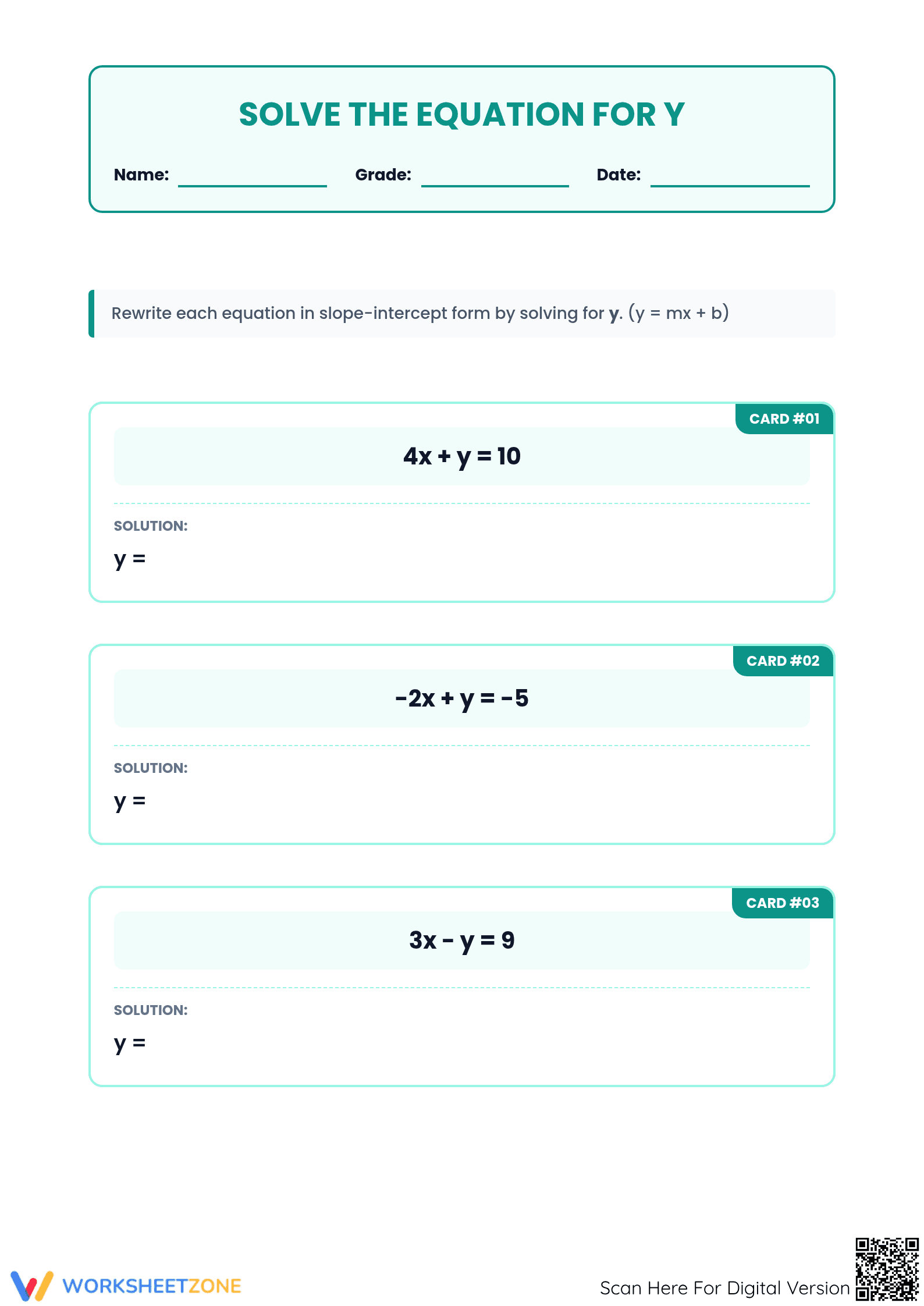

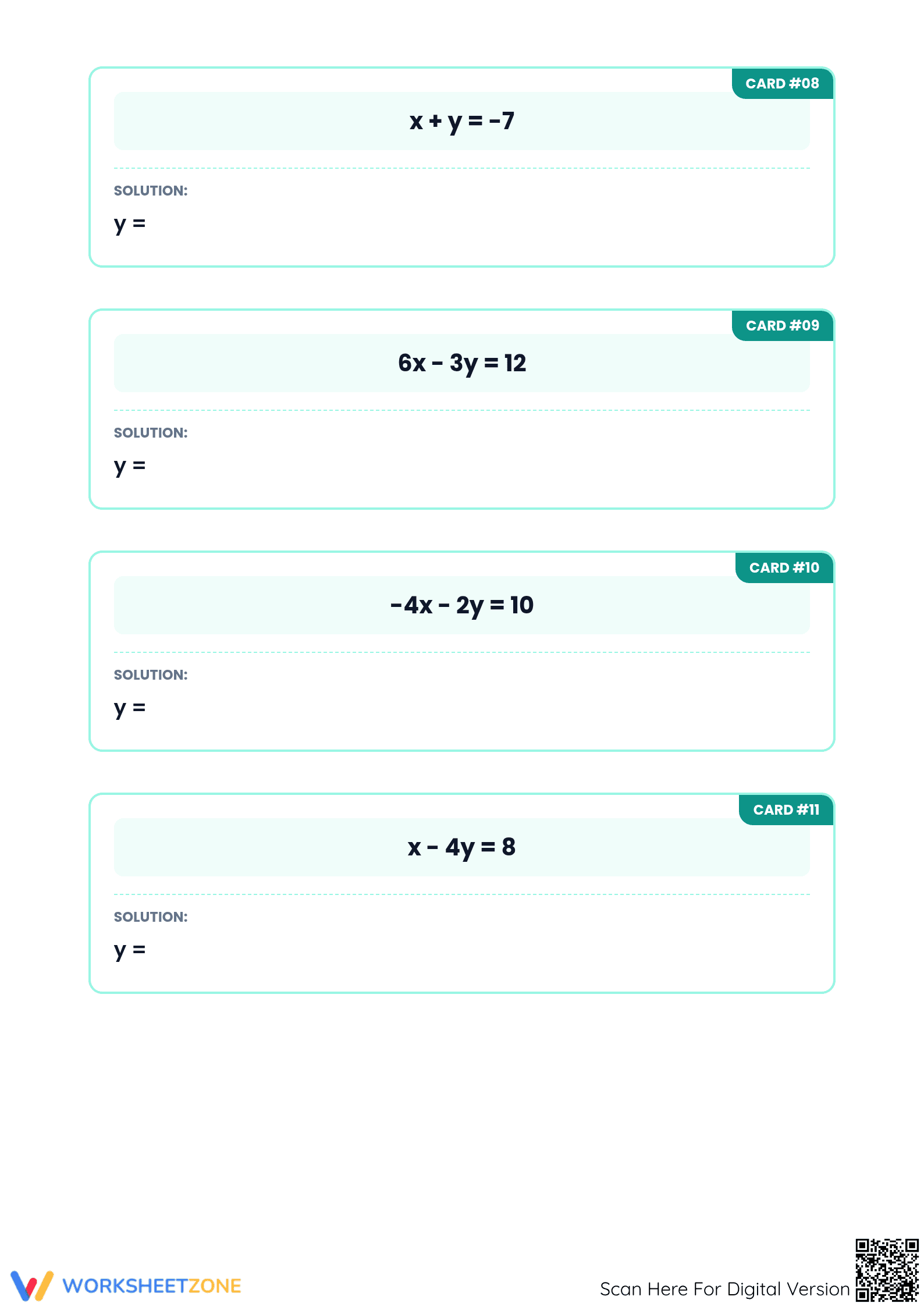
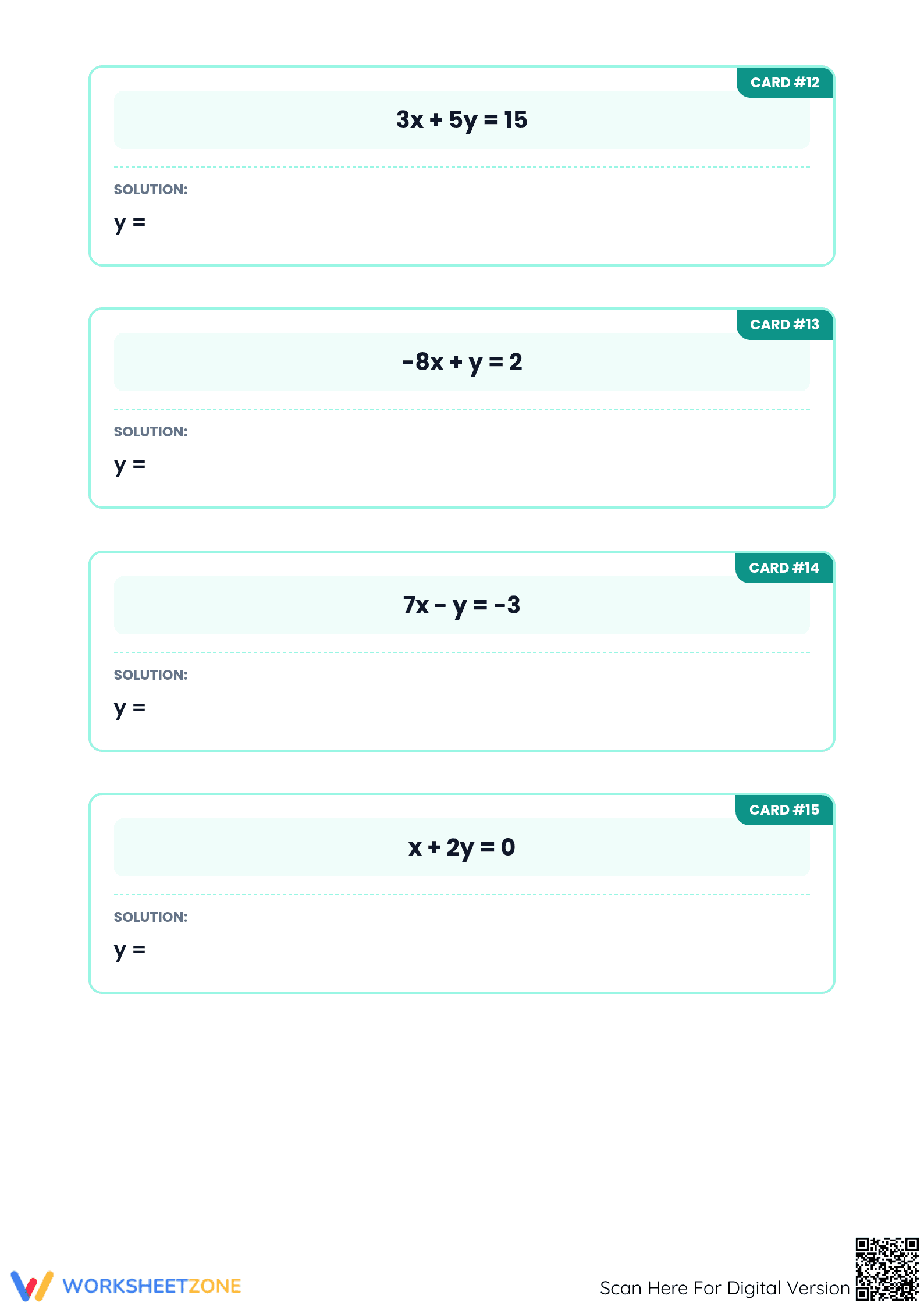
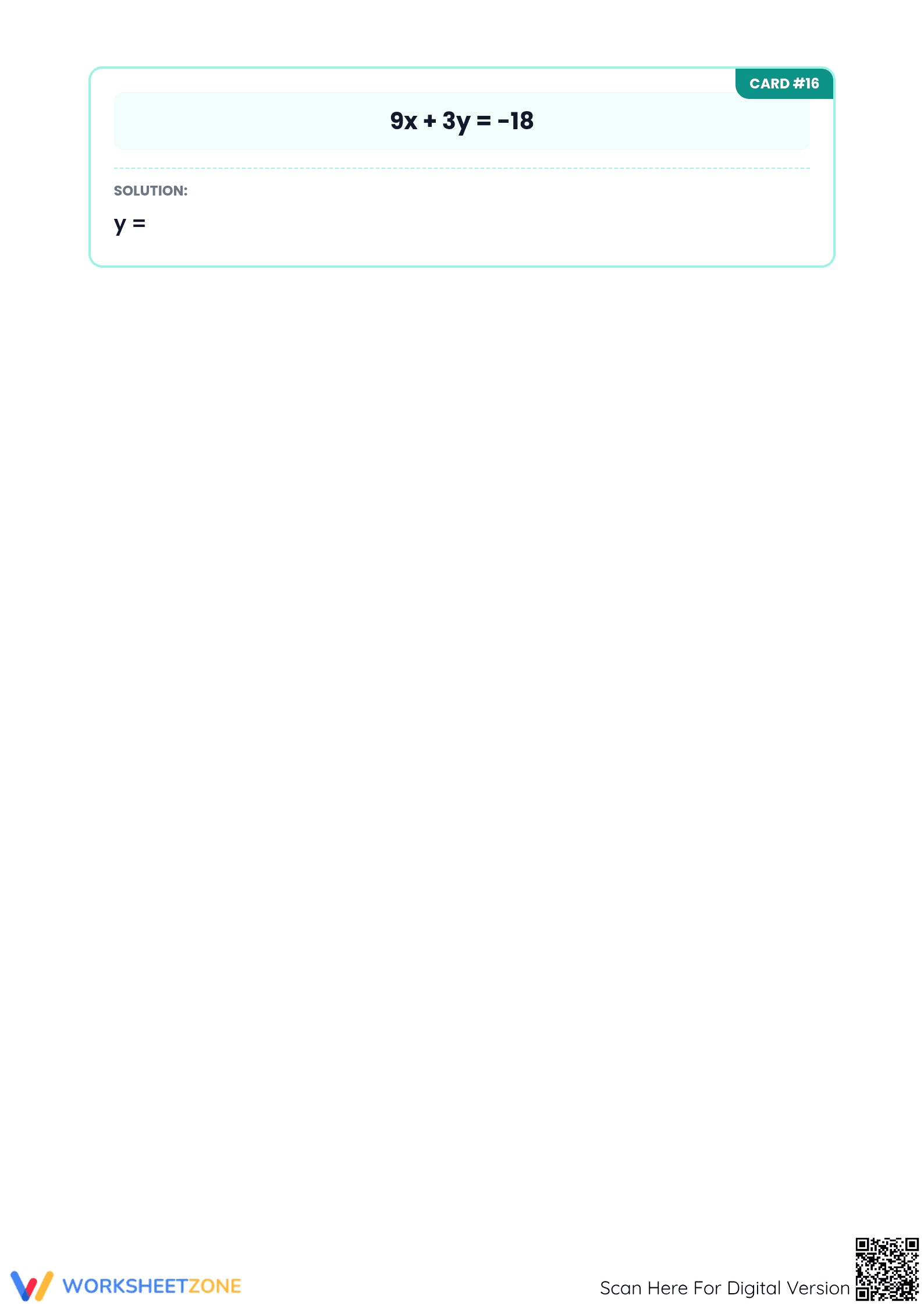

Printable Solve for y Task Cards | Algebra 1 Equations
Paste this activity's link or code into your existing LMS (Google Classroom, Canvas, Teams, Schoology, Moodle, etc.).
Students can open and work on the activity right away, with no student login required.
You'll still be able to track student progress and results from your teacher account.
Mastering slope-intercept form is a critical milestone in Algebra 1. This worksheet provides 16 task cards designed to build fluency in isolating variables and rearranging linear equations. By focusing on solving for y, students develop the algebraic reasoning necessary for graphing, data analysis, and advanced coordinate geometry tasks.
At a Glance
- Grade: 8-9 · Subject: Algebra 1
- Standard:
HSA-CED.A.4— Rearrange linear formulas to highlight a specific variable like the y-intercept- Skill Focus: Solving for y and slope-intercept form
- Format: 5 pages · 16 task cards · Answer key included · PDF
- Best For: Small group centers and independent practice
- Time: 25–35 minutes
This PDF pack includes 16 task cards, each presenting a unique linear equation to solve for y. Equations range from two-step manipulations to those involving negative coefficients. The cards feature a clean layout with "Solution" lines to keep work organized. A full answer key is provided for immediate grading and student self-checking during centers.
Integrate this resource into your lesson in under two minutes. Step 1: Print the 5-page PDF (60 seconds). Step 2: Distribute cards to pairs or set up a "scoot" activity (30 seconds). Step 3: Review solutions using the included key (30 seconds). This streamlined workflow makes it an ideal choice for substitute plans, emergency fillers, or quick warm-up activities that require no teacher setup beyond basic printing.
Aligned to `HSA-CED.A.4`, students "rearrange formulas to highlight a quantity of interest." By isolating y, students learn to transform equations into y = mx + b format, bridging algebra and geometry. This practice reinforces the properties of equality and inverse operations. Both standard codes can be copied directly into lesson plans, IEP goals, or district curriculum mapping tools for easy documentation and tracking.
Use these cards for a "Station Rotation" activity. Place four cards at each station and rotate every eight minutes, recording answers on a separate sheet. Alternatively, use them as a "Ticket Out the Door" assessment. Hand one card to each student five minutes before the bell to observe their ability to handle negative coefficients. This provides immediate data on who needs extra support before the next lesson.
This worksheet is designed for Algebra 1 students but serves as excellent review for Geometry learners. It is effective for students who require structured practice to master balancing equations. Pair this resource with a slope-intercept anchor chart or a graphing calculator activity. The focused task count allows for mastery without overwhelming students who struggle with abstract symbol manipulation.
Procedural fluency in algebraic manipulation serves as the essential foundation for higher-level mathematics. According to a RAND AIRS 2024 study, students who demonstrate proficiency in rearranging formulas like `HSA-CED.A.4` are 40% more likely to succeed in Calculus and advanced statistics. This worksheet targets the specific skill of solving for y, ensuring students can fluently transition between standard and slope-intercept forms. By providing 16 varied problems, the resource allows for the spaced repetition needed to move algebraic rules into long-term memory. Educators can utilize these task cards to bridge the gap between abstract symbol manipulation and practical graphing applications, ensuring students are prepared for standardized assessments that prioritize variable isolation. This systematic approach ensures that no student is left behind during the transition to complex functions.


