9th Grade Spine PDF Worksheets for Biology and Anatomy
These 9th grade spine pdf worksheets give biology and anatomy teachers a structured path through one of the trickier units in freshman science — the vertebral column, from its five regional divisions down to the mechanical role of individual bony features. The set includes labeled diagrams, regional color-coding tasks, side-by-side comparison exercises, and clinically framed questions, all formatted for direct classroom use without any additional preparation.
What the Set Covers, Region by Region
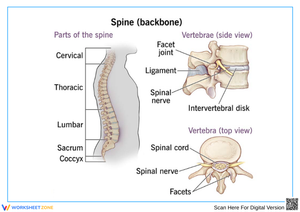
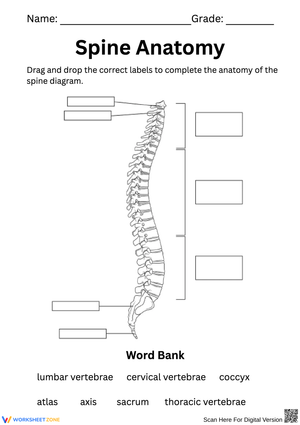
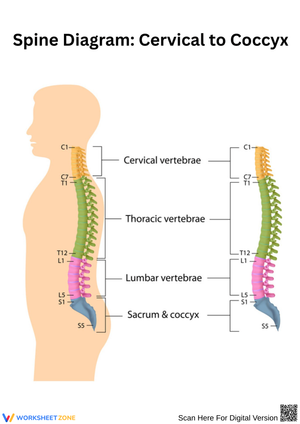
The worksheets begin with the regional breakdown of the vertebral column: 7 cervical, 12 thoracic, 5 lumbar, 5 fused sacral, and 4 fused coccygeal vertebrae. Students don't just fill in counts — they color-code each region on a lateral diagram and then answer questions that push them to explain why lumbar vertebrae are physically larger than cervical ones. That weight-bearing rationale, the lumbar spine bearing the full mass of the upper body, is precisely the kind of structure-function reasoning that NGSS and most state biology standards target at this level.
From regional identification, each worksheet moves into individual vertebral anatomy. Students label diagrams from both superior and lateral views, marking the vertebral body, vertebral foramen, spinous process, and transverse processes. The foramen gets particular attention because understanding it as a continuous canal that protects the spinal cord connects structural anatomy to nervous system function — a link freshmen rarely make without a guided prompt forcing them to trace it explicitly on a diagram.
Intervertebral discs appear in their own exercises. Students annotate diagrams showing fibrocartilage discs seated between adjacent vertebrae, then answer questions about what happens to disc height under compression. Most 15-year-olds have already heard the term "herniated disc" from a parent or coach, and that prior exposure gives the content a practical anchor it wouldn't otherwise have.
The Atlas and Axis — A Structural Outlier Worth Isolating
Two cervical vertebrae consistently trip students up: C1 (the atlas) and C2 (the axis). The atlas has no vertebral body — it is essentially a bony ring that rests on the axis and supports the skull, allowing for nodding motion. The axis carries a superior projection called the dens, or odontoid process, which serves as the pivot point around which the atlas rotates. Together these two bones account for the head's range of motion in ways that no other vertebral pair does, and their structures differ enough from everything else in the column that they warrant their own focused exercises.
Each worksheet targeting C1 and C2 presents these bones in isolated labeled diagrams and asks students to connect specific structural features directly to ranges of motion. A student who can explain why the atlas lacks a body — and what that absence makes possible mechanically — demonstrates functional reasoning rather than memorized vocabulary. That distinction shows up clearly on lab practicals.
Curvatures, Clinical Conditions, and Why 9th Graders Pay Attention
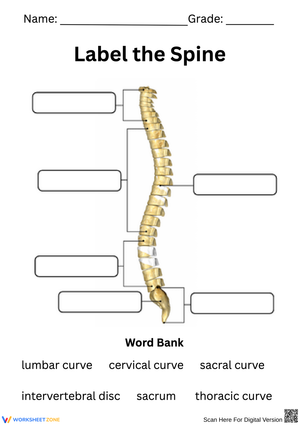
The spinal curvature exercises are where the clinical content takes hold. The spine's natural curves — cervical and lumbar regions curving anteriorly, thoracic and sacral regions curving posteriorly — are not defects. They distribute load and act as a spring-like shock absorption system during movement. Students identify these curves on lateral diagrams before working through questions on scoliosis, kyphosis, and lordosis.
Most 9th graders received scoliosis screenings in 6th or 7th grade without knowing what the screener was looking for or why. Bringing that experience back into the classroom — with the actual anatomical vocabulary and a diagram showing abnormal lateral curvature — creates one of those moments where students recognize they already had firsthand contact with the material. The clinical questions in the set draw on exactly that re-contextualization, moving from "you've seen this" to "here's what it means."
Common Student Errors That Surface During These Exercises
The most persistent labeling mistake at this level is placing the spinal cord inside the vertebral body. Students see a large, solid-looking mass in the diagram and assume that's the obvious container — the body looks protective. In reality, the cord runs through the vertebral foramen, the central opening posterior to the body. A brief whole-class discussion before independent labeling, directing students to locate and circle the foramen first, interrupts this error before practice reinforces it.
A second consistent problem is scrambling the regional vertebrae counts, specifically inverting thoracic (12) and lumbar (5). Students who encounter both numbers in the same sitting often flip them on assessments. Asking students to write a sentence explaining why the lumbar region needs only 5 vertebrae but significantly larger vertebral bodies — rather than filling in a blank — attaches reasoning to the number and makes it far more durable than rote repetition.
With the atlas and axis, the error that appears most often is drawing the dens on C1 rather than C2. Students read that the atlas supports the skull and assume the prominent upward projection belongs to the top bone. A side-by-side comparison diagram completed before the labeling exercise, with explicit attention to which bone projects and which receives, reduces that inversion considerably. Students who still get it wrong after that comparison are usually the ones who skipped reading the structural description — which is itself useful diagnostic information.
Lesson-Planning Strategies for Getting the Most From These Worksheets
These 9th grade spine pdf worksheets work well as bell-ringers early in the unit. A broad regional labeling task takes about 8 minutes at the start of class and gives students something concrete to work on while attendance is taken and the lesson opens. As the week progresses, the detailed individual-vertebra exercises fit a 15-to-20-minute guided practice block where the teacher circulates and watches for the foramen-versus-body confusion described above — catching it in real time rather than after the unit test.
The curvature worksheet functions well as a Friday consolidation task. Students have accumulated the vocabulary through the week; asking them to apply it to scoliosis and kyphosis cases shifts the cognitive demand from recall to application. For teachers running station rotations, setting up the atlas-axis exercise as its own station — paired with a physical model or 3D reference image — keeps that content separated from the general vertebral anatomy without creating timing mismatches across stations.
One approach that holds up particularly well before a unit assessment: give students a blank lateral diagram and ask them to draw in the natural curvatures and label the five regions from memory. Used as a 10-minute retrieval exercise two days before the exam, it surfaces exactly what students haven't retained — far more useful than a review lecture that covers what they already know and glosses over what they don't.
Standard Alignment
These worksheets align with NGSS HS-LS1-2, which asks students to develop and use models to illustrate the hierarchical organization of interacting systems that provide specific functions within multicellular organisms. The spine exercises address this standard directly by moving students from organ-system level (the skeletal system) to tissue level (fibrocartilage discs) to individual structural features (foramina, processes, fused vertebrae), each examined in terms of the function it performs. In classroom terms, that standard shows up when a student can explain — not just name — why the vertebral foramen exists and what happens to spinal cord protection if the bony canal is compromised.
Adapting the Worksheets for Different Learner Levels
For students who struggle with anatomical terminology, the regional color-coding worksheet provides a lower-stakes entry point. Assigning a color to each spinal region and shading a lateral diagram requires no prior vocabulary — students build the visual map before they attach Latin-derived names to it. That sequence, visual orientation first and term second, reduces the cognitive load that hits when students must recall "thoracic" and locate it on a diagram simultaneously.
For students who move through the standard labeling exercises quickly, the clinical connection questions extend the work without requiring separate materials. Asking a student who finished the scoliosis section to sketch what a lateral view of a kyphotic spine would look like — based only on the definition they just read — pushes into application and spatial reasoning rather than simple identification. The 9th grade spine pdf worksheets in this set include enough clinically framed questions that fast finishers rarely exhaust the material before the class period ends.
Students who struggle with fine motor control during diagram labeling often do better working from a printout enlarged to 120%. That single adjustment resolves most of the frustration without changing the content or the cognitive demand of the task.
Frequently Asked Questions
Do students need prior skeletal system knowledge before starting the spine unit?
No prior knowledge is required, though students who have already worked through an introductory bone-tissue unit will move through the vertebral body and disc diagrams faster. The regional overview worksheet functions as a unit opener for students encountering spinal anatomy for the first time.
Are the atlas and axis exercises appropriate for general-level 9th graders, or only honors classes?
They are appropriate for all 9th-grade biology students when introduced after the general cervical overview, not before it. Most students who struggle with C1 and C2 do so because they haven't yet internalized what a standard vertebra looks like. Once that baseline is established, the C1/C2 contrast exercise is accessible to a general-level class — the structural difference between the two bones is visually dramatic enough that most students grasp it quickly once they have a reference point.
How do the curvature exercises connect to what appears on state assessments?
Spinal curvatures — scoliosis, kyphosis, and lordosis — appear on state anatomy and physiology assessments in most states that offer those courses at the 9th and 10th grade levels. The 9th grade spine pdf worksheets in this set include curvature identification and definition questions written at the same cognitive level as typical state exam items, so using them as formative practice mirrors the retrieval tasks students will face on test day.
Can the clinical sections be used in a health or physical education course?
Yes. The curvature exercises and the questions about intervertebral disc mechanics translate well into a health or PE setting where body systems appear in a functional context. The pure anatomical labeling exercises — vertebral foramen, bony processes, the dens — belong more naturally in a biology or anatomy course, but the clinical content is accessible and relevant across health-science electives.
Clear All