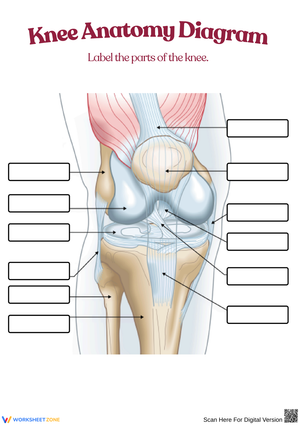
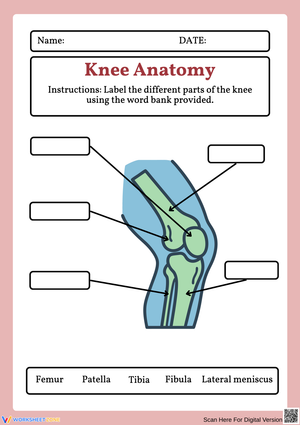
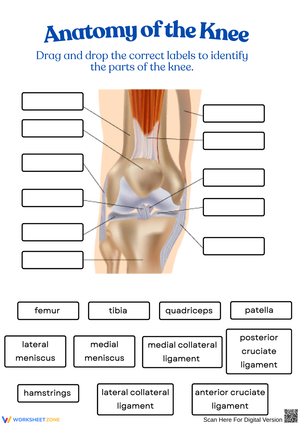
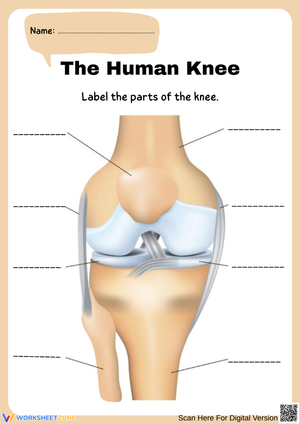
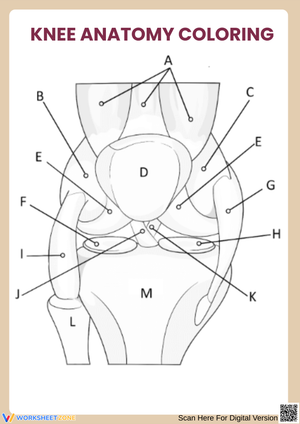
These knee worksheets for 9th grade give biology teachers a focused set of anatomy resources built around the joint that most 9th graders know best by name — the one they have twisted in gym class or watched a favorite athlete injure mid-season. Each worksheet targets a specific layer of knee anatomy, from the bones outward to the connective tissues and basic biomechanical principles, at a depth that fits the NGSS HS-LS1-2 standard and the typical 9th-grade unit on body systems.
Structures and Concepts Each Worksheet Addresses
The set is organized so teachers can assign individual worksheets in any order rather than marching through a fixed sequence. Content across the worksheets includes:
- Skeletal framework — identifying the femur, tibia, fibula, and patella in both anterior and posterior views, with written explanations of why the patella functions as a mechanical pulley rather than a passive shield
- Ligament labeling — placing the ACL, PCL, MCL, and LCL on unlabeled diagrams and explaining the direction of force each one resists
- Cartilage types — distinguishing articular cartilage from the fibrocartilage menisci using a color-coded diagram task; one worksheet asks students to name which tissue fails first under repetitive impact and to explain why
- Tendon identification — tracing the patellar tendon and quadriceps tendon and articulating the ligament-vs.-tendon distinction in writing, not just in labels
- Biomechanical analysis — examining why the knee is classified as a hinge joint but produces a rolling-and-gliding motion rather than pure rotation, and connecting femoral condyle shape to that movement pattern
Frequent Labeling Mistakes and Conceptual Slips to Watch For
The ACL and PCL cause the most consistent labeling errors in this unit. Students who read that the ACL prevents the tibia from sliding forward often assume the "A" stands for the direction of movement it resists — and then reverse the PCL's function entirely. The naming actually refers to where each ligament attaches on the tibia, not what direction of motion it prevents. Making that distinction explicit on the answer key, and asking students to rewrite both cruciate functions in their own words before checking their diagrams, catches this confusion before it settles.
The fibula creates its own trouble. Because it runs alongside the tibia, students frequently mark it as a direct load-bearing knee bone. When they trace the LCL toward the fibular head, they assume the fibula must be as structurally central as the tibia. A short annotation task — asking students to write the fibula's specific role at the knee versus its role further down the lower leg — breaks that assumption before the assessment.
Cartilage is a third area where vocabulary outruns understanding. Students can correctly write "articular cartilage" and "meniscus" on a diagram while still believing both are the same material doing the same job. Asking them to predict what would happen if only the menisci were removed — and then what would happen if only the articular cartilage were removed — reveals whether they understand the functional distinction or just memorized two labels.
Working These Worksheets Into Your Unit Plan
The most reliable opening move is to hand out a blank skeletal diagram on day one and have students label whatever they already know without any reference materials. That five-minute pre-assessment surfaces prior knowledge and makes the eventual answer key feel like a discovery rather than a list to copy down. From there, knee worksheets for 9th grade fit well into a station-based structure: one station for skeletal identification, one for ligament and tendon work, and one for the biomechanics analysis questions. Students get about 12 minutes per station, and the movement between tables keeps the energy up during what can otherwise turn into a dry memorization block.
The coloring worksheet for cartilage types works well as a focused task in the final 10 minutes of class — long enough to complete, short enough that students are not filling in color just to fill time. The biomechanics worksheet, which asks students to trace force pathways through the joint during a jump, needs more uninterrupted time and works best as a full-period activity with a brief class debrief at the end.
Standard Alignment
These worksheets support NGSS HS-LS1-2, which asks students to develop and use models to illustrate the hierarchical organization of interacting systems that provide specific functions for organisms. The knee is one of the clearest examples available for that standard: students trace how cells form tissues (cartilage, ligament fibers), tissues form functional structures (the joint capsule, the cruciate ligament pair), and those structures work together within the musculoskeletal system to produce stable, controlled movement. The standard does not name the knee, but it centers system-level functional analysis as the learning target — and each worksheet in the set asks students to explain function, not just name parts.
Adjusting the Set for Different Student Levels
Knee worksheets for 9th grade are straightforward to tier. For students still building science vocabulary, adding a word bank to the labeling worksheets keeps them working productively without turning the activity into a guessing exercise. The word bank does not give away function — it just removes the spelling barrier so students spend their cognitive effort on placement and meaning instead.
For students who move through the identification tasks quickly, the biomechanics worksheet includes open-ended analysis questions — such as why a wider femoral intercondylar notch might reduce ACL injury risk — that have no single correct answer and reward extended reasoning. Running the standard labeling worksheet alongside a no-reference variant takes no additional prep time beyond printing two versions; students who finish early shift to the harder format without any disruption to the rest of the class.
Frequently Asked Questions
What should students be able to label and explain by the end of this unit?
Students should identify the femur, tibia, fibula, and patella; place and name all four major ligaments; locate the medial and lateral menisci; and distinguish the patellar tendon from the quadriceps tendon. Beyond labeling, they should be able to explain in writing the functional difference between a ligament and a tendon — not just define each term in isolation — and describe why the knee's motion is more complex than a standard door hinge.
Do any of these worksheets require physical models or lab materials?
No physical materials are required. The biomechanics analysis and the cartilage coloring tasks are entirely paper-based. Teachers who want to extend the lesson can build a quick rubber-band model — attaching rubber bands to cardboard cutouts of the femur and tibia to simulate cruciate ligament tension — but that extension is supplemental, not a prerequisite for completing any worksheet in the set.
How many class periods does the full set typically take?
Most teachers work through the set across three to four 50-minute periods: one for skeletal structure, one for connective tissues, and one to two for biomechanics and review. Individual worksheets also work as single-period warm-ups or exit tasks if the unit timeline is compressed. Because each worksheet stands alone, there is no penalty for skipping one or rearranging the order to match what has already been covered in lecture.
Is prior anatomy knowledge required before starting?
No. The set assumes familiarity with terms like bone, muscle, and joint, but not with specialized anatomical vocabulary. The knee worksheets for 9th grade introduce terminology as students encounter it, so a student who has completed a basic cells-and-tissues unit but has had no previous anatomy instruction can begin the skeletal identification worksheet without additional preparation.












 Interactive Worksheet Maker
 Quiz Maker
 Word Search Maker
 Crossword Puzzle Maker
 Word Scramble Generator
 Sentence Scramble Generator
 Handwriting Worksheet Generator
 Name Tracing Generator
 Fill In The Blank Generator