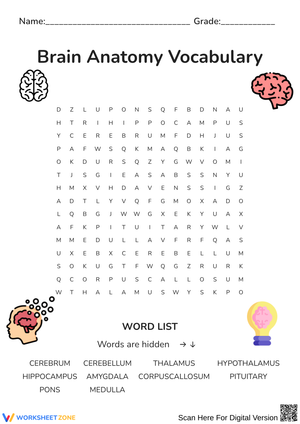
Brain PDF Worksheets for 9th Grade
These brain pdf worksheets for 9th grade give teachers a ready-to-print set covering the major structures, regional functions, and real-world applications that show up in a high school biology or anatomy unit. The activities run from diagram labeling on the first day of instruction through scenario analysis tasks that push students toward evidence-based reasoning — covering the full arc of a brain anatomy sequence without requiring anything beyond a printer and a lesson plan.
Structures and Concepts Covered Across the Set
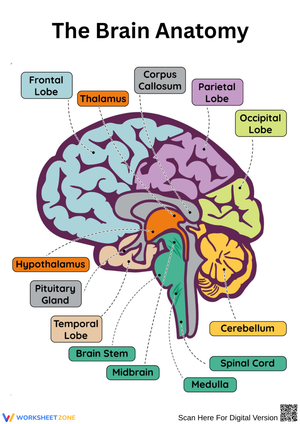
The worksheets address the structures that appear most consistently in Grade 9 curriculum frameworks and on unit assessments. Students work with the cerebrum and its four lobes — frontal, parietal, temporal, and occipital — identifying not just names but the specific functions each governs: planning and impulse control in the frontal lobe, spatial processing in the parietal, auditory processing and language comprehension in the temporal, and visual interpretation in the occipital. The cerebellum, brainstem, thalamus, hypothalamus, and cerebral cortex each appear across multiple worksheets in different formats, so students encounter the same structures through labeling, matching, and written explanation before the unit ends.
Each worksheet also reinforces core neuroscience vocabulary — neuron, synapse, axon, dendrite — because students who can name brain regions but cannot explain how signals travel between them are only halfway to the understanding that standardized questions actually test.
Worksheet Formats in This Collection
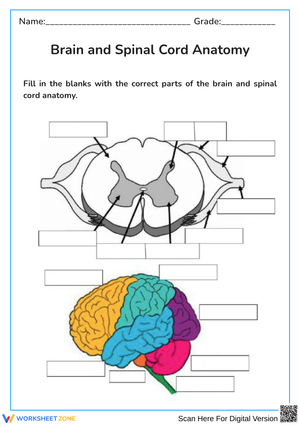
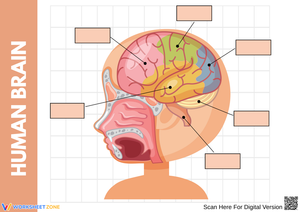
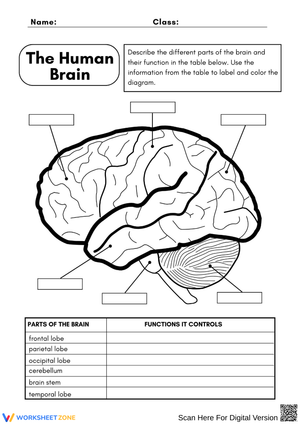
- Diagram labeling: Students mark a lateral or sagittal brain view with structure names. Works as a pre-assessment on Day 1 and again at the end of a unit for a direct before-and-after comparison.
- Function matching: Two-column activities connecting regions to roles — the cerebellum to balance and motor coordination, the hypothalamus to temperature regulation and hunger, and so on.
- Vocabulary fill-in-the-blank: Sentence-level exercises reinforcing terms before a quiz. Useful as independent seatwork once direct instruction is complete.
- Compare and contrast: Activities comparing left and right hemispheres, or the central nervous system against the peripheral nervous system. These push students to organize knowledge relationally rather than as an isolated list.
- Scenario analysis: Short case descriptions — a patient who loses balance after a fall, a person who can no longer form new memories after a brain injury — where students identify the affected region and justify their answer in writing.
The scenario worksheets generate the most classroom discussion. When a student reads that someone speaks normally but cannot understand spoken language, the group argument over whether that's a temporal or frontal lobe issue surfaces exactly the kind of misconception teachers need to catch before the test.
Frequent Student Errors Worth Watching For
The most common problem is not mislabeling on a diagram — students usually get those right after a few passes — but collapsing function categories when they shift to writing explanations. A student will correctly label the frontal lobe on a diagram and then, on a scenario question, attribute planning and decision-making to the cerebrum as a whole rather than localizing it to the frontal lobe specifically. They have learned the region name without internalizing that the lobes do genuinely different things.
A second error pattern shows up on compare-and-contrast tasks. Students routinely conflate the thalamus and hypothalamus, treating them as one structure with a shared function. The names are similar enough that without a targeted, direct explanation of what makes them distinct — the thalamus as a sensory relay station, the hypothalamus as a hormonal and homeostatic regulator — students mix them up on every assessment. Assigning each worksheet that covers these two structures back-to-back in the same class period, then revisiting the distinction two days later, catches this confusion before it hardens into a test-day mistake.
Building These Worksheets Into a Weekly Unit Plan
A five-day brain anatomy sequence works well when the worksheets are ordered from recognition to application. Start Day 1 with the diagram-labeling worksheet as an ungraded pre-assessment — students mark whatever they already know, which surfaces prior knowledge and signals to them that this content is something they are expected to learn, not just receive. Days 2 and 3 move through direct instruction and function-matching practice, ideally in pairs so misconceptions surface in conversation rather than silently on paper. Day 4 is where the brain pdf worksheets for 9th grade earn their keep: the scenario analysis tasks ask students to read a clinical description, identify the affected region, and write a one-to-two sentence justification. This is the hardest task in the set, and saving it for mid-week gives students enough content to actually work with. Day 5 returns to the original diagram. Students re-label it independently. The side-by-side comparison of Day 1 and Day 5 is a simple formative check that shows both the teacher and the student exactly how much ground has been covered.
PDF format makes the sequence practical — print class sets, post files to your LMS for absent students, or send worksheets home as review. Students working on printed copies benefit from using colored pencils to shade each lobe a different color, a spatial reinforcement strategy that helps students who struggle with text-based memorization retain regional distinctions longer than a single read-through will support.
Standard Alignment
These worksheets connect directly to NGSS LS1.A (Structure and Function), which asks students to explain how the specialized structure of cells, tissues, and organs enables them to perform specific life functions. The brain is one of the clearest cases in the human body for demonstrating this principle: the layered organization of the cerebral cortex, the compact efficiency of the brainstem, and the bilateral structure of the cerebrum all tie directly to what those regions do. Worksheet tasks that ask students to explain why the brainstem sits where it does, or why the cerebral cortex has such a large surface area relative to overall brain volume, push toward LS1.A's performance expectations in a way that straight labeling exercises alone do not.
Adjusting the Worksheets for Mixed-Ability Classes
The diagram-labeling worksheets work across ability levels with minimal adjustment. For students who need more support, provide a word bank alongside the blank diagram — this removes the free-recall burden and lets the student focus on spatial recognition instead. For advanced students, remove the word bank entirely and add a column requiring a brief function description next to each labeled structure.
The scenario analysis worksheets are the most demanding in the set. Students who freeze when given an open-ended written prompt benefit from a sentence frame: "The brain region most likely affected is _____ because _____." That structure keeps the task accessible without reducing the cognitive demand of the reasoning step. At the other end, students who finish quickly can write a second scenario of their own — naming a symptom and identifying which brain region would produce it — which is a genuinely harder task than analyzing a provided case.
Frequently Asked Questions
What brain structures do 9th graders need to know for this unit?
Grade 9 biology and anatomy units typically require students to identify and describe the cerebrum and its four lobes, the cerebellum, brainstem, thalamus, hypothalamus, and cerebral cortex. Foundational vocabulary — neuron, synapse, axon, dendrite — is also expected, since understanding structure-function relationships at the cellular level supports the organ-level content on most assessments.
How do these worksheets fit into a class that already uses a textbook?
They work alongside a textbook rather than replacing it. Use the labeling and matching worksheets as guided practice after a textbook reading or lecture, and the scenario analysis tasks as application checks after the core content is in place. The brain pdf worksheets for 9th grade in this set work as independent student practice, which frees up class time for discussion and clarification rather than adding to whole-group instruction time.
Are these worksheets free to download and print?
Yes. Every worksheet in this collection is available as a free PDF download on Worksheetzone. No subscription or account is required. Teachers can print class sets, post files digitally, or share them as take-home review without any cost.
Do these worksheets fit a semester anatomy course or only a short biology unit?
Both. The set spans a range of difficulty — from straightforward labeling to written scenario analysis — so it fits naturally into a dedicated semester anatomy course as well as a shorter human body systems unit inside a general biology class. Teachers running a full semester course often use the easier worksheets earlier in the term and return to the brain pdf worksheets for 9th grade scenario tasks when reviewing for a cumulative exam.
Clear All