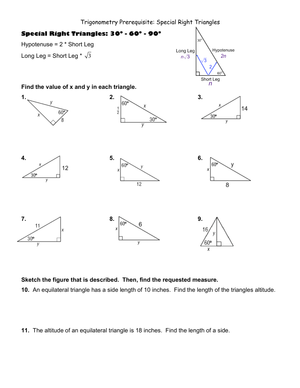
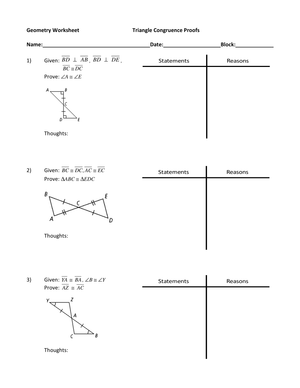
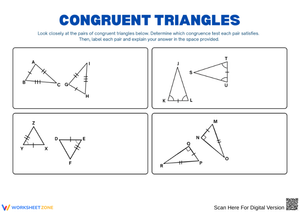
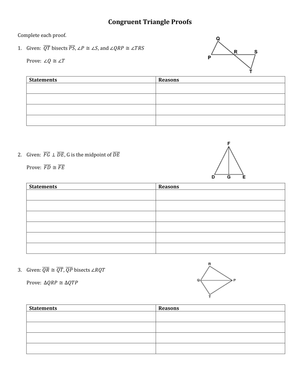
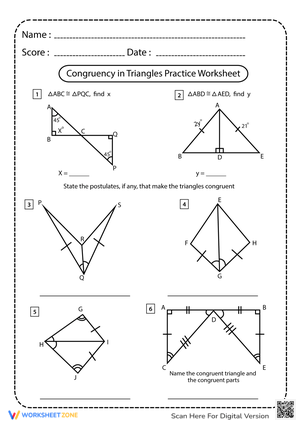
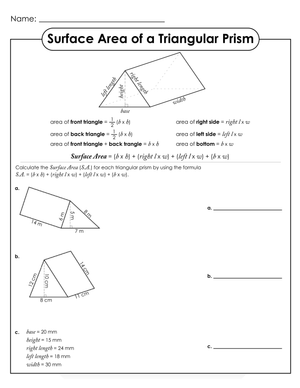
These 9th grade triangles worksheets resources give geometry teachers practice material that tracks the actual arc of a standard triangle unit — opening with classification and angle relationships, moving through the five congruence postulates, extending into similarity and proportionality, and landing on formal two-column proofs and introductory trigonometric ratios. The set addresses the full unit, not the easy front end of it, which is where most independent practice material runs out.
Triangle Skills These Worksheets Target
Each worksheet focuses on a specific skill rather than mixing multiple concepts together — a deliberate choice in a unit where students are already managing several new definitions at once. The skills covered across the set include:
- Triangle classification by angle measure (acute, obtuse, right) and side length (scalene, isosceles, equilateral), with problems requiring students to apply both systems to the same triangle simultaneously
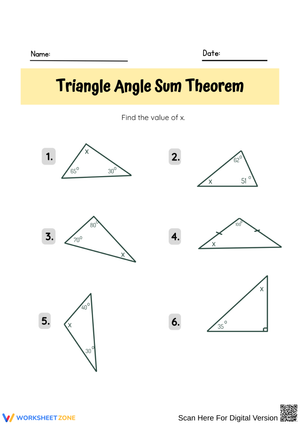
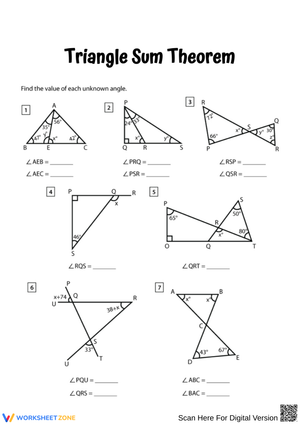
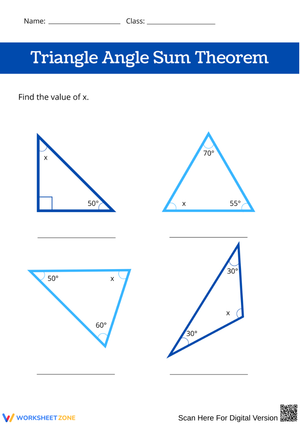
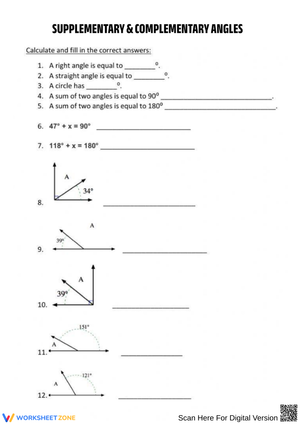
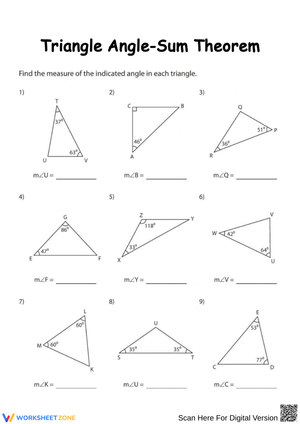
- Triangle Angle Sum and Exterior Angle Theorems paired with algebraic expressions, so students solve for unknown variable values rather than simply naming properties
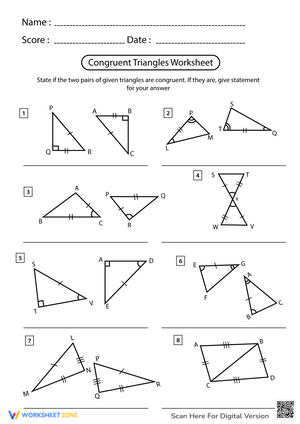
- Congruence postulates — SSS, SAS, ASA, AAS, and HL — including exercises that identify which postulate applies and exercises that deliberately present SSA to test whether students recognize it as insufficient
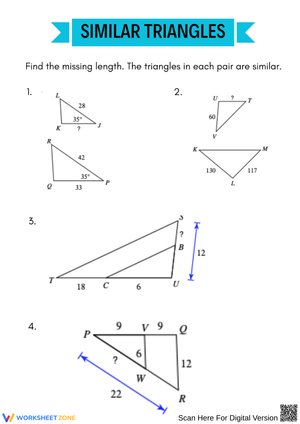
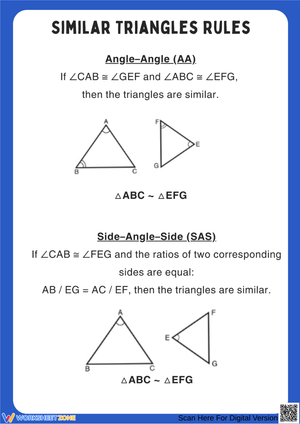
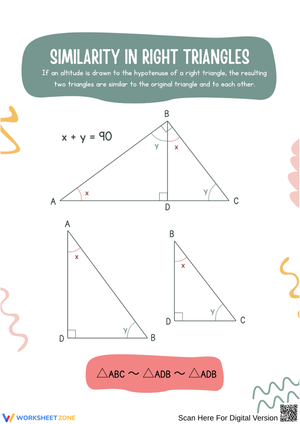
- Similarity theorems (AA, SSS similarity, SAS similarity) with proportion-solving and scale factor work connecting to perimeter and area relationships
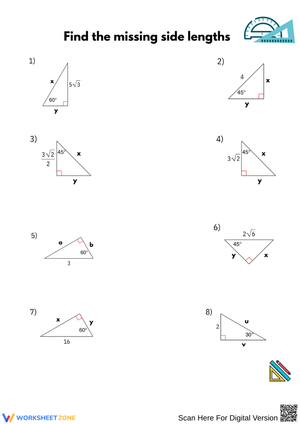
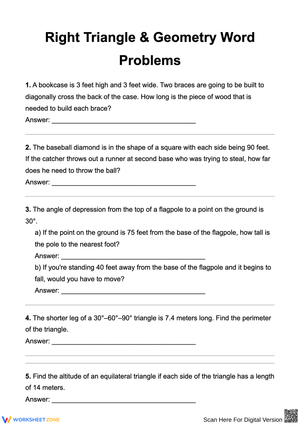
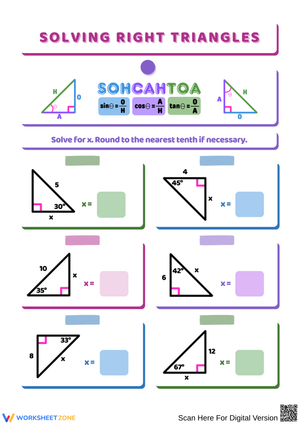
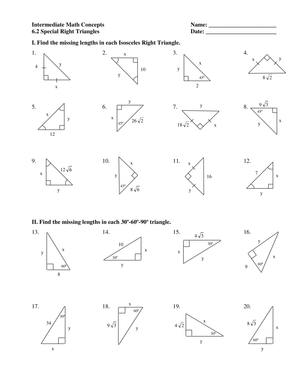
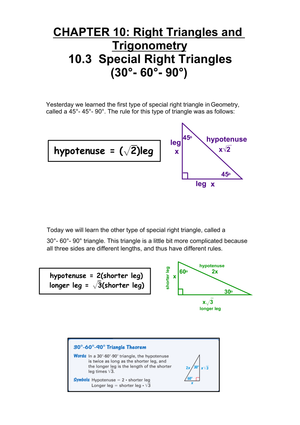
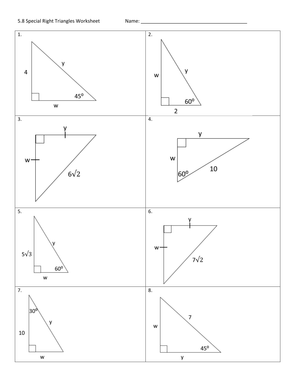
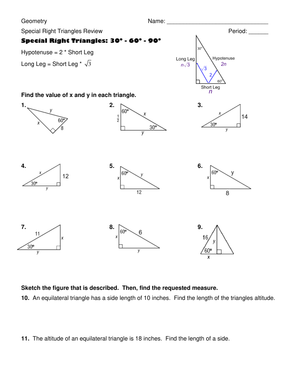
- Right triangle trigonometry — Pythagorean Theorem problems requiring radical simplification, and SOH-CAH-TOA problems set in angle-of-elevation and angle-of-depression contexts
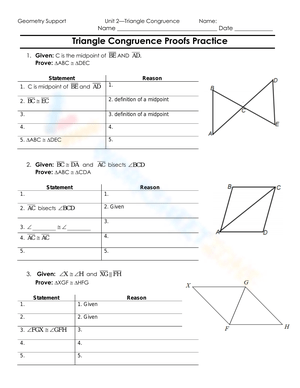
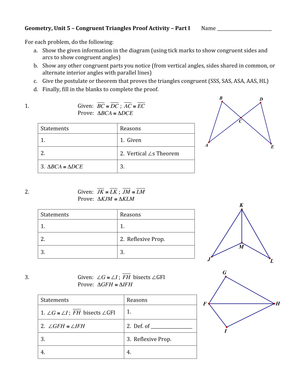
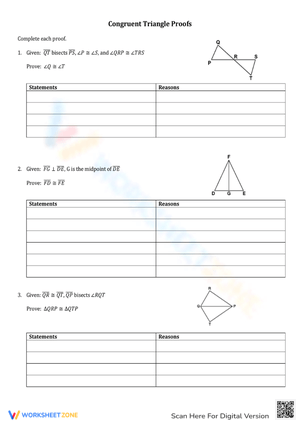
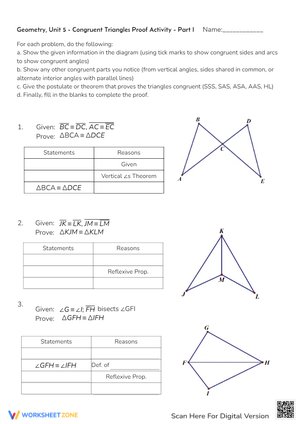
- Two-column proofs, ranging from fill-in formats where students supply missing reasons to full proofs where students generate every statement and reason from a diagram and the given information
Student Mistakes to Catch Before They Calcify
The Exterior Angle Theorem trips students up in a consistent and specific way. When a diagram is in a familiar orientation, most students apply the theorem correctly. But when the exterior angle appears at the bottom vertex or the triangle is rotated, they add the wrong pair of angles — choosing the adjacent interior angle plus one remote angle instead of both remote interior angles. That error is predictable, and the worksheets address it by presenting diagrams in varied orientations precisely to surface it before it becomes habitual.
The congruence postulate exercises expose a different failure: students treating SSA as a valid criterion. They see two sides and an angle marked and conclude congruence without checking whether the angle is the included one. Stating the rule in notes rarely fixes this. What actually works is showing two clearly non-congruent triangles that share two equal sides and a non-included equal angle — the visual counterexample registers in a way a written rule does not. That format is built into the worksheets for exactly that reason.
Proof work reveals a third pattern that is almost universal in 9th grade: students invoke CPCTC too early. They learn the acronym, find it satisfying to write, and reach for it at step two or three of a proof when it belongs only after congruence has been fully established. The fill-in proof formats in this set are structured so CPCTC appears at the end of the logical sequence, training the correct order before students work independently.
Working These Worksheets Into Your Unit Plan
The classification and angle-sum worksheets are natural warm-up material during the first week of the triangle unit. They reinforce the algebraic thinking students haven't yet applied in a geometry context, and a five-minute opening exercise gives you a fast read on who still struggles with multi-step equations — which matters because that skill reappears in every angle-relationship problem for the rest of the unit.
Congruence identification worksheets land best the day after direct instruction on a new postulate, while the theorem is still accessible. Waiting two or more class periods before structured practice on a new postulate costs significant retention. The trigonometry worksheets fit naturally at the end of a class period following the introduction of SOH-CAH-TOA, because students need immediate repetition with ratio setup before the three functions blur together. Angle-of-elevation and angle-of-depression problems then make an effective next-day bell-ringer — drawing the right triangle from a verbal description is a distinct cognitive task from computing the ratio, and it benefits from its own focused moment rather than being folded into the first day's practice.
Proof worksheets work best in a three-step delivery: project a fill-in proof and work through it with the class, then assign a second fill-in proof for independent work, then have students complete a proof given only the diagram and the given statements. That sequence typically spans two to three class periods and is worth the investment. Teachers who skip the guided middle step and move students straight to independent proof writing generally spend more time reteaching the logical structure than they saved by compressing the sequence.
Tailoring the Set for a Mixed-Readiness Class
Students who arrive in 9th grade without strong proportional reasoning will struggle specifically with the similarity worksheets — not because the geometry concepts are beyond them, but because setting up a proportion with a variable in the denominator is already unfamiliar territory. For those students, completing the congruence worksheets first builds the vocabulary for how triangles are described and marked. Revisiting similarity after a brief proportion review in class tends to go significantly more smoothly than pushing through without that detour.
Students who move quickly through classification and theorem work are ready for the coordinate geometry proof challenges in the later worksheets. Those require students to use the distance formula and slope to verify triangle congruence on the coordinate plane — a meaningful increase in abstraction that keeps advanced students productively engaged. Assigning these as extension work rather than mandatory work avoids creating workload inequity across the class.
For students who stall when faced with a blank proof template, the 9th grade triangles worksheets fill-in formats provide an entry point that is genuinely useful rather than cosmetically easier. Writing reasons for provided statements requires accurate recall and application of definitions — it is not a watered-down version of proof writing but a specific kind of practice that builds the vocabulary and logical awareness necessary for independent work later in the unit.
Standard Alignment
These worksheets address standards from the Common Core State Standards High School Geometry domain. Specific codes and their instructional placement in the unit:
- HSG.CO.B.7 and HSG.CO.B.8 — using rigid motions to understand triangle congruence and explaining why SSS, SAS, and ASA are sufficient criteria; these standards are addressed by the congruence identification worksheets in the first half of the unit
- HSG.SRT.A.2 and HSG.SRT.A.3 — identifying similarity correspondences and applying the AA criterion to prove triangles similar; these arrive in the second third of the unit as congruence work transitions to similarity
- HSG.SRT.B.4 and HSG.SRT.B.5 — proving theorems about triangles and using congruence and similarity criteria to solve problems; the two-column proof worksheets directly address both standards
- HSG.SRT.C.6 and HSG.SRT.C.8 — understanding trigonometric ratios as side-length ratios in right triangles and applying both the Pythagorean Theorem and trigonometric ratios to solve problems; the right triangle and trig worksheets address these at the back of the unit
In classroom terms, the CO standards occupy the congruence-and-proof arc at the front of the unit, while the SRT standards carry the back half through similarity, trigonometry, and coordinate applications. The 9th grade triangles worksheets set covers both arcs, making it usable across most of a standard eight-to-ten week Geometry 1 triangle unit rather than only one section of it.
Frequently Asked Questions
Why does the set include SSA exercises if SSA is not a valid congruence postulate?
Students encounter SSA in diagrams regularly, and the risk is not that they will list it by name — most do not — but that they will use it implicitly without recognizing the problem. They see two sides and an angle marked and conclude congruence, skipping the step where they verify whether the angle is included between the two sides. Including a visual counterexample directly in the worksheet stops this pattern in a way that a stated rule in notes rarely does. Seeing two clearly distinct triangles that satisfy the same SSA conditions is the moment when students actually understand why the criterion fails.
In what order should these worksheets be assigned across the unit?
The natural sequence is classification and angle relationships first, then congruence identification, then proof introduction using fill-in formats, then similarity and proportionality, then right triangle trigonometry. Because the worksheets are standalone, teachers who layer proof practice throughout the unit rather than saving it for a dedicated block — or who prefer to teach similarity before formal proof — can reorder the set to match their unit plan without losing coherence in the practice material.
Does the set include practice on the Triangle Inequality Theorem?
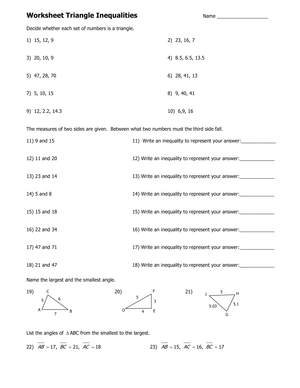
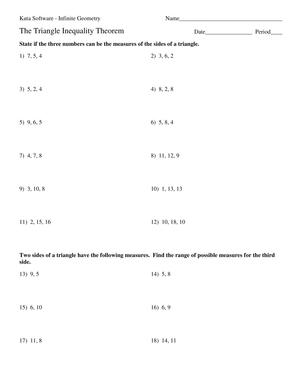
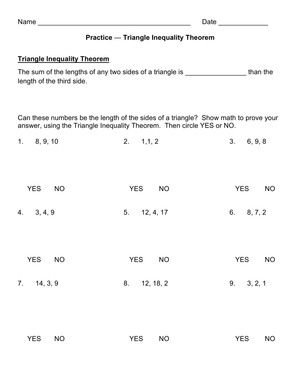
Yes. One worksheet focuses on the Triangle Inequality Theorem, requiring students to determine whether a given set of three side lengths can form a triangle and then find the range of possible values for a missing third side. This concept sits outside the congruence-and-similarity arc but appears on most state geometry assessments and is worth its own dedicated practice rather than being folded into a general review.
Are answer keys included?
Answer keys are included with each 9th grade triangles worksheets resource in the set. The proof answer keys show one valid proof structure — teachers should note that most triangle proofs accept more than one correct sequence of steps. The keys provide a clear reference model, not the only acceptable model, and teachers who build class discussions around student-generated proof variations can use the key as a starting point rather than a final word.














 Interactive Worksheet Maker
 Quiz Maker
 Word Search Maker
 Crossword Puzzle Maker
 Word Scramble Generator
 Sentence Scramble Generator
 Handwriting Worksheet Generator
 Name Tracing Generator
 Fill In The Blank Generator




 BACK TOSCHOOL