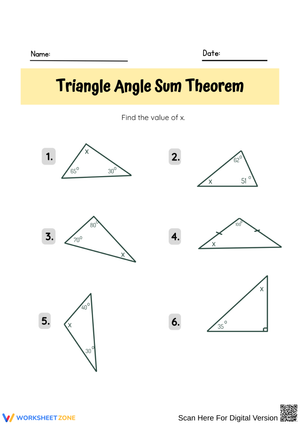
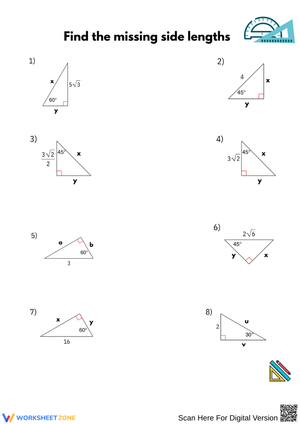
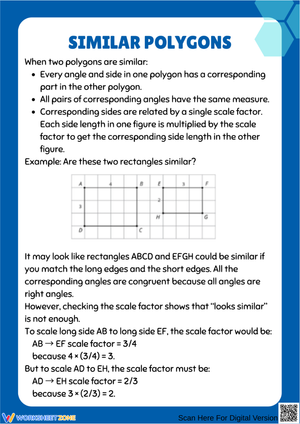
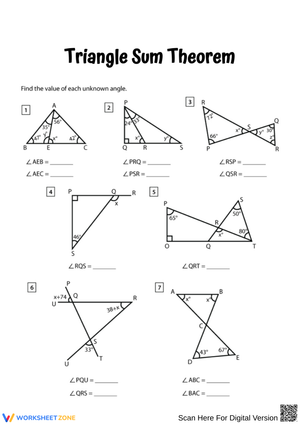
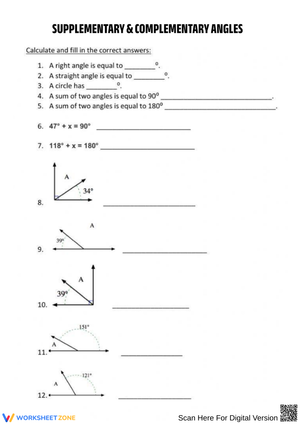
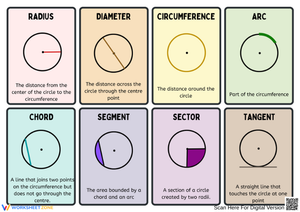
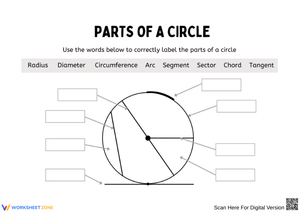
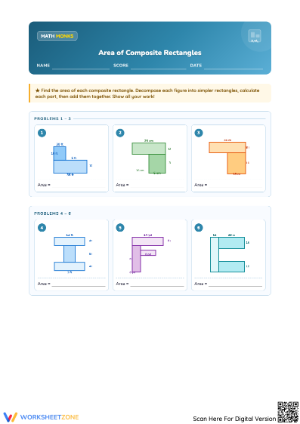
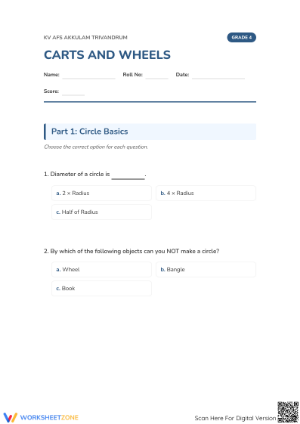
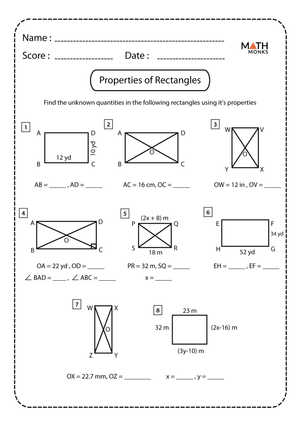
These 9th grade shapes printable worksheets move students from labeling triangles and quadrilaterals — something most of them can do by middle school — into the analytic work that defines freshman geometry: writing coordinate proofs, applying congruence postulates, and calculating surface area and volume for composite solids. Each worksheet targets a specific skill rather than surveying an entire unit, which makes them easier to slot into the week without disrupting your pacing.
The Geometry Skills These Worksheets Build
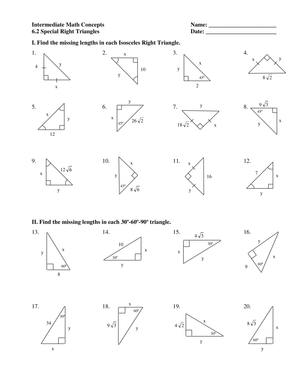
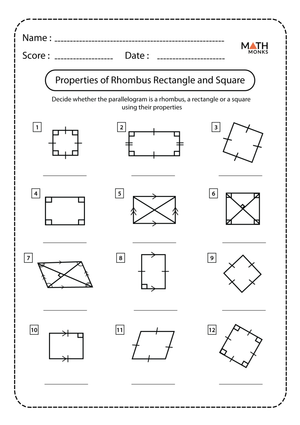
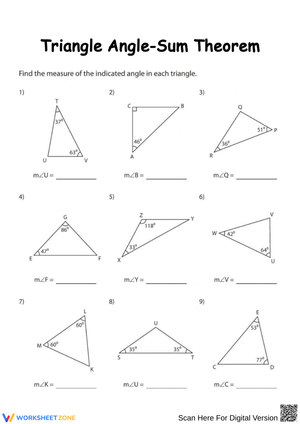
Polygon work begins with interior and exterior angle relationships. Students apply the formula (n minus 2) times 180 to find angle sums, then solve for unknown variable measures in non-regular polygons — the type of problem that consistently reappears on cumulative assessments. The quadrilateral strand moves quickly into coordinate geometry: students verify that a given set of vertices produces a parallelogram, a rectangle, or a rhombus by calculating slopes and distances rather than relying on visual appearance alone.
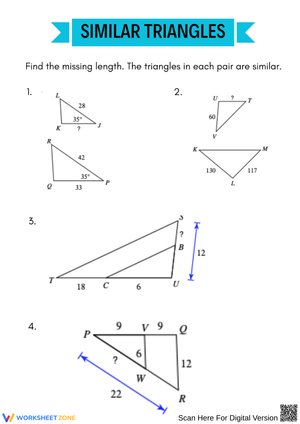
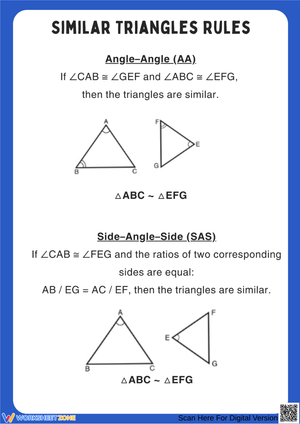
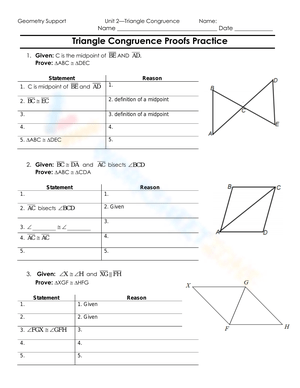
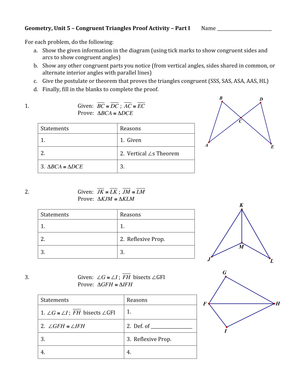
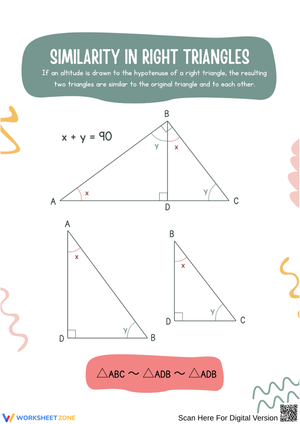
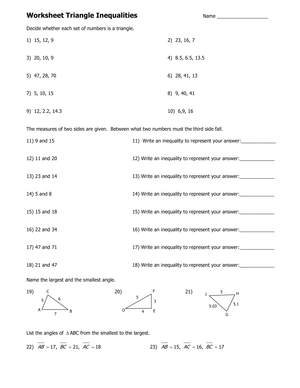
Triangle congruence gets the most sustained treatment across the set. Each worksheet presents labeled diagrams and asks students to identify the appropriate postulate — SSS, SAS, ASA, AAS, or HL — then write the congruence statement in correct notation. Fill-in-the-blank two-column proofs give students the logical structure before they're expected to generate every reason independently. Similarity worksheets build on the same proportional reasoning: students set up ratios across corresponding sides, find scale factors between dilated figures, and solve indirect measurement problems using shadow lengths.
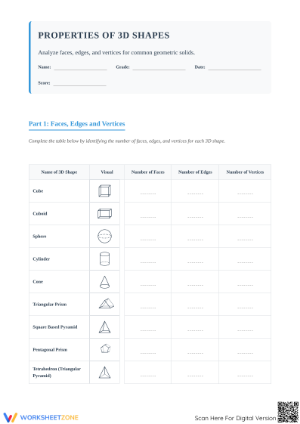
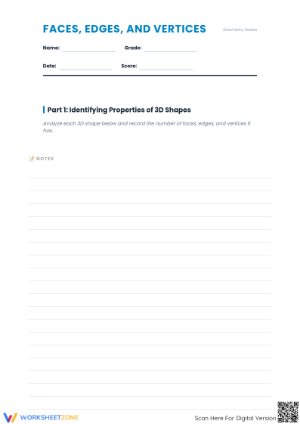
For three-dimensional shapes, several worksheets present nets before any formula work appears. Students trace which faces fold into which positions, building the spatial picture that makes surface area calculations meaningful. Composite solid problems require students to decompose the figure, calculate volume for each component separately, then combine results — which demands both formula recall and organizational discipline.
Student Error Patterns Worth Anticipating
The most persistent error in polygon angle work is applying the interior angle sum formula and then stopping. Students correctly calculate 720 degrees for a hexagon and record that as their final answer for a single interior angle, bypassing the division step entirely. The error is easy to miss on a quick scan because the setup looks right — the mistake happens at the very end.
In congruence proofs, students routinely write "SSA" as a justification — a postulate that does not exist. They've absorbed the pattern of three-letter abbreviations without understanding why SSA fails (the ambiguous case produces two possible triangles, not one). 9th grade shapes printable worksheets that include a deliberately flawed proof for error analysis are particularly effective here: handing students a completed proof with SSA as a reason and asking them to explain why the argument breaks down produces stronger retention than a direct explanation from the front of the room.
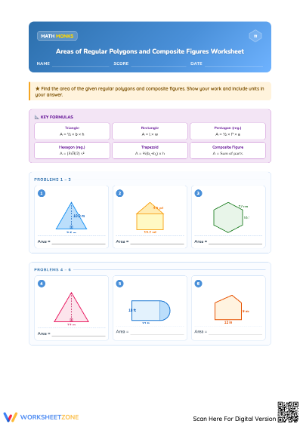
Volume problems with composite solids generate a setup error more often than you'd expect. Students calculate the volume of both components and subtract when they should add — or vice versa. A cylinder with a cone resting on top is not the same calculation as a cylinder with a conical cavity removed from its interior, and students working quickly confuse the two without careful diagram reading. This is one of the harder errors to catch with a formula check alone.
Standard Alignment
These worksheets address the High School Geometry strand of the Common Core State Standards. The polygon and quadrilateral content connects to HSG.CO.C.11 (proving theorems about parallelograms) and HSG.GPE.B.4 (using coordinates to prove geometric theorems algebraically). Triangle congruence and similarity align with HSG.CO.B.8 and HSG.SRT.A.2 through HSG.SRT.A.3. The three-dimensional content falls under HSG.GMD.A.3 and HSG.MG.A.1.
In practical terms, most of these standards fall in a first-semester freshman geometry course, with 3D solids typically addressed in the second semester. Teachers using a non-CCSS state framework will find the content maps cleanly onto equivalent standards, since polygon properties, triangle congruence, and volume formulas are universal to high school geometry curricula regardless of which standards document a district follows.
How to Build These Worksheets Into Your Weekly Lesson Plans
The most reliable placement is the warm-up slot. A single problem from a congruence worksheet takes five to seven minutes and activates prior knowledge before new instruction begins. After a unit test, pulling a review worksheet for the first ten minutes of the following class helps interrupt the typical post-assessment shutdown — the day students have mentally moved on before the teacher has.
Error analysis deserves a dedicated slot. After students complete a worksheet independently, pair them and have each partner identify the other's mistakes before you collect anything. The conversation that follows — "you didn't divide by six after you got the angle sum" — is more effective than a scored paper returned two days later. 9th grade shapes printable worksheets with multi-step problems are especially suited to this approach, because errors tend to appear at different steps for different students, which makes the partner exchange genuinely instructive rather than redundant.
For sub plans, the worksheets require no additional setup beyond the instructions printed on each one. A composite solids worksheet paired with a formula reference sheet will occupy most of a class period without any verbal explanation from a substitute.
Adjusting the Set for a Range of Geometry Learners
For students still working on basic formula application, the 3D worksheets that begin with nets are the right entry point — students trace and label before numbers appear. Pairing these with a formula reference chart removes the memory load and keeps the focus on the calculation sequence itself.
Students who move through standard problems quickly benefit from the coordinate proof worksheets, which require more algebraic fluency than the diagram-only tasks. You can push further by asking these students to write a general proof — proving the property for any parallelogram using variable vertex coordinates — rather than working from a specific numerical example.
For students in intervention or working toward retake credit, sorting the resources by skill and working through them in sequence over multiple sessions is more effective than mixing topics. Organized this way, the worksheets function less like review packets and more like a diagnostic-driven practice sequence.
Frequently Asked Questions
Do these worksheets include answer keys?
Yes. Each worksheet includes a detailed answer key that shows the full solution process for multi-step problems — not just final answers. For volume and surface area calculations, the key shows each substitution step, which helps students locate exactly where their work diverged from a correct path.
What prerequisite knowledge do students need before the congruence proof worksheets?
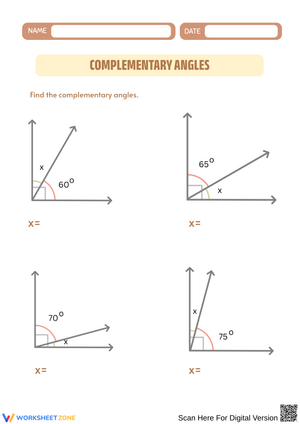
Students should be comfortable with basic angle relationships — supplementary, complementary, and vertical angles — and should have been introduced to the two-column proof format before working through the congruence strand. The fill-in-the-blank versions work well as a first structured exposure to proof writing, but students who have never seen a two-column proof will spend most of their time deciphering the format rather than reasoning about the geometry.
Are these worksheets appropriate for credit recovery or summer coursework?
Yes. Teachers working with 9th grade shapes printable worksheets in a recovery context often assign them in the same sequence as the original course — polygons, then triangles, then 3D solids — and use the answer keys to guide students through self-correction before moving on. The skill-specific organization makes it straightforward to identify and target gaps without reassigning entire units.
Can these be used alongside dynamic geometry software?
They work either way. The diagrams are clear enough to print without any digital tool, and students who use Desmos Geometry or GeoGebra for on-screen exploration can use the worksheets as a bridge between that exploration and pencil-and-paper proof writing. Neither approach depends on the other.














 Interactive Worksheet Maker
 Quiz Maker
 Word Search Maker
 Crossword Puzzle Maker
 Word Scramble Generator
 Sentence Scramble Generator
 Handwriting Worksheet Generator
 Name Tracing Generator
 Fill In The Blank Generator




 BACK TOSCHOOL