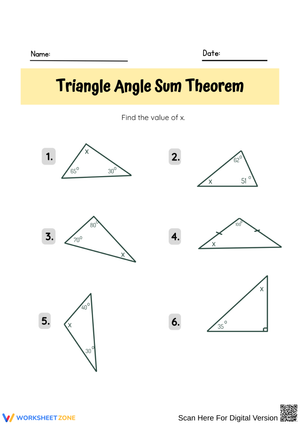
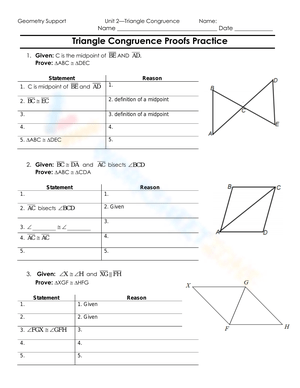
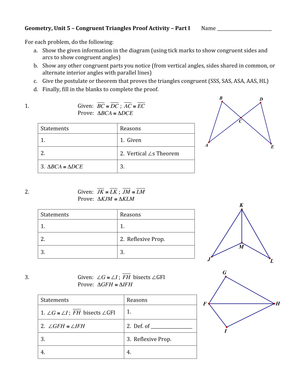
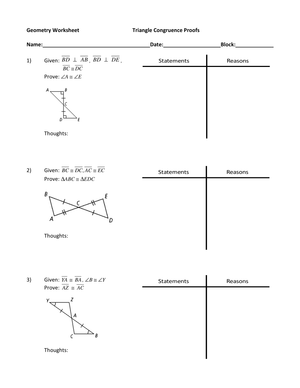
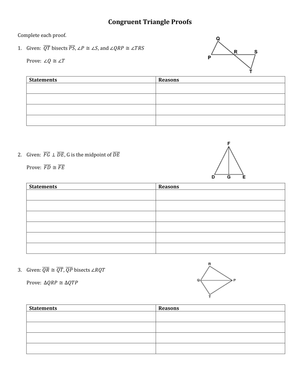
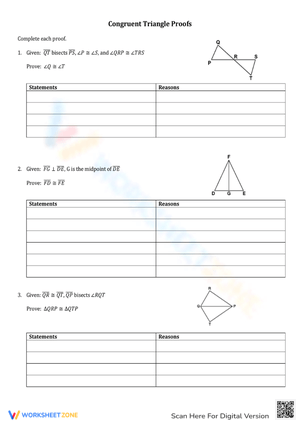
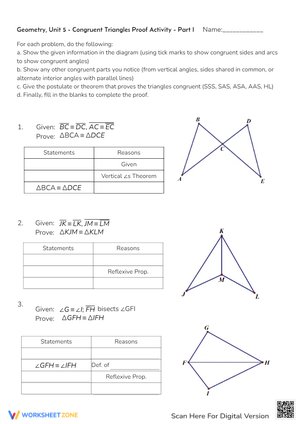
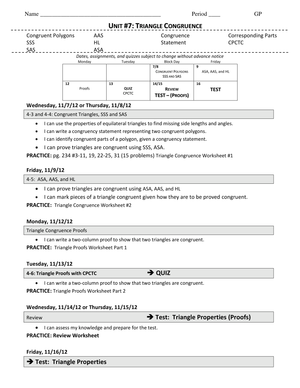
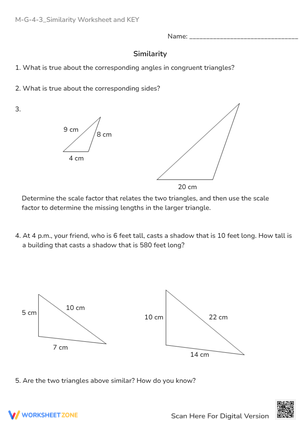
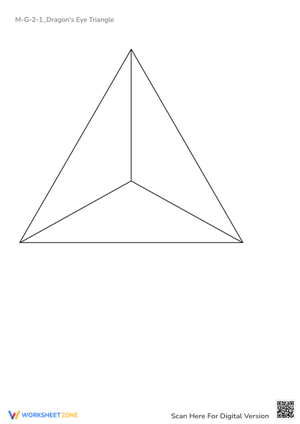
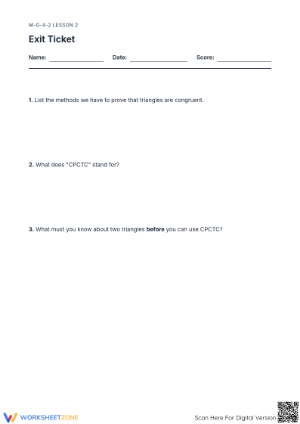
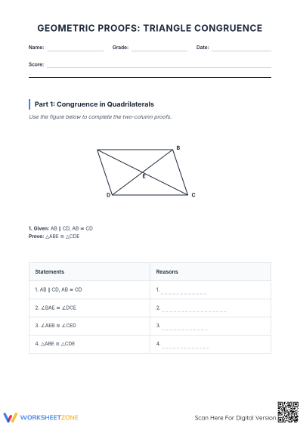
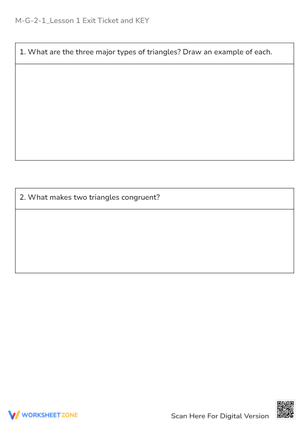
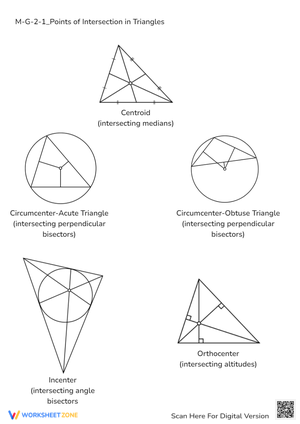
These triangle congruence proofs printable worksheets for 9th grade cover the full arc of formal proof writing — from identifying which congruence postulate applies to a labeled diagram all the way through constructing an independent two-column argument with no hints provided. Teachers get a set they can pull from at the beginning of the unit, return to mid-unit for reinforcement, and use again when students prepare for cumulative assessments.
What the Set Asks Students to Do
The progression across each worksheet mirrors the cognitive demand curve most geometry teachers recognize. Early worksheets ask students to mark congruent parts on a diagram and name the postulate — SSS, SAS, ASA, AAS, or HL — before writing a single reason. This separates the visual analysis task from the logical writing task, which matters because students who conflate them tend to stall at step one.
From there, the worksheets move into fill-in-the-blank two-column proofs where the statements column is completed and students supply only the reasons. Then the reverse: reasons are given, statements are blank. Both versions are necessary. Students who can supply reasons but not statements often lack the underlying geometric vocabulary, while students who can write statements but not reasons are guessing at logic without understanding why each step follows from the last.
The final tier presents complete diagrams with given information and a prove statement, leaving every step to the student. Several of these involve overlapping triangles, where identifying which parts are shared requires careful reading of the figure rather than surface-level pattern matching.
Student Errors These Worksheets Surface Early
The most persistent error in 9th-grade proof writing is the SSA attempt. Students see two sides marked congruent and an angle marked congruent and write "SAS" — but the angle isn't between the two sides. The included-angle distinction is what separates SAS from SSA, and SSA proves nothing. Every teacher who has graded a full class set of proofs has seen this error on at least a third of the papers. Each worksheet that targets SAS includes non-examples specifically to force students to check whether the angle is included before applying the postulate.
A second consistent gap is the Reflexive Property. When two triangles share a side — say, diagonal AC in a quadrilateral split into triangles ABC and ACD — students frequently reach for a congruence postulate without ever stating that AC is congruent to itself. The proof is technically incomplete without that step, but students skip it because it seems obvious. Requiring them to write "Reflexive Property of Congruence" as an explicit reason builds the habit of accounting for every part the proof uses.
Vocabulary errors drive more proof failures than logic failures do. Students who write "bisects" when they mean "is perpendicular to," or who confuse a midpoint definition with the Segment Addition Postulate, lose credit not because they can't reason geometrically but because they don't have precise language. These worksheets surface that gap during practice, when there is still time to close it before a unit test.
Fitting These Worksheets Into Your Geometry Unit
The fill-in-the-blank worksheets work well during the initial instruction phase — use them the day after you model a two-column proof on the board, while the format is still fresh. Students who face a blank proof grid the morning after one model quickly discover they don't remember what counts as a valid reason. A guided worksheet that day prevents that confusion from calcifying into bad habits before the next class.
Reserve the independent proof worksheets for the middle of the week, not Fridays. Students need to be able to ask questions immediately after completing them. A Friday warm-up with an identification-only worksheet — name the postulate, no full proof required — works well for low-stakes retrieval practice. The triangle congruence proofs printable worksheets for 9th grade in this set label difficulty level clearly, so teachers can assign the right worksheet to the right moment in the unit without sorting through the entire set before every lesson.
Color-coding is worth building into the routine from the start. Give students three colored pencils and ask them to mark the first pair of congruent parts in red, the second in blue, and the third in green before writing a single statement. Students who color-code their diagrams are far less likely to claim SSS when the figure only shows two congruent sides and one congruent angle.
Standard Alignment
These worksheets address CCSS.MATH.CONTENT.HSG.CO.B.8: "Explain how the criteria for triangle congruence (ASA, SAS, and SSS) follow from the definition of congruence in terms of rigid motions." At the classroom level, this standard asks students to treat congruence postulates not as rules to memorize but as logical consequences of what it means for a rigid motion to preserve distance and angle measure. The worksheets reflect that framing — the reasons column in every two-column proof asks students to articulate why each step follows, which is precisely what the standard's emphasis on explanation requires.
Reaching Different Skill Levels With the Same Set
For students who are not yet fluent with two-column proof format, adding a printed reasons bank to the bottom of each worksheet removes the retrieval burden and lets them focus on logical sequencing instead. The bank might include eight to ten valid reasons — Reflexive Property, Vertical Angles Theorem, definition of midpoint, definition of angle bisector — alongside three or four distractors. Choosing the correct reason from a list is a more accessible task than generating it from memory, and it still requires genuine understanding of what each reason means in context.
Students who move quickly through the standard proofs respond well to the overlapping-triangle worksheets where no congruency marks are pre-drawn. They must read the given information, mark the diagram themselves, and decide on a proof strategy before writing anything. That additional step — translating written givens into a marked figure — is where the triangle congruence proofs printable worksheets for 9th grade in this set offer the most meaningful stretch for advanced learners.
For students who struggle with the written language of proofs, pairing worksheet practice with a sentence-frame reference card helps considerably. Frames like "Because M is the midpoint of AB, we know that AM ≅ MB" translate the geometric reasoning into a fill-in format that reduces writing anxiety without removing the mathematical thinking.
Frequently Asked Questions
Why doesn't SSA prove triangles congruent?
SSA — two sides and a non-included angle — fails because the same two side lengths and a non-included angle can produce two geometrically different triangles. This is the ambiguous case. Teachers often demonstrate it with a compass and straightedge construction: fix two side lengths and the non-included angle and show students that the third side can swing into two valid positions. Including SSA diagrams as non-examples in the worksheets gives students practice recognizing and rejecting this combination before it causes errors on assessments.
When in the unit should I introduce CPCTC?
Once students write a complete two-column proof ending with a congruence postulate with some consistency, CPCTC (Corresponding Parts of Congruent Triangles are Congruent) extends that logic naturally. A proof concluding "triangle ABC ≅ triangle DEF" can then justify individual part claims — that angle A ≅ angle D, for example — by citing CPCTC as the reason. Introduce it the lesson after students demonstrate reliable success on independent proofs, not before, or CPCTC becomes a phrase students invoke without understanding what it actually licenses.
How many steps should a beginning proof have?
Most introductory two-column proofs at this level run four to six steps: two or three given statements, one or two derived steps using properties like the Reflexive Property or the Vertical Angles Theorem, and a final congruence statement. Proofs requiring more than eight steps usually involve overlapping triangles or multiple property applications. Telling students the expected step count before they begin removes one source of anxiety without revealing any of the logic.
Do the worksheets include answer keys?
Each worksheet includes a completed two-column proof in the answer key. For fill-in-the-blank formats, the key shows both the expected statement and the expected reason, with brief notes where more than one valid reason could apply. The triangle congruence proofs printable worksheets for 9th grade in this set write their answer keys the way a teacher would actually explain the proof aloud — not just the minimum acceptable response, but the reasoning behind each step.














 Interactive Worksheet Maker
 Quiz Maker
 Word Search Maker
 Crossword Puzzle Maker
 Word Scramble Generator
 Sentence Scramble Generator
 Handwriting Worksheet Generator
 Name Tracing Generator
 Fill In The Blank Generator




 BACK TOSCHOOL