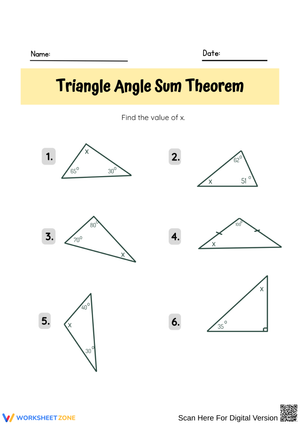
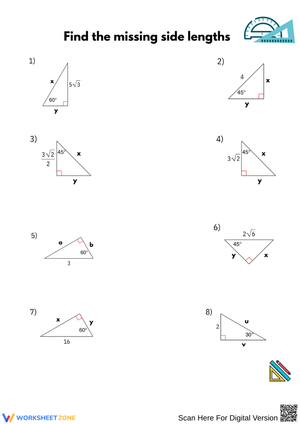
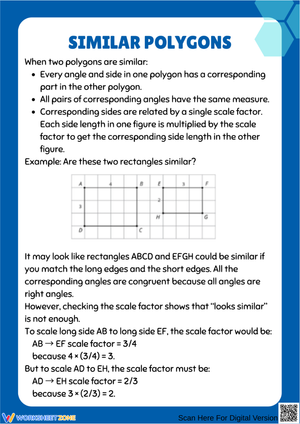
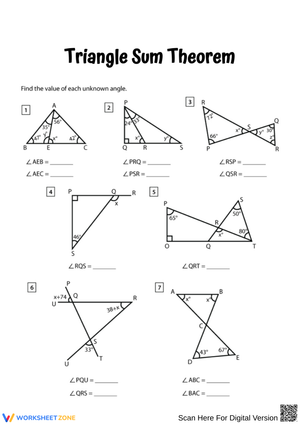
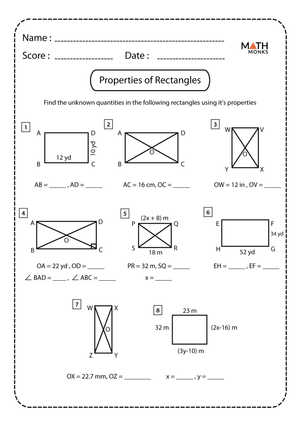
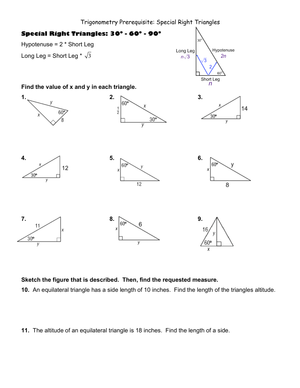
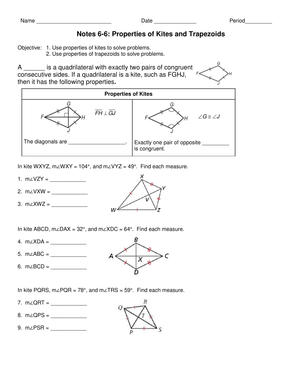
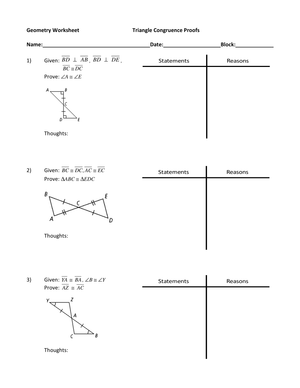
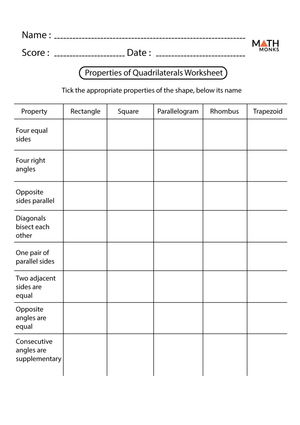
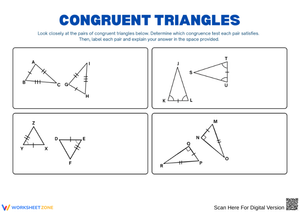
These 9th grade 2d shapes pdf worksheets give geometry teachers targeted practice materials for the exact moment in the year when shape identification gives way to formal reasoning — coordinate proofs, transformation sequences, and the algebraic logic that governs polygon relationships. Each worksheet focuses on one skill cluster rather than mixing problem types, which keeps students' thinking clear during a unit where cognitive overload is a real risk.
Content and Skills Each Worksheet Builds
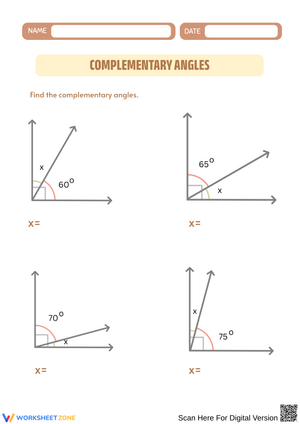
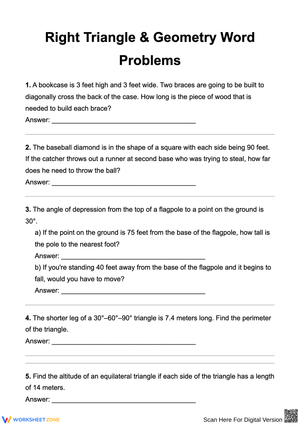
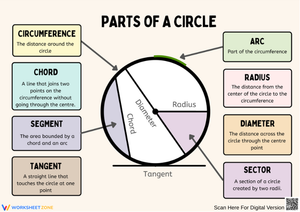
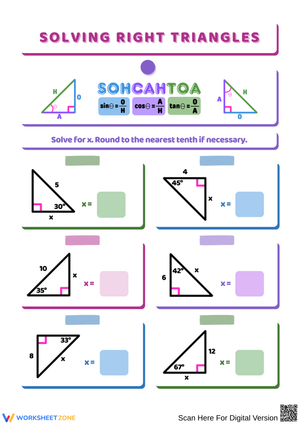
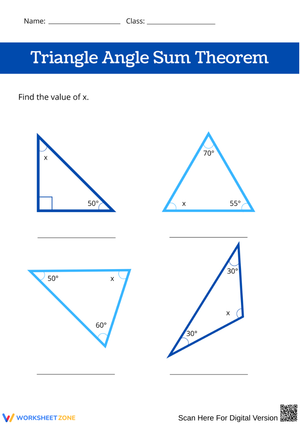
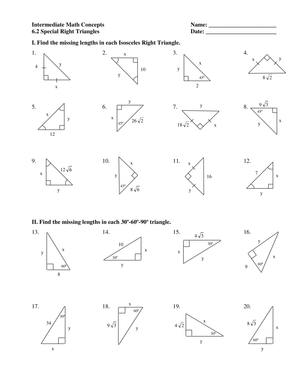
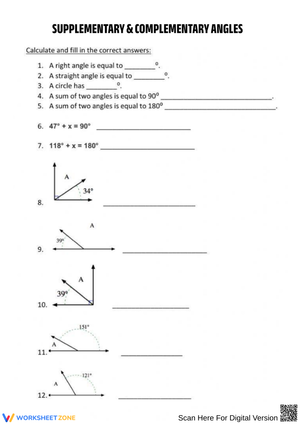
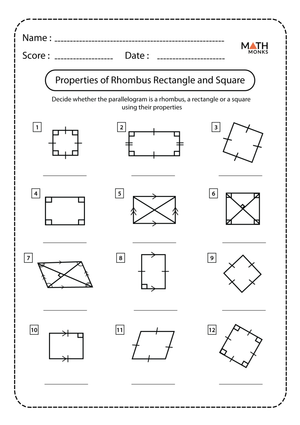
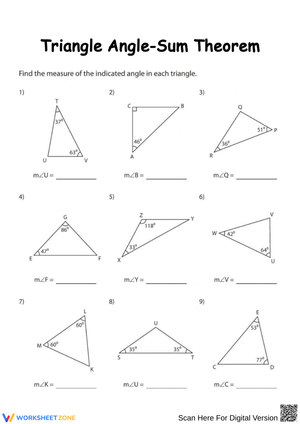
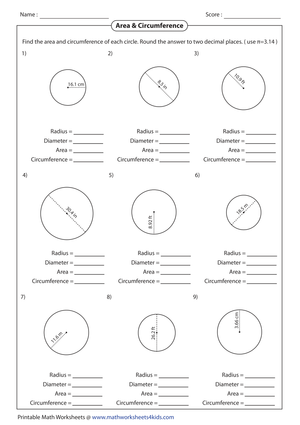
The set works through the major strands of ninth-grade two-dimensional geometry in sequence. Students practice finding unknown angle measures in polygons by applying the interior angle sum formula — not just reciting it, but setting up and solving equations when several angles are expressed algebraically. Other worksheets ask students to classify quadrilaterals on a coordinate plane by using slope to test parallelism and perpendicularity, then the distance formula to compare side lengths. Composite figure problems require decomposing irregular shapes into rectangles, triangles, and semicircles before calculating total area — exactly the kind of multi-step problem that appears on most state end-of-course assessments.
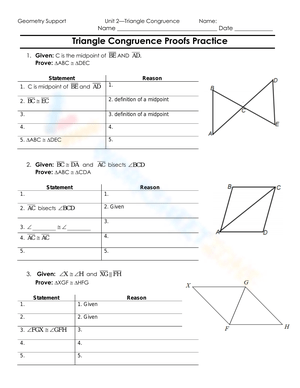
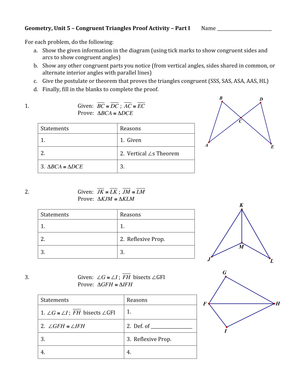
The 9th grade 2d shapes pdf worksheets covering transformations draw a consistent and important distinction: rigid motions — translations, rotations, and reflections — preserve side lengths and angle measures, producing congruent images, while dilations produce similar figures where side lengths scale proportionally but angles remain fixed. Students also work through guided two-column proofs, filling in missing statements or reasons before attempting proofs independently, which makes the logic of formal argument visible before students are expected to generate it from scratch.
Where Each Worksheet Fits Best in a Geometry Unit
The most effective use pattern treats each worksheet as a focused practice block rather than a full lesson. The polygon angle worksheets work well as Monday warm-up problems — a short, structured task that helps students re-enter the material without a cold start on a day when motivation tends to lag. The coordinate proof worksheets pair well with direct instruction days: give students fifteen minutes to attempt one proof immediately after the lesson's example problems, while the class is still in thinking mode, then debrief together before releasing students to independent work.
Transformation worksheets are worth saving for the day after students have used dynamic geometry software to visualize rotation and reflection on screen. Having students translate what they saw in the software into coordinate notation on paper cements the connection between the visual and the algebraic — that handoff tends to be where the understanding actually consolidates. Two-column proof worksheets, because they show proof structure explicitly, are strong candidates for the period before a unit test, when students benefit from reinforcing logical structure rather than encountering new problem types.
Error Patterns Worth Catching Before the Unit Test
The interior angle sum formula produces a specific and predictable error. Students memorize (n−2)×180 correctly but then treat the result as though every angle in the polygon equals that total divided by n — even when the polygon is irregular and the angles are clearly different sizes. On a worksheet where three angles are given numerically and a fourth is expressed as (3x + 15)°, a significant number of students divide the total sum equally across all four angles rather than subtracting the known angles and solving for x. Catching this during worksheet review, before the unit test, prevents that reasoning from calcifying into a test-day habit.
In coordinate geometry, students who calculate slope correctly often earn partial credit on classification problems because they prove only half of what's required. A student asked to show that a quadrilateral is a rectangle will verify that opposite sides are parallel and then stop — skipping the check that adjacent sides are perpendicular. The worksheet format, where each step is visible in sequence, makes it straightforward to annotate this kind of incomplete argument and discuss it during class review without waiting for a test to surface the gap.
Transformation problems generate their own reliable sign errors. When rotating a figure 90° counterclockwise, students frequently apply the rule (x, y) → (−y, x) correctly to the first vertex, then make sign mistakes on the remaining vertices as the work gets messier on the page. A quick peer-check routine — where one student performs the transformation and another verifies each resulting coordinate pair — catches these errors before they become habitual.
Standard Alignment
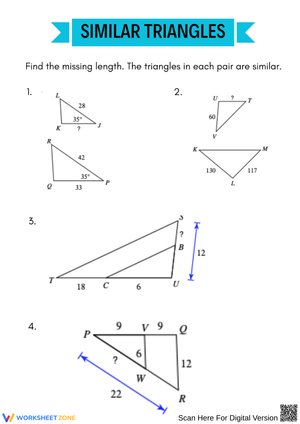
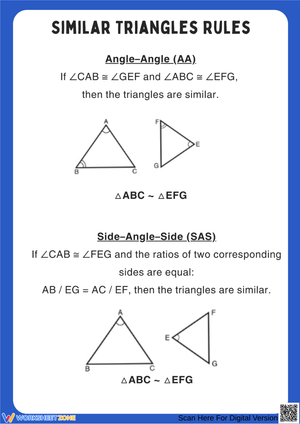
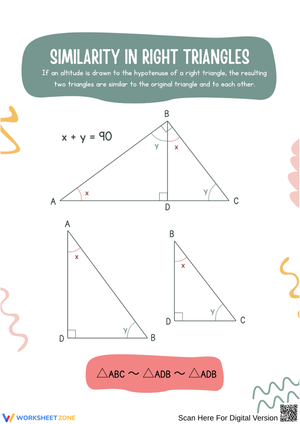
These worksheets address standards across the Common Core State Standards High School Geometry domain. Polygon angle relationships connect to HSG-CO.C.10 and the broader properties cluster in HSG-CO.A. Coordinate geometry worksheets are built around HSG-GPE.B.4, which asks students to use slope, distance, and midpoint as proof tools rather than as isolated calculation procedures — a key conceptual shift at this grade level. Transformation worksheets address HSG-CO.A.2–5, covering rigid motion definitions and the formal connection between transformations and congruence. Similarity and dilation work falls under HSG-SRT.A.1–3.
Teachers in states with modified or independent standards frameworks will find these strands map closely to equivalent state-level geometry expectations. Verifying specific code alignment against your current state standards document is worth the few minutes it takes before distributing the worksheets to students.
Adjusting the Set for Mixed-Ability Classrooms
The 9th grade 2d shapes pdf worksheets in this set span a range of entry points without needing to be rewritten for different groups. Students with strong middle school preparation can move directly into the coordinate proof and composite figure worksheets. For students who need more of a foundation before algebraic geometry, the polygon angle worksheets that use integer angle values — rather than expressions with variables — provide a clear entry point that separates geometric reasoning from algebraic fluency so neither skill undermines the other.
For students working above grade level, any coordinate geometry worksheet gains in difficulty when you ask them to find a missing vertex given only three of the four coordinates, requiring them to reason backward from the figure's required properties. That added constraint turns a classification task into something closer to an open investigation. On the other end, guided two-column proof worksheets — where half the reasons are already filled in — give students who freeze when facing a blank proof column a concrete foothold into the structure of logical argument without removing the thinking entirely.
Frequently Asked Questions
How much class time does a typical worksheet in the set require?
Most worksheets run 15–25 minutes for students working at grade level, which makes them sized for a focused practice block rather than a full class period. Composite figure worksheets can run closer to 30 minutes when students encounter unfamiliar shape combinations and need time to plan their decomposition before calculating. Two-column proof worksheets vary the most: a guided proof with several blanks might take 10–12 minutes, while an independent proof involving a more complex figure may use most of the remaining period.
Are these resources useful for state end-of-course exam preparation?
The 9th grade 2d shapes pdf worksheets in this set cover the two-dimensional geometry content that appears with high frequency on state end-of-course geometry assessments: polygon angle relationships, coordinate classification of quadrilaterals, composite figure area, and transformation notation. The problem formats — which call for numerical answers alongside brief written justifications — mirror what most state geometry tests require. Using them during the weeks before an assessment as targeted, topic-by-topic review produces more durable results than a broad sweep through all geometry content at once.
Do the answer keys show full worked solutions or just final answers?
Answer keys include step-by-step worked solutions — which matters most for the coordinate proof and two-column proof worksheets, where the process carries as much instructional weight as the result. For polygon angle problems where students set up and solve an equation, the key shows the equation, the algebraic steps, and the final angle measure. That level of detail makes the keys useful not just for checking answers but for pinpointing exactly where a student's reasoning separated from the correct path during individual or small-group review.
Can these worksheets work in a remote or hybrid setting?
The PDF format makes distribution through any learning management system straightforward. Students can annotate the worksheets digitally using standard tools in Google Drive or Microsoft OneDrive, or print them, complete the work by hand, and upload a photo. For coordinate geometry and proof worksheets especially, many teachers find that students who annotate by hand — even within a digital submission workflow — produce more careful, legible reasoning than those working entirely on-screen, likely because the spatial layout of the problems rewards deliberate, slower writing.














 Interactive Worksheet Maker
 Quiz Maker
 Word Search Maker
 Crossword Puzzle Maker
 Word Scramble Generator
 Sentence Scramble Generator
 Handwriting Worksheet Generator
 Name Tracing Generator
 Fill In The Blank Generator




 BACK TOSCHOOL