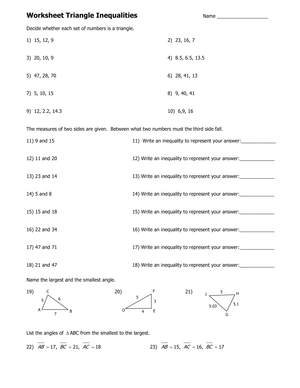
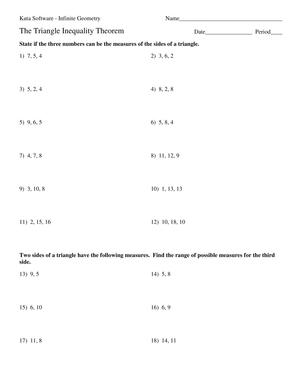
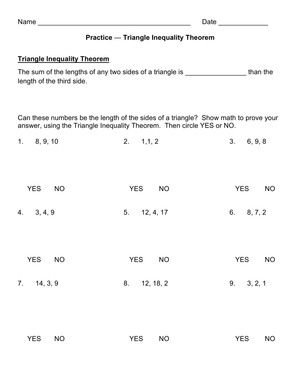
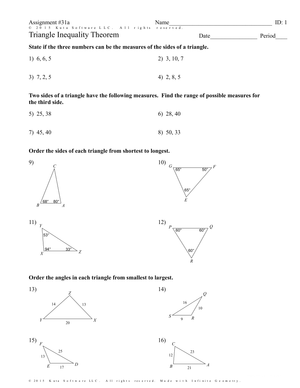
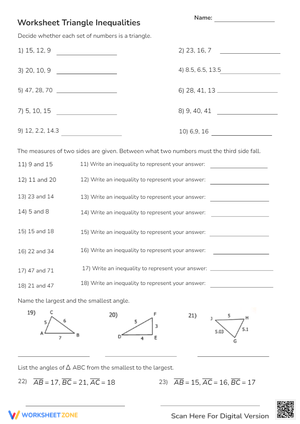
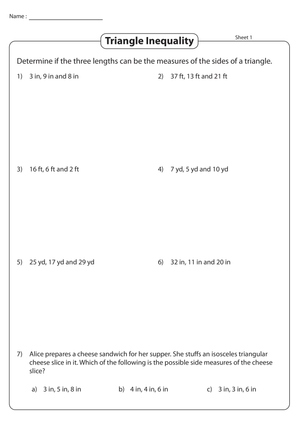
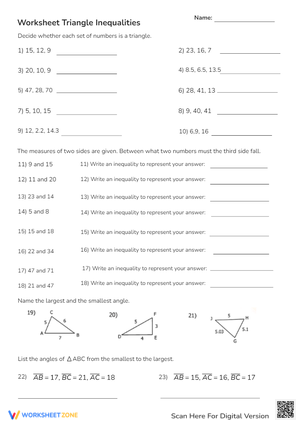
These 9th grade triangle inequality theorem pdf worksheets cover five distinct problem types, giving geometry teachers a set of resources that holds up across an entire unit rather than a single lesson. Students can recite the rule—the sum of any two sides must be greater than the third—after about five minutes of instruction. The harder work is applying that rule to missing-side range problems, to side lengths written as linear expressions, and to angle-ordering tasks. That's where structured, repeatable practice matters.
The Five Problem Types Across the Set
Each worksheet targets a specific application of the theorem, so teachers can assign them sequentially or pull individual worksheets to address a particular skill gap.
- Feasibility checks: Students receive three numerical values and decide whether those lengths can form a triangle. The shortcut—add the two smallest values and compare to the largest—comes quickly, but the worksheets push students to write out all three inequality conditions so the logic becomes explicit rather than purely intuitive.
- Range of the missing third side: Given two known side lengths, students determine the interval the unknown side must fall within. The answer takes the form of a compound inequality: the unknown must be greater than the absolute difference of the two known sides and less than their sum.
- Algebraic side lengths: Several worksheets replace numerical side lengths with linear expressions, requiring students to set up and solve compound inequalities with a variable. These problems integrate the geometry concept directly into algebra practice without treating the two units as separate tracks.
- Degenerate triangle identification: Students decide whether a given set of measurements produces a valid triangle, a degenerate case, or an impossibility. The degenerate case—where the sum of two sides equals exactly the third—deserves its own practice because students consistently treat it as a valid triangle.
- Angle and side ordering: This problem type connects the inequality theorem to the broader side-angle relationship. Students order angles from smallest to largest given side lengths, or identify the longest and shortest sides given angle measures—a bridge from the theorem into the wider triangle unit.
Errors Worth Catching Before They Calcify
The degenerate triangle case produces the most consistent student error in this topic. When given sides of 3, 4, and 7, most students correctly compute 3 plus 4 and get 7. Then they mark the triangle valid—because in their reasoning, "not less than" reads as acceptable. They have not internalized that the theorem demands a strict greater-than relationship, not greater-than-or-equal-to. The feasibility worksheets address this directly by including degenerate cases in every problem set and requiring students to label the result explicitly: valid triangle, degenerate, or impossible. That labeling step is what forces the distinction rather than leaving it implicit.
On the algebraic worksheets, the most common failure is checking only one of the three required inequalities. A student given sides of 5, 10, and (2x + 3) will typically write "5 plus 10 is greater than 2x + 3" and solve from there, ignoring the two conditions that put the variable expression on the left side. This produces an incomplete solution and, in certain configurations, allows values that would make the expression negative. Each algebraic worksheet is structured so students list all three inequality conditions before solving any of them—a small format choice that closes this gap without requiring additional explanation from the teacher.
Standard Alignment
These worksheets address CCSS.MATH.CONTENT.HSG-CO.C.10: "Prove theorems about triangles." In most 9th grade geometry sequences, this standard lands during the triangle unit—after students have worked through angle sum properties but before formal congruence proofs begin. The triangle inequality theorem occupies a useful instructional position there: accessible enough to give students early traction in the unit, but extendable into algebraic territory that reveals whether students can reason logically across two mathematical domains at once. The feasibility and algebraic problem types also align with the NCTM process standards for reasoning and proof, since both require students to justify why a set of values does or does not satisfy all three conditions simultaneously.
Fitting These Worksheets Into Your Lesson Plan
The feasibility-check worksheet works well as a Monday warm-up following initial instruction on the theorem. Eight to ten minutes, a quick whole-class review, then move into the day's main lesson. The fast feedback loop matters here—students who confuse the strict inequality with a non-strict one need that correction before it migrates into their algebraic work later in the week.
Save the algebraic worksheets for after students have had at least one full lesson on compound inequalities, or run them alongside a targeted review of that skill. Assigning an algebraic worksheet the night before a unit quiz functions as both practice and a formative check. The kinds of errors students make on those problems tell you exactly which misconceptions need the last ten minutes of class before the assessment.
Because the 9th grade triangle inequality theorem pdf worksheets are formatted with clean problem numbering and clear workspace, any five-question subset pulls out easily as an exit ticket. The answer keys show the full compound inequality setup rather than just the final answer, which makes it faster to identify exactly where in the process a student's work went wrong.
Adjusting the Set for a Range of Learners
Students who are still shaky on compound inequalities will struggle with the algebraic worksheets before they struggle with the geometry. For those students, begin with the numerical feasibility and range worksheets until the geometric logic is solid, then reintroduce the algebraic problems once compound inequalities have been reviewed. This sequencing helps identify which difficulty is actually the obstacle—the theorem itself or the algebra wrapped around it.
Students who move through the numerical problems quickly find genuine challenge in the angle-ordering worksheet and in any extension involving variable expressions on two or more sides simultaneously. Finding the range of a variable such that all three inequality conditions hold at once—and then intersecting those solution sets—is legitimately demanding at this level. For students who need additional support, a small reference card listing all three conditions (a plus b is greater than c, a plus c is greater than b, b plus c is greater than a) keeps working memory focused on applying the theorem rather than reconstructing it from scratch on every problem.
Frequently Asked Questions
How do you quickly check whether three side lengths can form a triangle?
Add the two smallest side lengths and compare the result to the largest. If that sum is strictly greater than the largest side, the triangle is valid. If the sum equals the largest side, the shape is degenerate—a straight line rather than a closed polygon. If the sum is less than the largest side, a triangle is impossible. Writing all three conditions is still recommended during instruction so students internalize the full logic rather than relying on the shortcut alone.
What is the range formula for a missing third side?
Given two known side lengths a and b, the unknown third side x must satisfy a compound inequality. The absolute difference of the two known sides must be less than x, and x must be less than the sum of the two known sides. In plain terms: the third side must be greater than how far apart a and b are, and less than how large they would be if combined.
Can a triangle have sides of 3, 4, and 7?
No. The sum of 3 and 4 equals 7, so the required condition—that 7 be strictly greater than 7—fails. Those three segments produce a degenerate case: the pieces lie flat against each other in a straight line rather than closing into a polygon. This specific example appears frequently in the 9th grade triangle inequality theorem pdf worksheets because the degenerate case is what students most reliably misjudge when they first encounter it on assessments.
Are these worksheets useful for cumulative review or test prep?
The set works well for targeted review because each worksheet isolates a different application of the theorem. Teachers preparing students for a geometry assessment find the 9th grade triangle inequality theorem pdf worksheets practical for that purpose—the algebraic and angle-ordering problem types represent the higher-complexity items most likely to appear on standardized tests, while the feasibility worksheets reinforce the foundational reasoning those harder problems depend on.














 Interactive Worksheet Maker
 Quiz Maker
 Word Search Maker
 Crossword Puzzle Maker
 Word Scramble Generator
 Sentence Scramble Generator
 Handwriting Worksheet Generator
 Name Tracing Generator
 Fill In The Blank Generator




 BACK TOSCHOOL