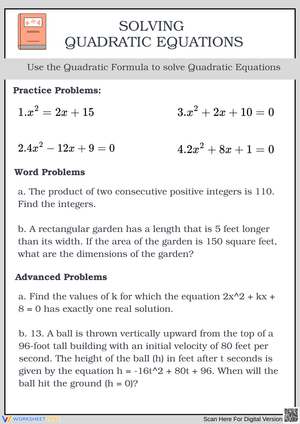
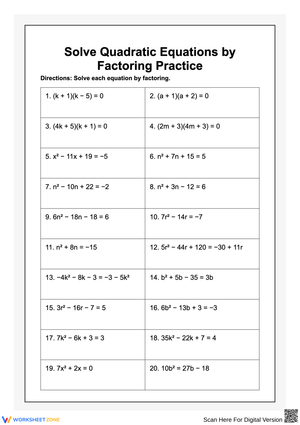
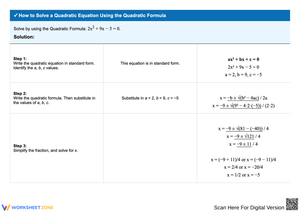
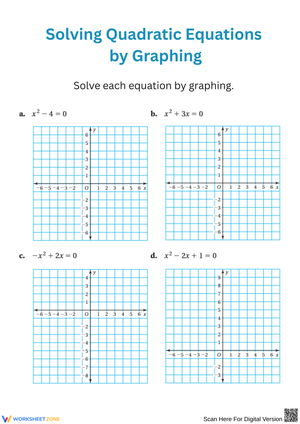
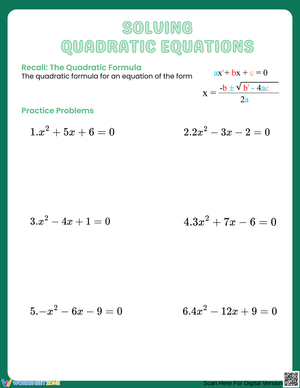
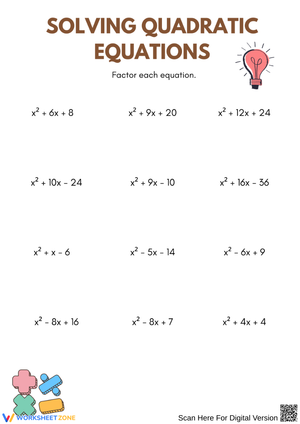
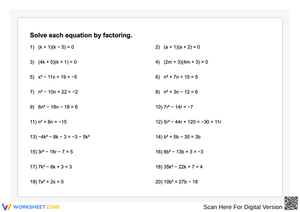
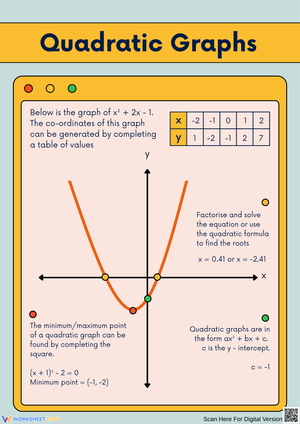
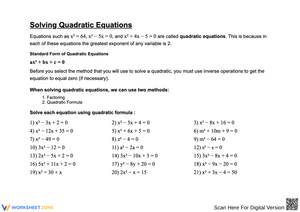
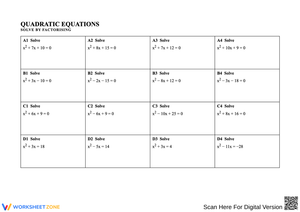
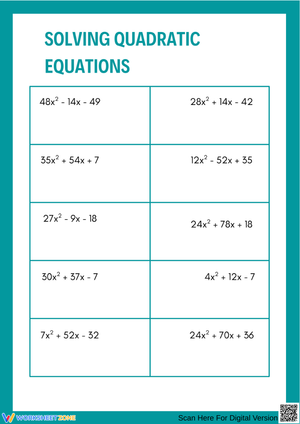
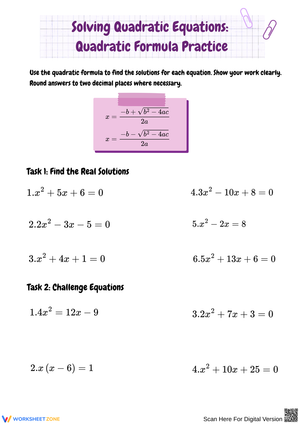
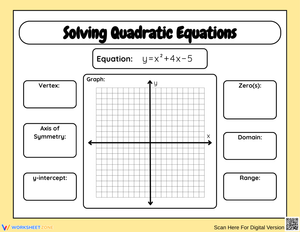
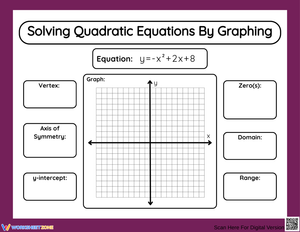
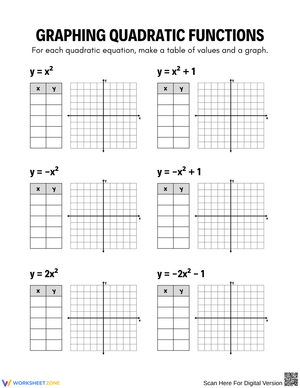
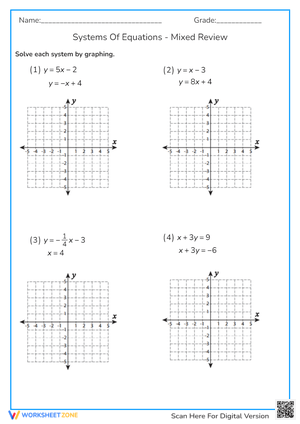
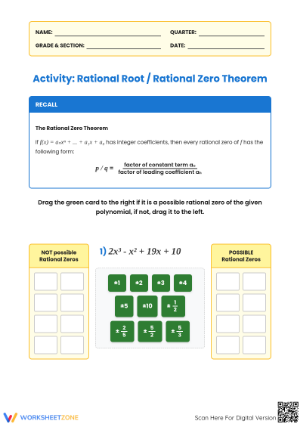
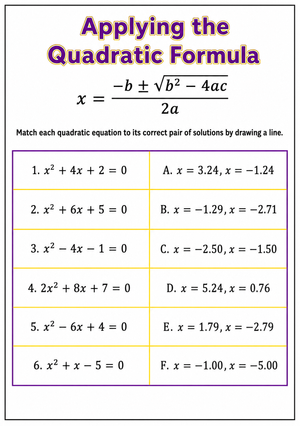
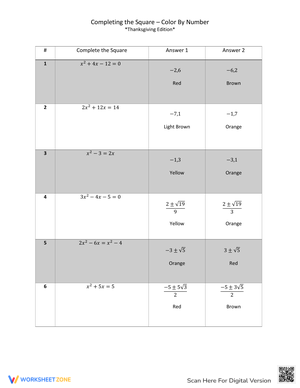
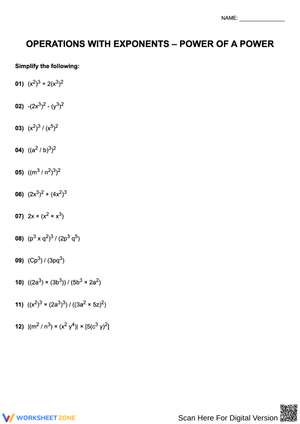
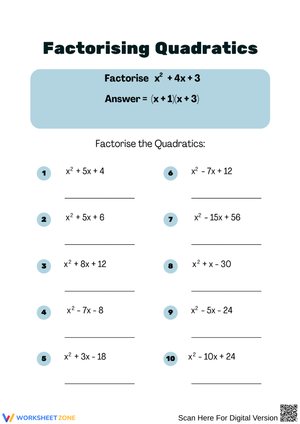
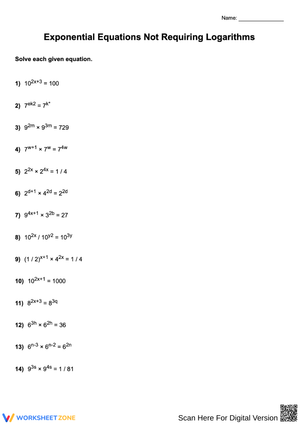
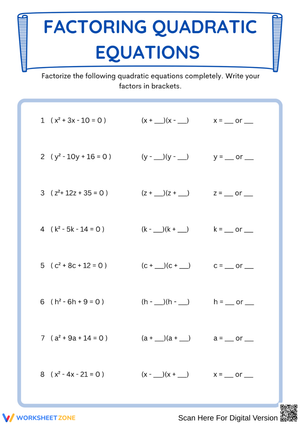
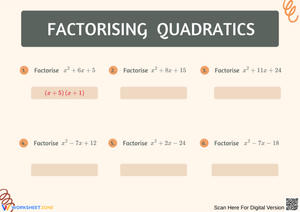
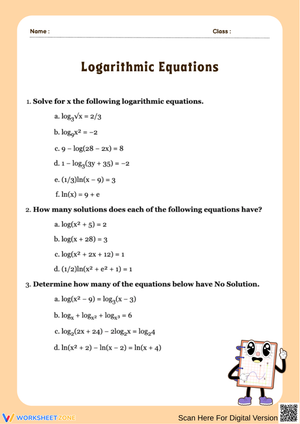
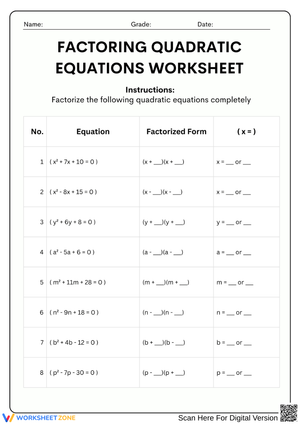
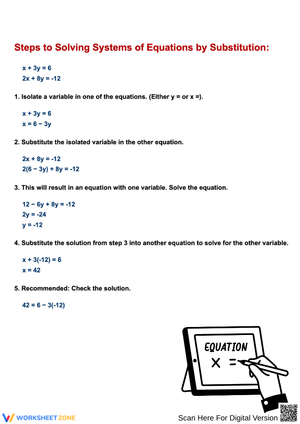
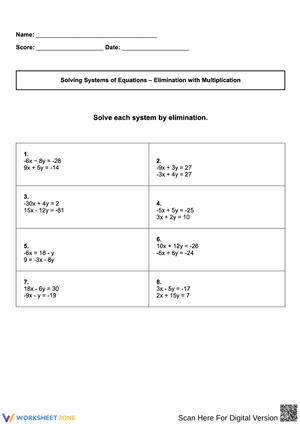
These solving equations worksheets for 9th grade follow the actual pacing of an Algebra 1 course — from one-step equations at the start of the year through multi-step problems requiring the distributive property, then variables on both sides, literal equations, and the special cases of identities and contradictions. Each worksheet is a standalone, downloadable resource teachers can drop into a lesson as independent practice, use as a five-minute opener, or hand to a small group needing extra repetition on one specific skill.
Skills the Set Covers
The progression maps onto how most Algebra 1 teachers sequence instruction in the fall semester. Across the set, each worksheet targets a distinct equation type:
- Two-step equations as a re-entry point — many 9th graders haven't formally practiced equation solving since 8th grade and need a quick fluency rebuild before moving forward
- Multi-step equations with the distributive property, including cases where the coefficient being distributed is negative
- Combining like terms on one side, then both sides, before the variable can be isolated
- Variables on both sides of the equal sign, with mixed-sign coefficients that catch students who habitually move only the smaller term
- Equations with fractions and decimals, building rational-number fluency that carries directly into Chemistry and Physics lab work
- Literal equations — rearranging formulas such as d = rt or A = ½bh to isolate a specified variable
- Identities and contradictions, so students learn to recognize when a variable canceling out is a valid result, not a sign they've made an error
- Translation word problems requiring students to define a variable, write the equation, and solve in full sequence — not just the solve step in isolation
Equation-Solving Errors That Appear Consistently in Student Work
The most predictable error is a sign mistake during distribution. When students encounter -3(x - 4), they often produce -3x - 12 instead of -3x + 12. The rule — negative times a negative yields a positive — stops registering once attention shifts to the next operation. This is less a memorization failure than a working-memory problem: students are tracking the variable, the coefficient, and the sign simultaneously, and one element gets dropped. Having students circle the sign on the number outside the parentheses before they distribute interrupts that pattern without slowing down students who already handle it correctly.
A different confusion appears with special-case equations. When the variable cancels and the remaining statement reads something like 6 = 6, most students assume they made an arithmetic mistake and start over from the top. The reverse happens with contradictions: arriving at 2 = 9 signals their own error to them, not a valid mathematical outcome. A five-minute discussion before students first encounter these problems — what does it mean for an equation to be always true or never true? — prevents a significant amount of frustrated rework on the worksheet itself.
Combining unlike terms produces its own consistent errors. Students who handle 4x + 7x without trouble will still write 4x + 7 = 11x. The problem sharpens on equations like 4x + 7 = 2x + 15, where the visual structure of two terms on each side cues students to add before they've moved the variable.
Standard Alignment
These solving equations worksheets for 9th grade address HSA-REI.B.3 (Reasoning with Equations and Inequalities), which requires students to solve linear equations in one variable — including equations whose coefficients are represented by letters. That second clause is precisely why the literal equations worksheet belongs in this set: the standard explicitly covers letter-coefficient problems, not just numeric ones. The word-problem worksheets also connect to HSA-CED.A.1, which covers creating equations in one variable to model real-world situations. Teachers using state-specific frameworks will find equivalent coverage under whatever standard governs one-variable algebraic reasoning at the high school level.
Working These Worksheets Into Your Algebra 1 Lesson Sequence
The most effective use of solving equations worksheets for 9th grade in a weekly rotation is pairing each practice set with a short error-analysis debrief the following day. Students work through the worksheet during the last 10 to 12 minutes of class, then the next morning — before the new lesson starts — they swap papers and annotate against a posted answer key. The task isn't simply marking right or wrong; students write one phrase explaining where the logic broke down on any incorrect step. That 8-minute annotation window consistently surfaces more genuine understanding than a teacher-led re-teach of the same material. It also catches students who got the right answer by guessing: they mark their own work correct but can't explain the reasoning behind a step when asked.
For teachers running small-group rotations, the literal equations worksheet and the variables-on-both-sides worksheet hold up well at a teacher-led station while other groups work through integer-based multi-step problems independently. This keeps direct instruction happening at exactly the level where students are most likely to stall without support.
A color-coded annotation approach also transfers directly to these materials: students use one color when applying the distributive property, a second for combining like terms, and a third for inverse operations. When a student's work breaks down mid-problem, the color map tells the teacher which step introduced the error — no verbal explanation from the student required.
Tailoring the Set for Students at Different Points in the Progression
Students enter Algebra 1 with real variation in equation-solving readiness. Some finished 8th grade with solid two-step fluency; others are still inconsistent on combining like terms. Differentiation runs in both directions.
For students who need additional support, hold off on the fractions-and-decimals and literal equations worksheets until integer-based procedural steps feel automatic. Providing a written reference card listing the four properties of equality gives these students a concrete decision-making tool mid-problem rather than asking them to retrieve steps from memory while also managing coefficients and signs. Asking them to write one justification sentence per operation — "I subtracted 6 from both sides because..." — slows the work slightly but surfaces reasoning errors that checking final answers alone will not reveal.
For students who move through the standard problems quickly, the literal equations and word-problem worksheets offer genuine extension. Asking advanced students to construct their own equations that produce no solution or infinite solutions — then trade with a partner who must verify and explain the outcome — pushes the solving equations worksheets for 9th grade content further without requiring a separate enrichment resource.
Frequently Asked Questions
Do the worksheets include answer keys?
Yes. Each worksheet comes with a complete answer key showing intermediate steps on multi-step problems, not just final answers. This matters for teachers using these as grading rubrics or for students doing self-correction. The keyed steps can also be adapted as demonstration problems for error-analysis activities where students locate and fix a deliberate mistake embedded in worked-out solutions.
Can these be completed digitally?
The files are PDFs compatible with standard annotation tools on Chromebooks, tablets, and most school-issued devices. The workspace between problems is sized to accommodate full step-by-step work — which is important when the instructional goal is reviewing process rather than checking whether a student arrived at the right number.
When in the school year should each worksheet be assigned?
Most Algebra 1 teachers assign the two-step and integer multi-step worksheets in late August or early September as a review of 8th-grade material. The distributive property and combining-like-terms worksheets fit October for most pacing guides. Variables on both sides and literal equations tend to land in November. The special-cases worksheet works best after students have accumulated enough solving experience that arriving at a result like 7 = 7 registers as genuinely surprising — assigned too early, the concept doesn't stick because students haven't yet internalized what a "normal" answer is supposed to look like.














 Interactive Worksheet Maker
 Quiz Maker
 Word Search Maker
 Crossword Puzzle Maker
 Word Scramble Generator
 Sentence Scramble Generator
 Handwriting Worksheet Generator
 Name Tracing Generator
 Fill In The Blank Generator




 BACK TOSCHOOL