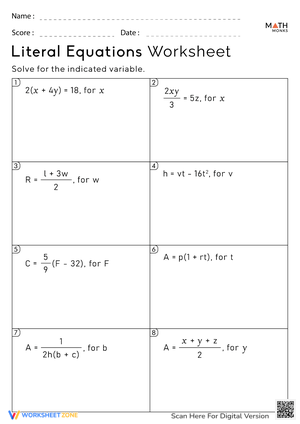
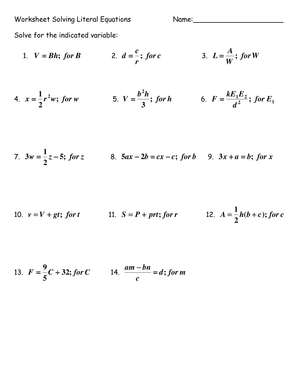
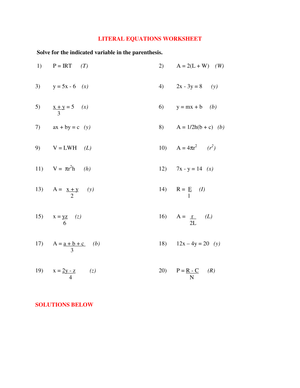
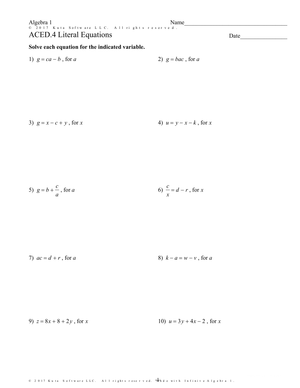
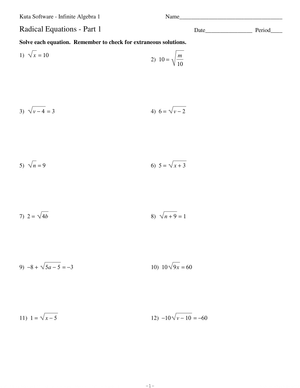
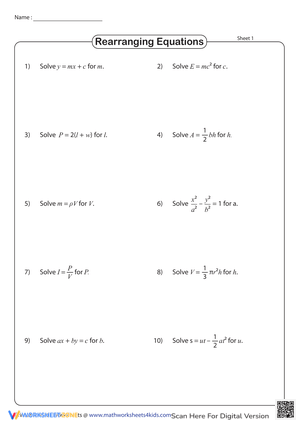
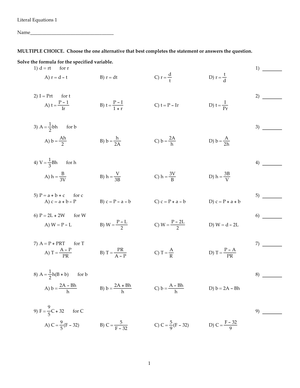
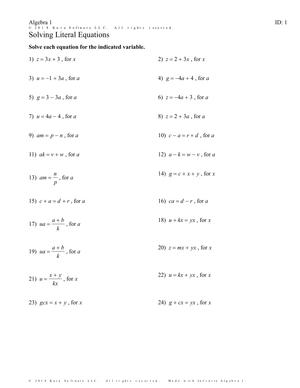
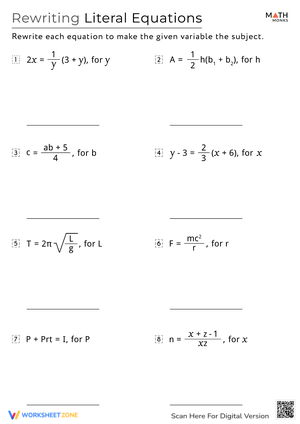
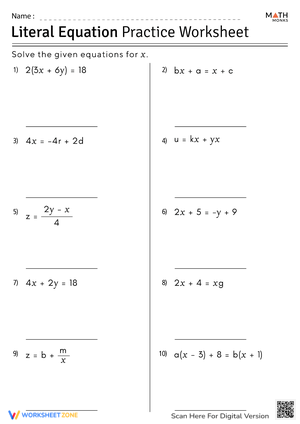
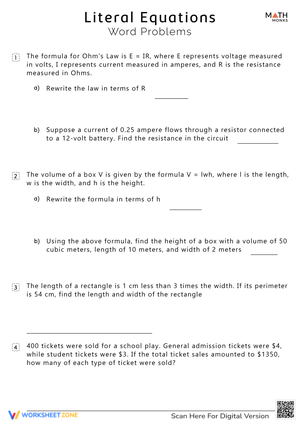
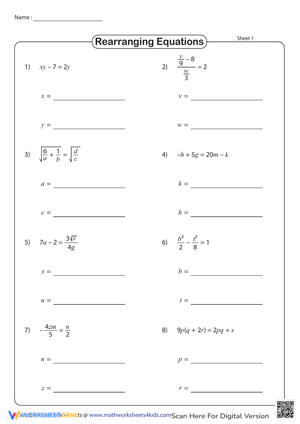
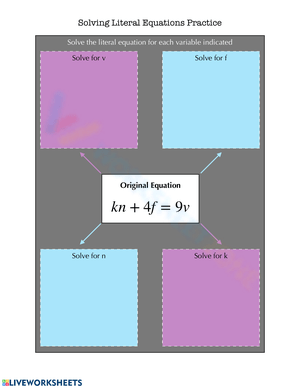
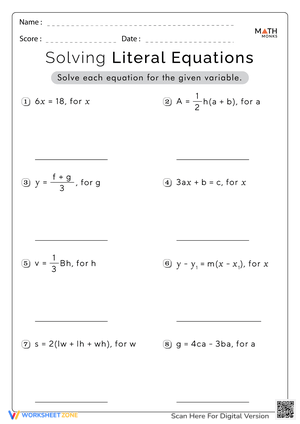
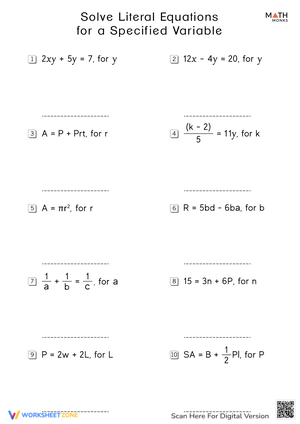
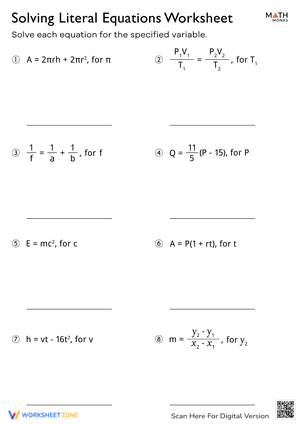
Solving literal equations worksheets for 9th grade give Algebra 1 teachers a direct way to address one of the most disorienting conceptual shifts in high school math: moving from solving for a number to isolating a variable inside an expression full of other letters. Students who handle two-step linear equations without trouble often freeze when the same inverse-operation logic is applied to A = lw or y = mx + b — not because the algebra changed, but because the result never collapses into something they can verify with arithmetic. This set gives teachers a sequenced collection of printable practice resources, from single-operation rearrangements to complex multi-variable manipulations, with error-analysis problems built in.
What the Set Covers
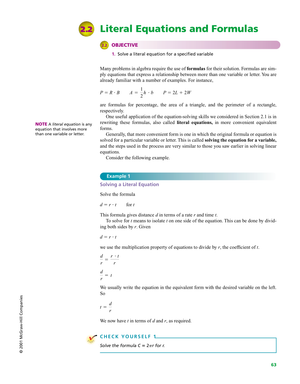
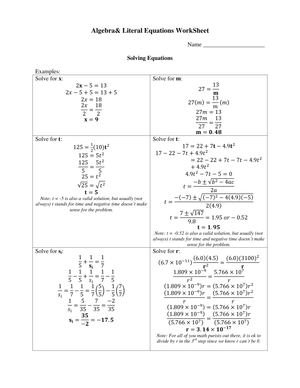
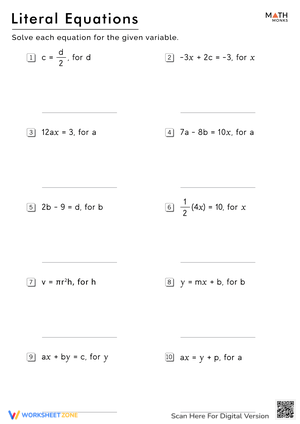
These solving literal equations worksheets for 9th grade move through the skill in a deliberate sequence. Early problems use single-operation formulas like d = rt, where students solve for r or t in one division step. The middle tier introduces two-step formulas — isolating b in y = mx + b, or rearranging P = 2l + 2w to solve for l. Later worksheets bring in formulas with fractions, squares, and multiple terms in a numerator that must be factored before dividing. Each worksheet stays within a coherent range of difficulty, so teachers can assign them in sequence or pull individual ones to target a specific gap.
Across the set, students:
- Identify the target variable before beginning any algebraic steps
- Apply inverse operations in the correct order across all terms on one side of an equation
- Leave results in unsimplified form when numerical simplification is not possible
- Recognize that an expression like (c − b)/a is a complete and valid answer
- Work with formulas drawn from geometry, physics, and basic finance — not just abstract symbol exercises
Frequent Student Errors Worth Watching For and Correcting
The most persistent mistake is partial division. A student working through P = 2l + 2w subtracts 2l from both sides correctly, then divides only 2w by 2, arriving at w = P − l instead of w = (P − 2l)/2. They see a 2 attached to the term they want and divide it without recognizing that the entire remaining expression must also be divided. Error-analysis problems in the set put that exact mistake in front of students and ask them to locate and explain it — considerably more effective than a general warning about distributing division across a numerator.
A second consistent pattern shows up when the target variable ends up on the right side of the equal sign. If a student solves 3 = mx + b for x, they sometimes stop mid-problem and try to flip the equation because they're convinced the variable must appear on the left. Including problems where the target variable starts on the right — and where the correct result looks like x = (3 − b)/m — trains students to accept that form rather than perform unnecessary extra steps. That flexibility matters later in Physics and Chemistry, where formulas get rearranged in whichever direction the available data requires.
Building These Worksheets Into Your Weekly Algebra Sequence
The strongest placement for solving literal equations worksheets for 9th grade is immediately after a multi-step equation unit and before students encounter slope-intercept form. That window matters: students who can already isolate a variable in y = mx + b when they arrive at graphing lessons avoid an entire category of confusion that would otherwise follow them through every function-related topic in the second semester.
On introduction day, one technique that works consistently is the "variable mask." Have students cover the target variable with a finger or sticky note and ask: "What is happening to the thing you're covering?" If it's being multiplied by r, they divide. This strips the problem to one operation at a time and prevents students from being distracted by surrounding letters. It also surfaces something important — the other variables in the equation behave exactly like constants during the isolation process. Once students see that, the logic falls into place faster than it does through direct explanation alone.
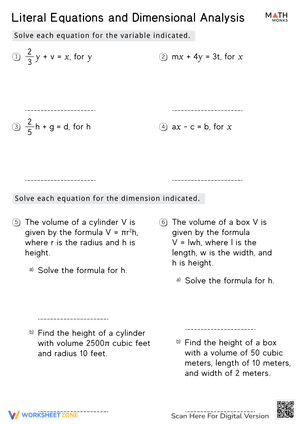
Group work pairs well with these worksheets when you assign different target variables from the same formula. Give one pair V = lwh and ask them to solve for l; give another the same formula and ask for h. Comparing results opens a real discussion: the expressions look different, but the relationships between variables stay consistent no matter which one is isolated. That comparison does more for structural algebraic thinking than the same amount of additional individual practice.
Standard Alignment
The primary standard addressed across the set is HSA-CED.A.4, which requires students to rearrange formulas to highlight a quantity of interest using the same reasoning applied when solving equations. In classroom terms, this standard sits at the end of equation-solving instruction and at the beginning of formula-intensive work in concurrent science courses. A student who meets this standard in Algebra 1 arrives in Chemistry already knowing how to isolate V in D = m/V without needing it retaught as a separate science skill. The work on these worksheets also reinforces HSA-REI.B.3 — solving linear equations and inequalities in one variable — because every manipulation step in a literal equation is a direct application of that standard's reasoning.
Adjusting the Set for a Range of Learners
For students who are still shaky on inverse operations, the most effective adjustment is to run literal equations in parallel with numerical ones. Place 2x + 6 = 14 next to 2x + b = c and have students solve both using identical steps. The numerical version gives them a concrete self-check — they can verify x = 4 by substituting back. That parallel structure reduces abstraction without changing any of the algebraic reasoning being practiced. After five or six paired problems, the literal version alone is no longer intimidating for most students.
Students who move through the worksheets quickly can be extended by assigning every variable in a given formula as the target, then asking them to write a word problem where each rearrangement would actually be needed. Solving D = m/V for V is one level of skill; constructing a scenario that requires that specific form — with units, a context, and a real question — is a different cognitive task entirely. Doing that for all three variables in the formula makes the algebraic manipulation feel purposeful rather than procedural.
Students working below grade level often benefit from keeping a reference list of inverse operation pairs — multiplication/division, addition/subtraction, squaring/square root — visible during the first several worksheets. Removing that reference gradually as fluency develops prevents both over-reliance and the frustration of retrieving procedural knowledge before it has become automatic.
Frequently Asked Questions
What makes literal equations harder than regular equations for most 9th graders?
The algebra itself isn't harder. What's harder is accepting that the answer is an expression rather than a number. Students who solve 2x + 6 = 14 get x = 4 — something they can verify by substituting back. When they solve ax + b = c for x, the answer is (c − b)/a, and there is no single number to check against. That absence of a concrete, verifiable result is what trips most students up, not the operations themselves.
Do students need to know specific formulas before starting?
No. Every formula is printed on each worksheet — students don't need prior exposure to it. Familiarity with formulas like d = rt or P = 2l + 2w helps students feel more grounded in the early problems, but the skill being practiced is rearrangement, not recall. A student who has never seen a particular formula still has everything needed to isolate the target variable.
Where do these fit in a standard Algebra 1 pacing guide?
Most Algebra 1 pacing guides place literal equations in Unit 2 or Unit 3, after one- and two-step equations and before linear functions. The topic is relatively brief as a standalone unit, but the skill reactivates constantly — during slope-intercept form work, when solving systems by substitution, and again when students derive or use the quadratic formula.
Are these useful for students also taking a science course?
These solving literal equations worksheets for 9th grade align directly with what students do in Physical Science and Biology when rearranging formulas like F = ma, D = m/V, or I = Prt. A student who has worked through the set handles those rearrangements without needing the science teacher to reteach the algebra from scratch. The transfer isn't incidental — it's the practical reason this skill appears in Algebra 1 standards at this grade level.
Can these worksheets support test preparation?
Yes. Literal equation problems appear on most state algebra assessments and in the Heart of Algebra domain of the SAT. The error-analysis problems are particularly useful for multiple-choice test prep: many state assessment items present a partially worked solution with one incorrect step and ask students to identify where the error occurred. Working through error-analysis problems on these worksheets is direct practice for that format.














 Interactive Worksheet Maker
 Quiz Maker
 Word Search Maker
 Crossword Puzzle Maker
 Word Scramble Generator
 Sentence Scramble Generator
 Handwriting Worksheet Generator
 Name Tracing Generator
 Fill In The Blank Generator




 BACK TOSCHOOL