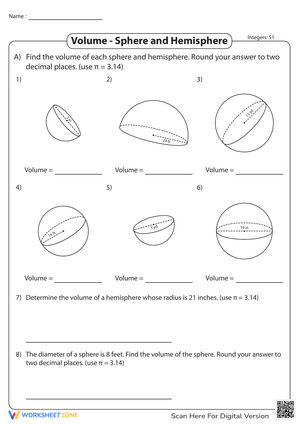
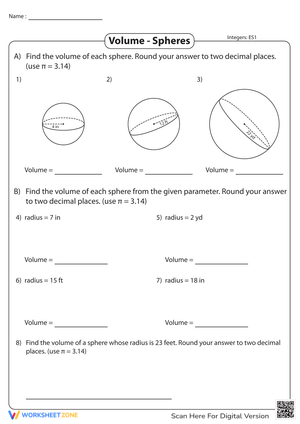
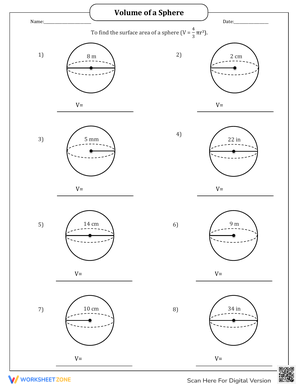
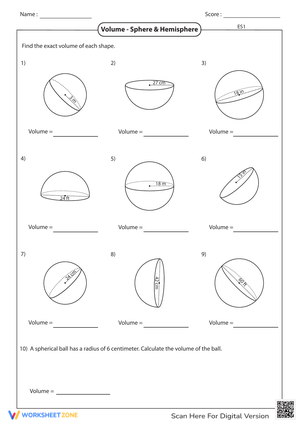
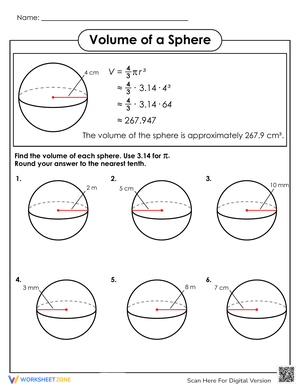
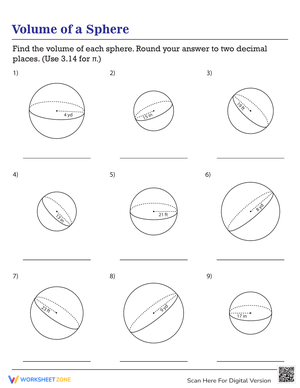
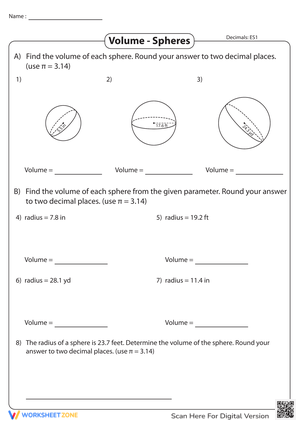
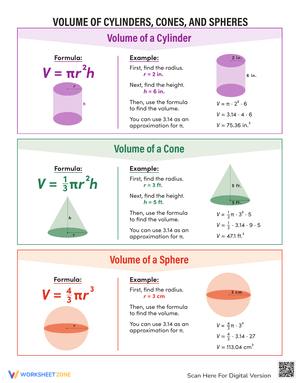
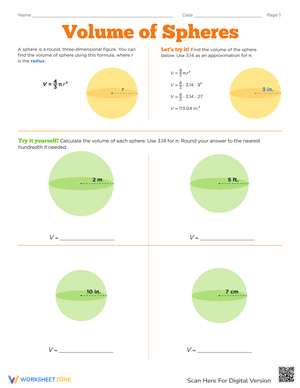
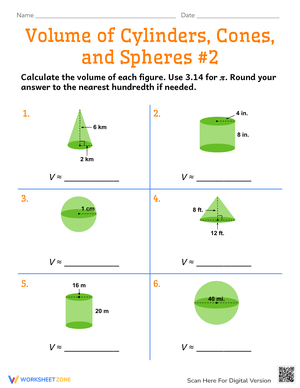
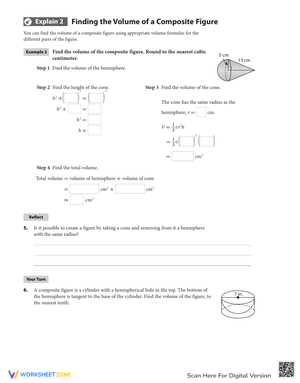
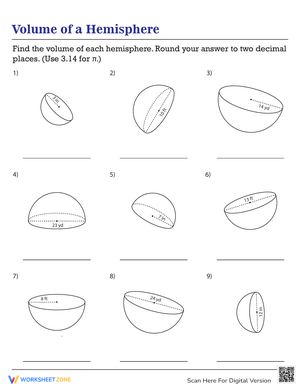
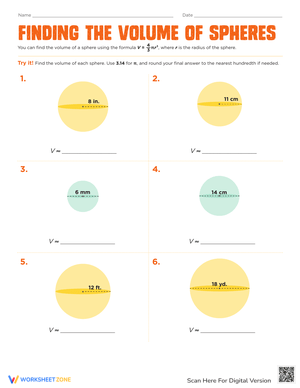
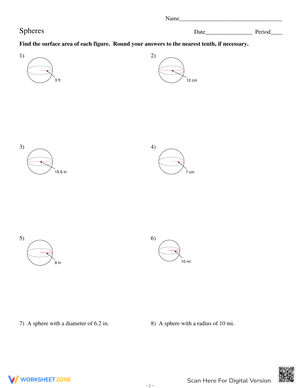
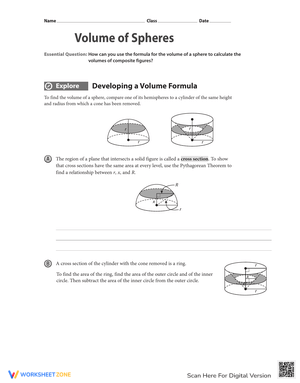
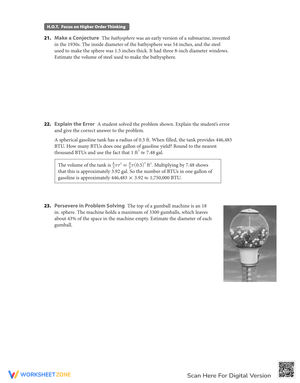
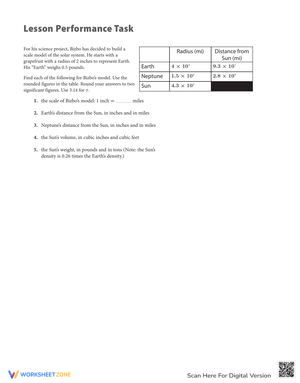
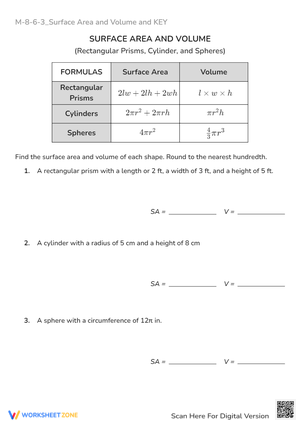
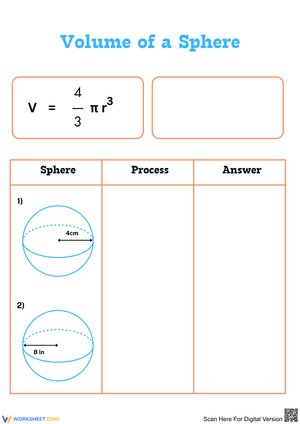
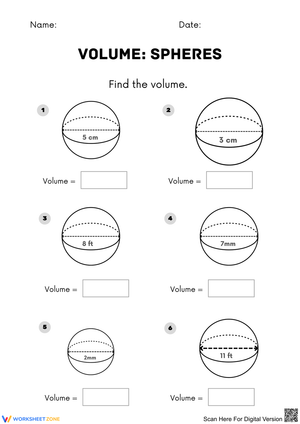
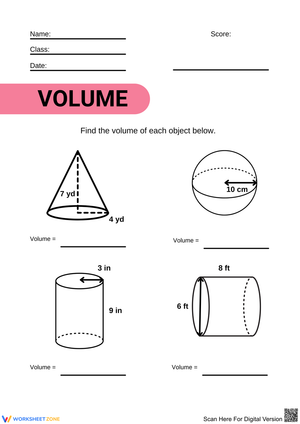
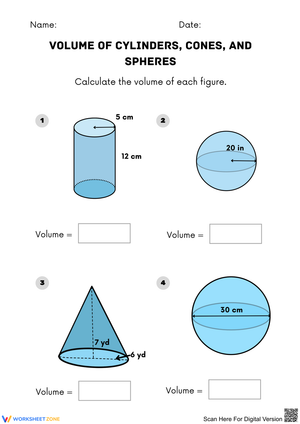
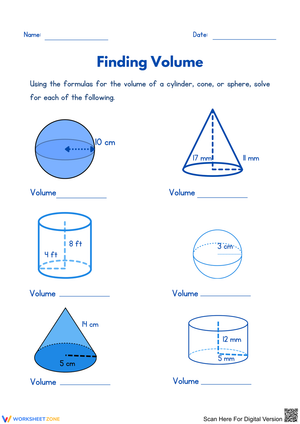
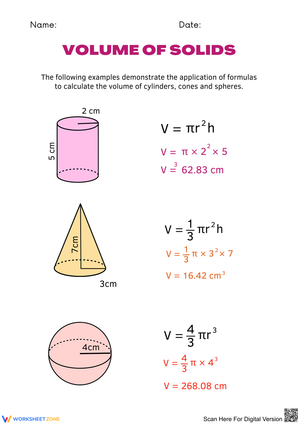
These volume of a sphere worksheets for 8th grade give teachers print-ready practice that addresses the formula, the radius-versus-diameter distinction, and both exact and decimal answer formats across a focused, sequenced set. Students work with V = (4/3)πr³ from direct substitution through word problems — building the procedural fluency that 8th-grade geometry standards actually require.
The Specific Skills Each Worksheet Targets
At this level, students apply the formula rather than derive it. The cognitive load sits in three places: identifying the radius correctly (especially when only diameter appears in the problem), cubing that radius without switching to multiplication by 3, and carrying the 4/3 factor all the way through without dropping it. Each worksheet targets at least one of those pressure points directly.
- Substituting a whole-number radius into V = (4/3)πr³ with all steps written explicitly
- Halving a given diameter before substituting — the step students most often skip
- Writing answers in exact form, leaving π as a factor
- Rounding computed answers to a specified decimal place when directions require it
- Labeling every final answer with correct cubic units
- Applying the formula within short word problems involving spherical objects
The exponent work here matters beyond this topic. Cubing the radius gives students real practice raising a value to the third power under computational pressure — and that transfers directly to other 8th-grade work with expressions and equations.
What to Expect in Student Work — and Where the Errors Land
The radius-diameter confusion hits hardest on the first diameter problem a student encounters. A sphere with a diameter of 10 cm becomes r = 10 in most first attempts, producing a volume eight times the correct value. Students who answered every radius-given problem accurately will still make this error, because the habit of using the printed number directly is deeply ingrained by the time diameter problems appear.
The next failure point is the exponent. Students who write the formula from memory will still compute r³ as r × 3 — they add the exponent rather than cube. A student who records r = 4 and then writes r³ = 12 instead of 64 is showing that error clearly. Asking students to write r³ = ___ as its own line before multiplying anything else surfaces the mistake during guided practice, before it becomes a test-day habit.
The 4/3 factor drops out more often than any other piece of the calculation. Students multiply by 4 and forget to divide by 3, or they apply 3.14 for π early and then lose track of where the 4/3 fits in the chain. Square units instead of cubic units appear persistently in final answers even when the numerical computation is correct — a sign that unit labeling is being treated as an afterthought rather than part of the solution itself.
Fitting These Worksheets Into the Rhythm of a Geometry Unit
The day after introducing sphere volume, assign an early worksheet with radius-only problems — six to eight items where students write each step explicitly: r = ___, r³ = ___, (4/3)πr³ = ___. That forced notation slows the computation down and makes error patterns visible before students move into mixed practice. It also gives you something concrete to look at during circulation — you can spot the r × 3 mistake at a glance.
Once students show accuracy on radius-only items, a worksheet mixing radius-given and diameter-given problems works well as homework or the second class period's independent work. The diameter items near the end are where you find out who has the concept and who has memorized the steps without understanding what the radius actually is.
These volume of a sphere worksheets for 8th grade also fit naturally into the ten-minute warm-up block at the start of a review day. Pull one exact-answer item and one decimal-rounding item, work them together briefly, and use any wrong answers as the basis for a short class discussion before moving on. Students who have been away from the formula for a week will show you within those ten minutes whether anything retained.
For small-group intervention, isolate the diameter-to-radius conversion step entirely. Give students a short worksheet where every problem opens with: "The diameter is ___. The radius is ___." They complete that second blank before the rest of the problem appears. That structure tells you within five minutes whether the conceptual gap is actually there or whether the student just needs a reminder cue.
Standard Alignment
These worksheets align to CCSS 8.G.C.9, which requires students to know and apply the formulas for the volumes of cones, cylinders, and spheres to solve both real-world and mathematical problems. In classroom terms, sphere volume typically arrives near the end of an 8th-grade 3D geometry unit, after students have already worked through cylinders and cones. The standard expects movement between exact and approximate answers and application in context — both of which the set addresses directly. Teachers working in states with adapted standards will find this set aligns to equivalent geometry benchmarks that place solid volume in Grade 8.
Adjusting the Set for Students Working at Different Levels
Students who arrive at this topic needing more support benefit from a worksheet that stays in radius form throughout and prints the formula at the top. Breaking the computation into labeled lines — r = ___, r² = ___, r³ = ___, then the full product — gives those students a step-by-step structure to follow without being told what to write. That approach reduces working-memory pressure enough that the formula itself can start to stick, rather than disappearing under the weight of keeping the procedure organized.
Students ready to push further can work with worksheets that introduce decimal radius measurements (r = 3.5 cm, r = 7.2 m), require answers rounded to a specific number of decimal places, or include a brief written explanation prompt: "Sphere A has twice the radius of Sphere B — how do their volumes compare? Show and explain." That last task requires applying V = (4/3)πr³ twice and then reasoning about what cubing the radius actually does to the result. It separates the students who genuinely understand the relationship from those who can execute the formula correctly without knowing why the numbers behave the way they do.
Frequently Asked Questions
Do these worksheets come with answer keys?
Yes. Each worksheet in the set includes a corresponding answer key that shows both the exact answer in terms of π and the decimal approximation. That format lets teachers check work quickly and also gives students a model of what a fully labeled, correctly formatted solution looks like — which is especially useful when students are learning to write answers in exact form for the first time.
When in a unit should these be assigned?
The radius-only worksheets belong right after the initial lesson, once students have seen the formula modeled at least twice. Mixed radius-and-diameter worksheets fit day two or three of practice. Word-problem worksheets belong at the unit's end or during review, when students have the formula under control and need practice extracting measurement information from problem contexts rather than reading it directly from a labeled diagram.
How do I handle students who keep approximating π when directions call for an exact answer?
This is one of the more persistent direction-reading issues in 8th-grade geometry, and it rarely fixes itself without direct intervention. The most reliable correction is requiring students to read the direction line and circle the word "exact" before they begin the problem. Some teachers mark these items incorrect without partial credit during practice — not as a punitive measure, but because treating the error as consequential early in the unit prevents it from carrying into assessments.
Can the set be used for standardized test review?
Volume of a sphere worksheets for 8th grade work well for test prep when combined with cylinder and cone worksheets in a mixed review rotation. CCSS 8.G.C.9 groups all three solids together, and students who have only practiced spheres separately sometimes stall when a test item places multiple solid types in the same problem set. Running mixed-format review during the final week of the unit addresses that directly.
Are there worksheets suitable for below-grade-level students?
Volume of a sphere worksheets for 8th grade that focus exclusively on radius-given problems — with the formula printed at the top and labeled computation lines built in — work well for students who need more time before the diameter conversion step is added. Using those worksheets in a small-group setting while on-level students work independently lets the same lesson reach two different starting points without requiring a separate lesson plan for each group.













 Interactive Worksheet Maker
 Quiz Maker
 Word Search Maker
 Crossword Puzzle Maker
 Word Scramble Generator
 Sentence Scramble Generator
 Handwriting Worksheet Generator
 Name Tracing Generator
 Fill In The Blank Generator