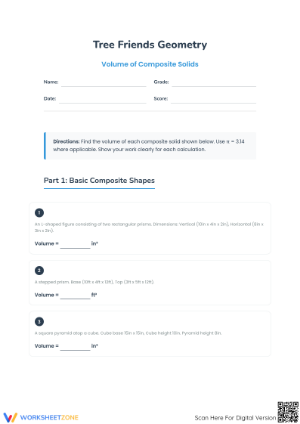
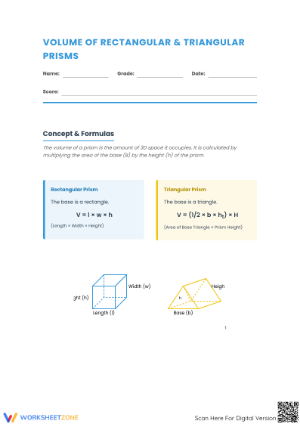
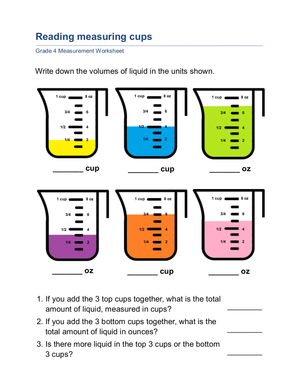
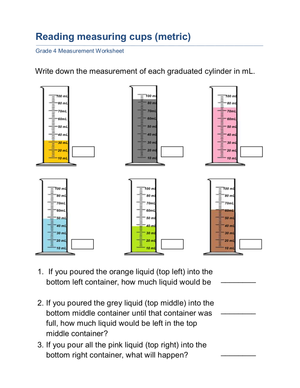
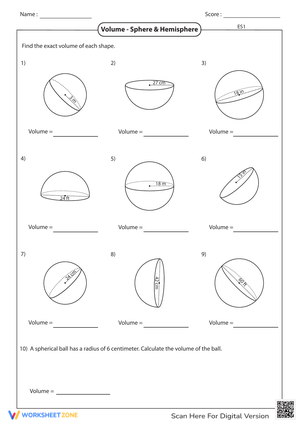
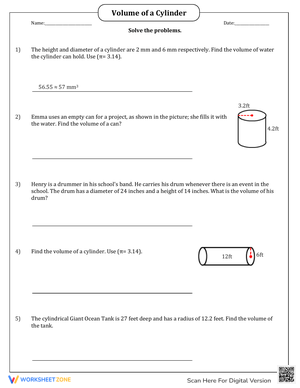
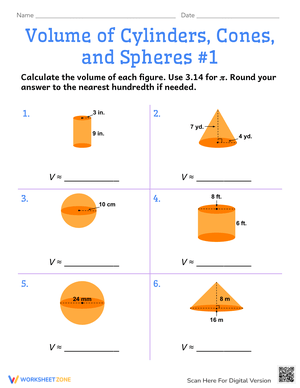
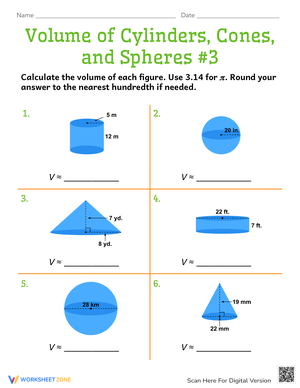
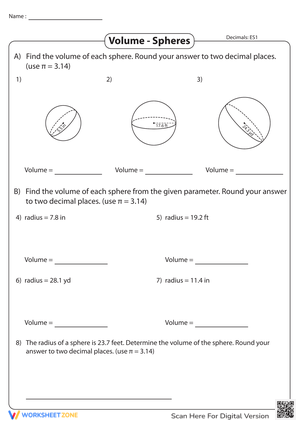
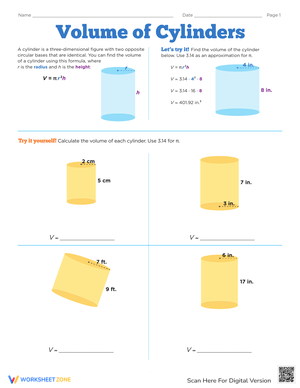
These volume printable worksheets for 8th grade cover the four solid figures central to 8th grade geometry — rectangular prisms, cylinders, cones, and spheres — with each worksheet targeting a specific formula set, a specific error type, or a mixed combination of both. Teachers get a complete set that fits naturally into direct instruction, stations, small-group intervention, or quiz review without additional prep to adapt the material.
What's Inside the Set
Volume instruction at this level brings a real conceptual shift. Students are no longer applying one formula to one familiar shape — they are choosing among several, determining whether a given measurement is a radius or a diameter, and working through decimals, pi, and missing dimensions across the same problem set. The worksheets address that full range of demand.
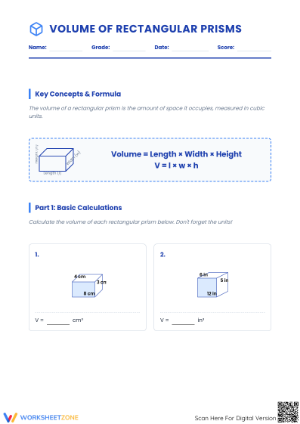
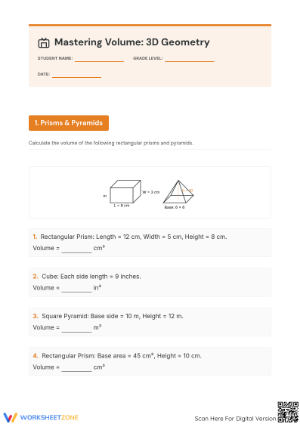
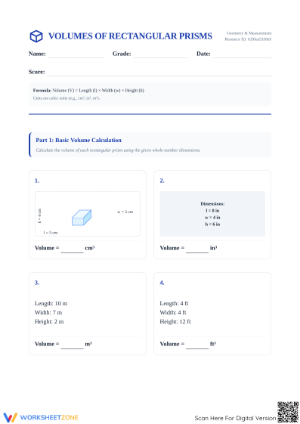
- Rectangular prisms: Revisiting V = lwh with whole-number and decimal values, reinforcing three-dimensional measurement vocabulary before students encounter more complex solids.
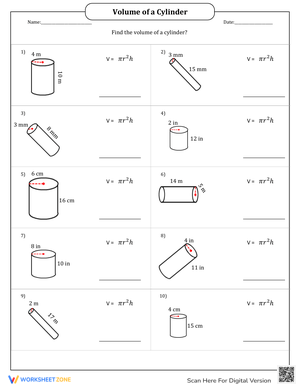
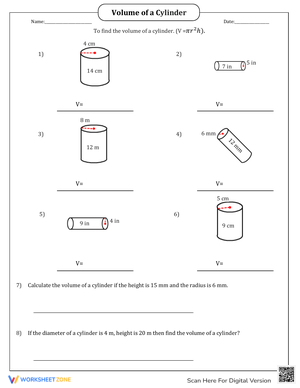
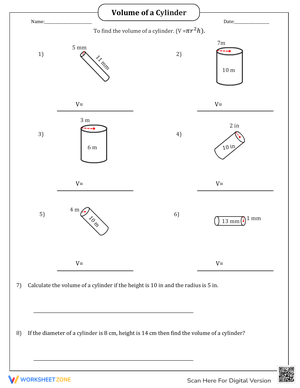
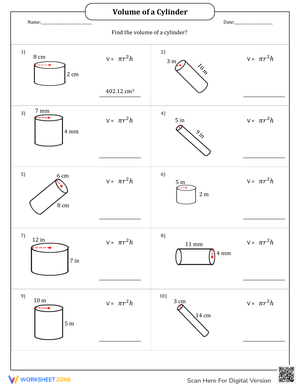
- Cylinders: Applying circle-area concepts in a volume context, working with both radius and diameter, and computing with pi expressed as 3.14 or as the symbol — depending on the level of each worksheet.
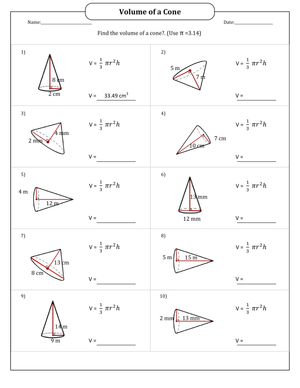
- Cones: Building the one-third relationship between a cone and a cylinder of equal base and height — the single most important conceptual point in the unit.
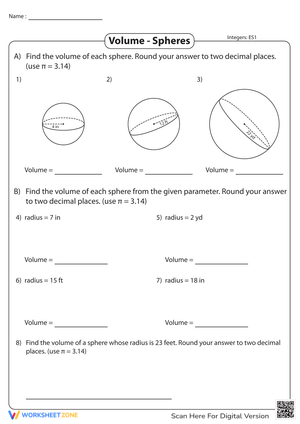
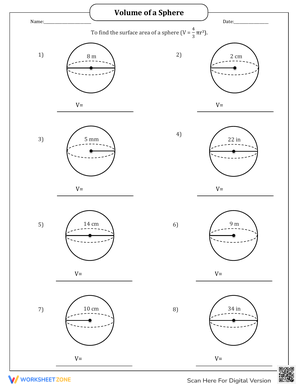
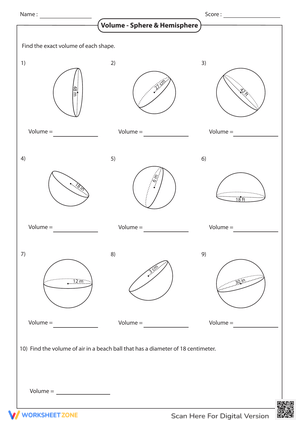
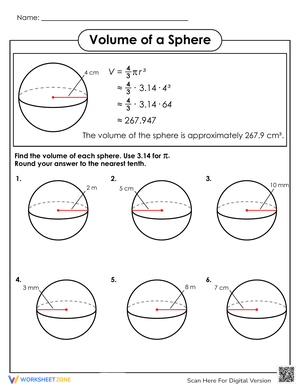
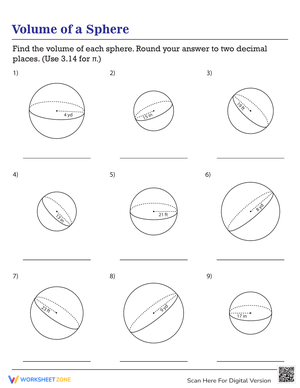
- Spheres: Organizing multi-step computation with the sphere formula, where exponent errors appear most reliably in student work.
- Mixed-solid practice: Identifying the shape first, then selecting and applying the correct formula — the decision-making step that grade-level assessments actually test.
Word problems appear across the set as well, including items where students must determine which measurement is relevant before computing. That reading-and-reasoning demand is where procedural fluency and conceptual understanding separate — and it shows up in actual student work in ways that straight computation problems cannot reveal.
Formula Mistakes Teachers Should Expect and Address
The most persistent mistake in this unit is not formula confusion — it is unit confusion. Students who compute cylinder volume correctly using π × r² × h will still write the answer in square units because the presence of pi and the circle-area formula has trained them to think "area." The cubic unit label never registers. Building a class norm of stating the unit type before checking any numerical answer catches this more reliably than repeating the formula explanation.
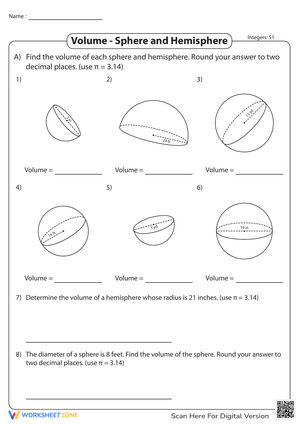
Sphere problems produce a specific and predictable computation error: students write (4/3)π × r² instead of (4/3)π × r³. With a radius of 3, that means computing (4/3)π × 9 rather than (4/3)π × 27 — wrong by a factor of 3, but not absurdly wrong, which means neither the student nor a fast homework scan will catch it. These volume printable worksheets for 8th grade include sphere items in both standalone and mixed-review formats, making it easier for teachers to identify this error on a focused worksheet before it reaches an assessment.
Cone problems surface a third pattern. Students who learned cylinder volume first will write V = πr²h for a cone and leave out the one-third factor entirely. On a mixed-review worksheet, where format cues no longer signal which formula applies, this error appears more often than it does on cone-only practice. Teachers should watch for answers exactly three times the correct value — that ratio is the diagnostic signal for this particular mistake.
Diameter-for-radius substitution affects cylinder and sphere problems most often. When a problem states a diameter of 8, students routinely compute with 8 rather than 4, and because the rest of the setup is otherwise correct, the error is nearly invisible without checking the first step. Asking students to underline the radius value and write it out separately before touching the formula is a low-effort routine that surfaces this confusion quickly.
Where Each Worksheet Fits in a Unit Plan
The most reliable structure is to match the worksheet type to the instructional moment. Early in the unit, shape-specific practice — one worksheet covering cylinders only, another covering cones — lets students build procedural fluency without juggling competing formulas at once. Mid-unit, removing any formula reference from the worksheet forces retrieval, which matters for retention. Near the end, mixed-solid worksheets require students to identify the shape before solving, which is exactly what assessment items demand and what earlier shape-specific practice cannot fully replicate.
For bell work, a four- to five-problem single-shape worksheet takes about eight minutes and gives teachers a real read on where the class stands before new instruction begins. The last few minutes before a quiz — when telling students to "look over your notes" produces blank stares — is a better moment for one mixed-review worksheet than for almost any other activity. Students work through something concrete, and teachers see which formula is still shaky before anyone walks out the door.
Small-group intervention works well when cylinder and sphere worksheets are paired in the same session. Students see the structural overlap between the two formulas and can articulate where the computation diverges, which builds more durable understanding than solving each type in complete isolation. For departments sharing resources across multiple sections, volume printable worksheets for 8th grade sorted by solid type — one set per shape, one set for mixed review — remove the coordination overhead that leads teachers to rebuild the same materials independently.
Matching the Practice to Different Student Readiness Levels
Below-level students benefit from worksheets that include a formula reference box at the top and labeled diagrams with measurements already marked. Those built-in supports let students focus on the formula-application process rather than simultaneously managing unfamiliar notation, unit labels, and computation. Whole-number values and single-shape sets work better for these students during early instruction — introducing decimals and mixed solids before the formulas are stable increases errors without building understanding.
On-level students handle mixed item types, some decimal values, and problems that require choosing between radius and diameter within the same set. Removing the formula reference at this stage is appropriate; students at this level should be retrieving formulas with some regularity by mid-unit rather than reading them directly from the worksheet.
Advanced students need missing-dimension problems, where the volume is given and they solve algebraically for a radius, height, or side length. Composite solid problems — a cylinder topped with a cone, for instance — push students to think about volume as a sum or difference of parts rather than a single formula application. These are the problems where students who have been computing correctly suddenly discover they do not fully understand what volume means. That realization is worth surfacing before a unit assessment, not after.
Standard Alignment
The primary standard addressed across these worksheets is CCSS 8.G.C.9, which requires students to know the formulas for the volumes of cones, cylinders, and spheres and apply them to both mathematical and real-world problems. This standard arrives after students have worked with rectangular prisms under 6.G.A.2 in 6th grade and with circle area under 7.G.B.4 in 7th grade, so it deliberately sits at the convergence of several prior concepts. Prism review worksheets early in the unit are not filler — they activate those earlier standards and give students a familiar entry point before the formulas grow more complex.
Frequently Asked Questions
Which solid should I introduce first?
Most teachers start with cylinders. Students already know how to find the area of a circle, and extending that to volume by adding a height dimension is a manageable next step. Cones work well after cylinders because the one-third relationship becomes clearer when students already know the cylinder formula they are modifying. Spheres generally come last — the formula is the most procedurally complex, and students handle it better after building confidence with the other two curved solids. Prism review can run alongside any of these as warm-up practice without disrupting the sequence.
Do the worksheets come with answer keys?
Yes. An answer key is included with each worksheet, which makes them workable for homework, substitute plans, and independent station practice. For mixed-review worksheets in particular, having the key lets support staff or co-teachers verify multi-step work efficiently without reworking every problem from scratch during a session.
How should I sequence these if I'm behind on pacing?
When time is tight, prioritize cylinders and cones — those formula sets require the most instructional attention and are explicitly named in CCSS 8.G.C.9. Sphere practice can compress into one or two focused sessions. Volume printable worksheets for 8th grade that present cylinders and cones in a mixed format let teachers get adequate repetition on both shapes without running entirely separate practice sessions for each one.
Can I use these for test prep before we've finished the unit?
Yes, selectively. Pull shape-specific worksheets for any solid already taught and hold the mixed-review sets until students have worked with all four figures. That approach keeps test prep grounded in what students have actually studied rather than introducing unfamiliar formula demands under time pressure.













 Interactive Worksheet Maker
 Quiz Maker
 Word Search Maker
 Crossword Puzzle Maker
 Word Scramble Generator
 Sentence Scramble Generator
 Handwriting Worksheet Generator
 Name Tracing Generator
 Fill In The Blank Generator