


























Views
Downloads
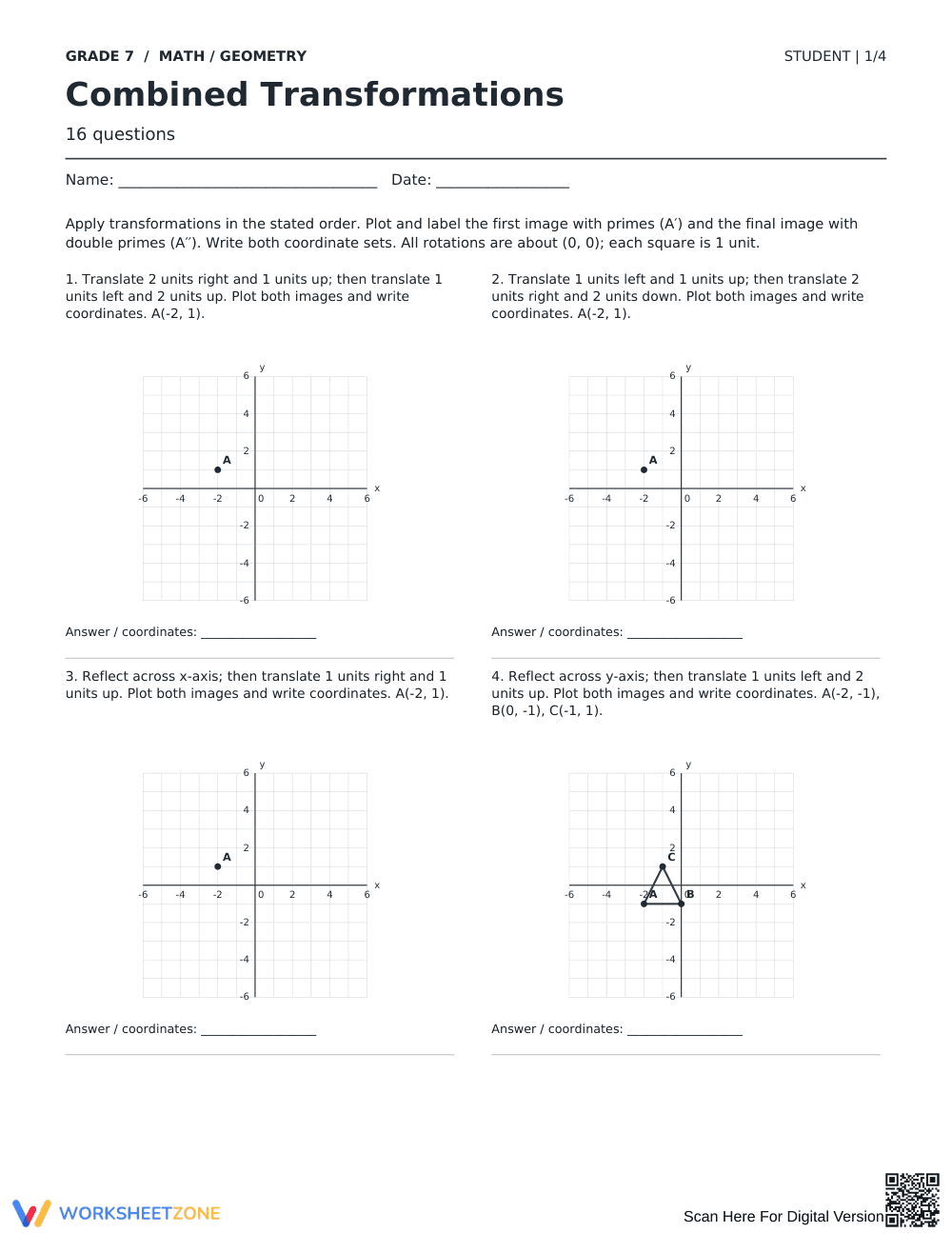
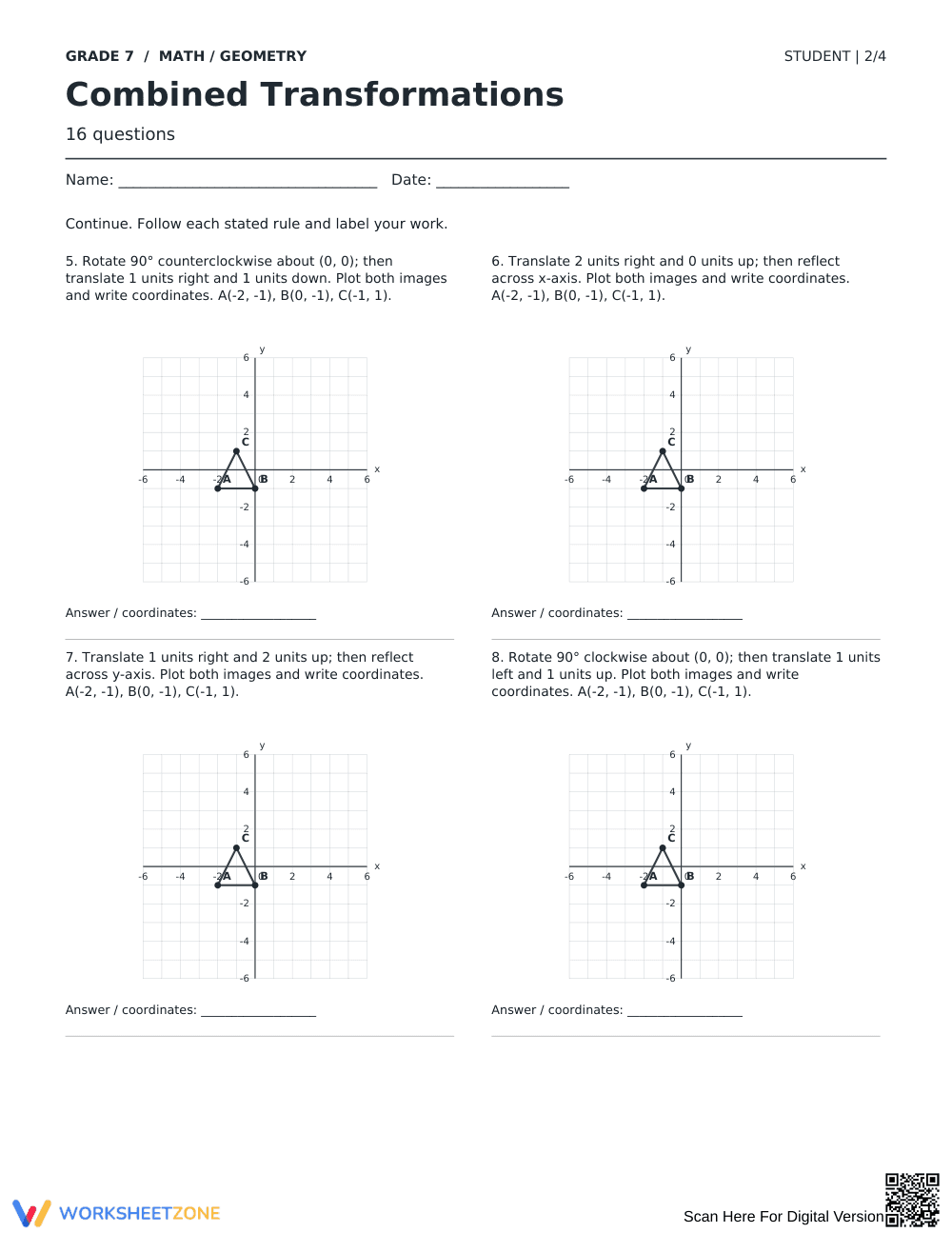
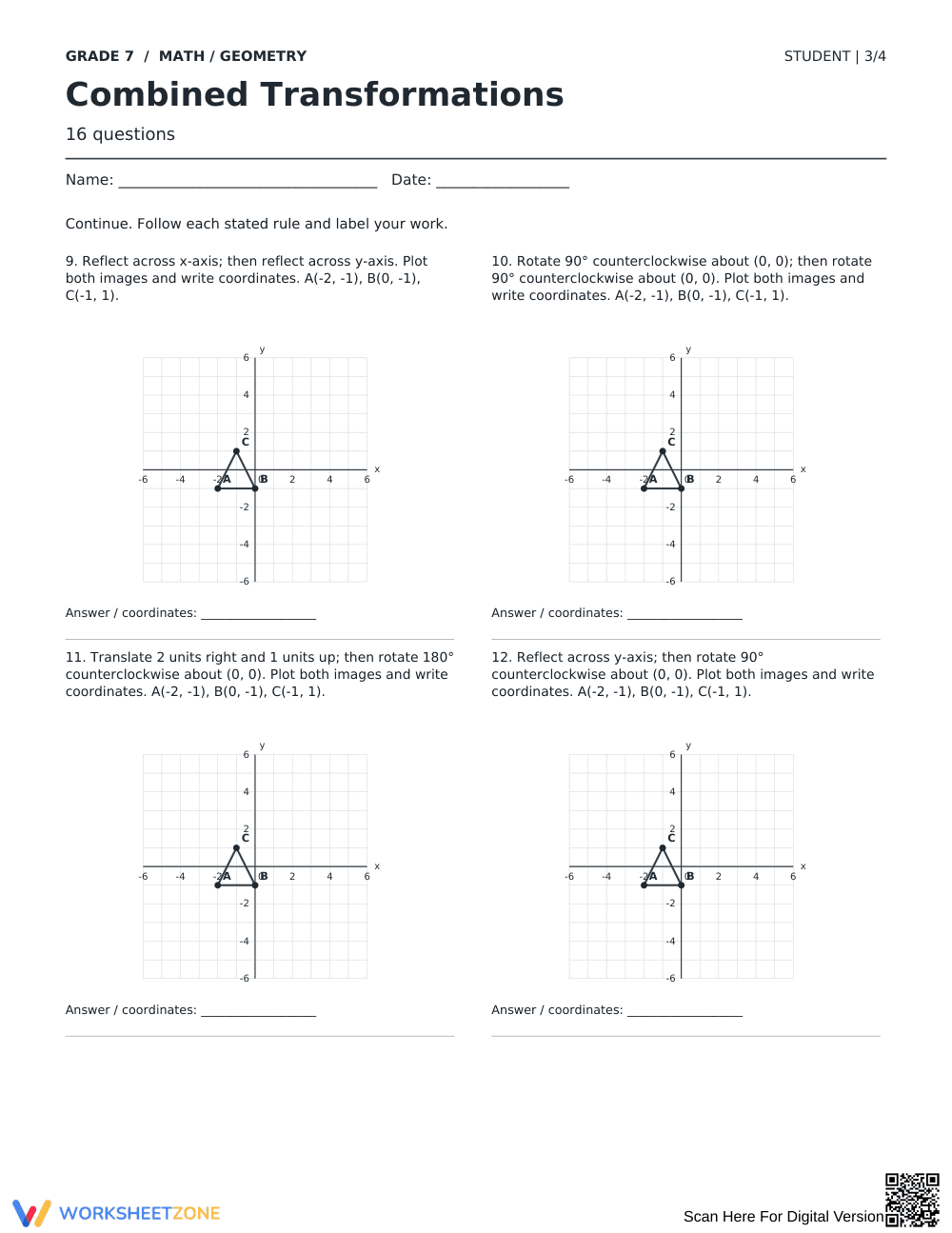
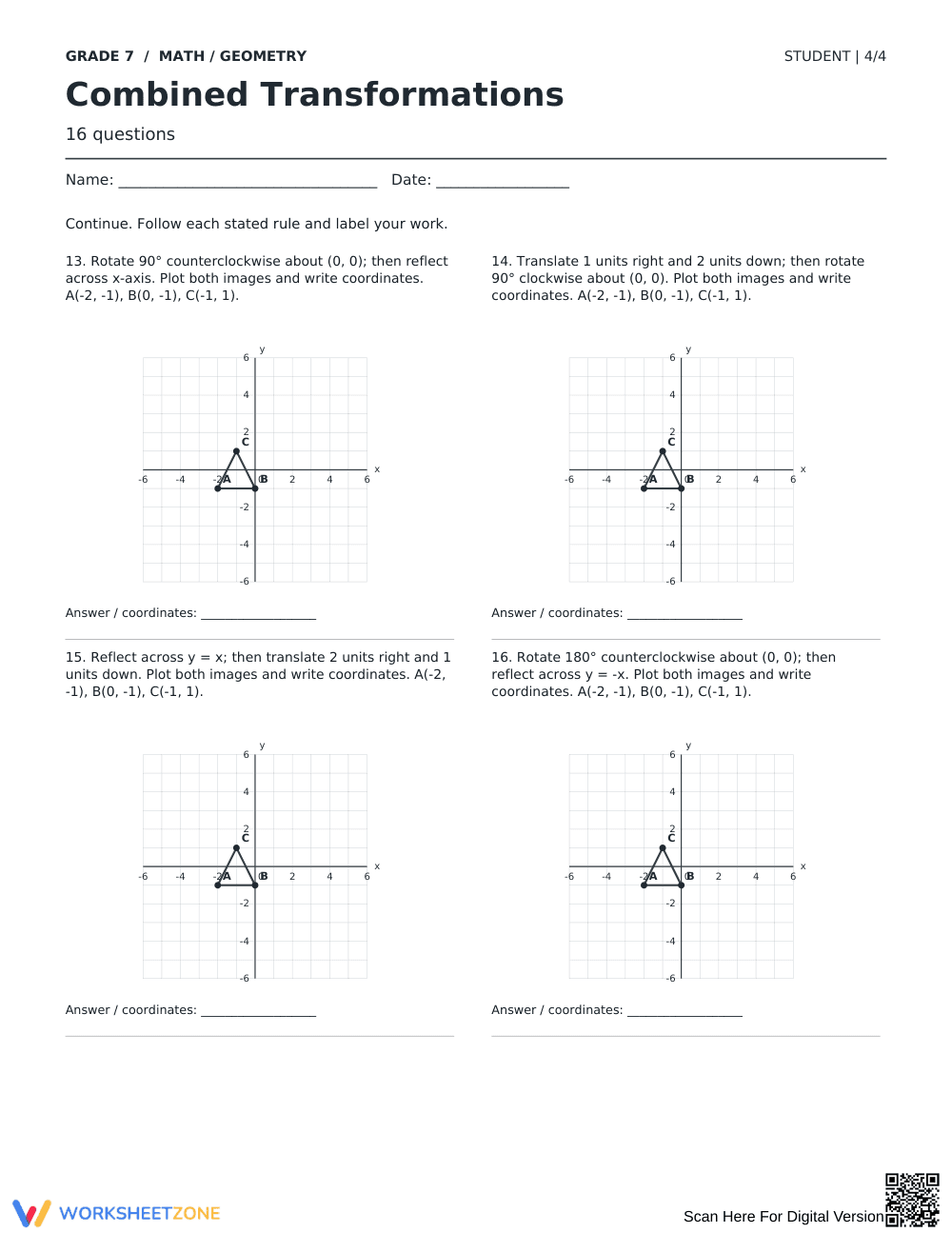

Combined Transformations Printable | Grade 7 Math
Paste this activity's link or code into your existing LMS (Google Classroom, Canvas, Teams, Schoology, Moodle, etc.).
Students can open and work on the activity right away, with no student login required.
You'll still be able to track student progress and results from your teacher account.
This Grade 7 geometry worksheet builds student fluency with combined transformations on the coordinate plane, guiding learners through translations, reflections, and rotations so they can accurately map figures and describe the resulting image coordinates. With 20 structured problems and a full answer key, students gain the repeated practice needed to master multi-step transformation sequences.
At a Glance
- Grade: 7 · Subject: Math / Geometry
- Standard:
CCSS.MATH.CONTENT.7.G.A.2— Draw and describe geometric figures and the relationships between them- Skill Focus: Combined transformations — translations, reflections, and rotations on the coordinate plane
- Format: 4 pages · 20 problems · Answer key included · PDF
- Best For: Guided practice after direct instruction
- Time: 30–45 minutes
The worksheet spans 4 student-facing pages and presents 20 problems that progress from single-step transformations to combined sequences requiring students to apply two or more transformations in order. Each problem includes a coordinate grid, clearly labeled pre-image vertices, and transformation instructions. The full answer key shows plotted images and labeled coordinates, making self-correction and teacher review straightforward.
- Guided practice (Problems 1–6): Students perform one transformation at a time — a translation or a reflection — with labeled axes and simple integer coordinates. Heavy scaffolding supports initial concept formation.
- Supported practice (Problems 7–14): Students apply two sequential transformations, such as a reflection followed by a rotation, recording both intermediate and final image coordinates. Grids remain provided; transformation rules are stated explicitly.
- Independent practice (Problems 15–20): Students interpret combined transformation descriptions, execute the full sequence without intermediate prompts, and verify that the final image matches the given conditions. This mirrors the gradual-release model so students build confidence before working independently.
Standards Alignment
This worksheet is aligned to CCSS.MATH.CONTENT.7.G.A.2: Draw geometric shapes with given conditions and describe the relationships between figures produced by transformations. Supporting work also connects to CCSS.MATH.CONTENT.8.G.A.1, giving teachers a natural bridge for previewing eighth-grade expectations around congruence and similarity.
How to Use It
Assign Problems 1–6 immediately after direct instruction on individual transformation types to check for understanding before moving to combined sequences. Use Problems 15–20 as an end-of-lesson exit ticket or a next-day warm-up to assess retention. Observe whether students correctly track intermediate image coordinates between transformations — a common error point signaling the need for re-teaching sequence order. Most students complete the full worksheet in 30–45 minutes.
Who It's For
This worksheet is designed for seventh-grade students receiving core geometry instruction, including those in inclusion settings who benefit from provided coordinate grids and explicit transformation rules. Teachers may pair it with a classroom anchor chart listing rotation rules (90°, 180°, 270° clockwise and counterclockwise) and a brief lesson using patty paper or dynamic geometry software to build conceptual understanding before procedural practice.
Teachers can use student performance on the final six problems as a formative data point for small-group reteaching or acceleration decisions, supporting the gradual-release framework that research identifies as essential for procedural fluency in geometry.


