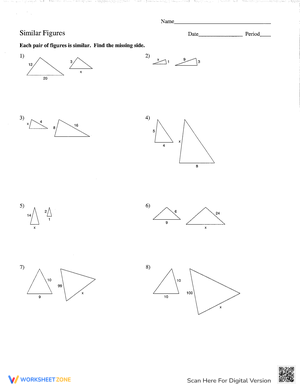
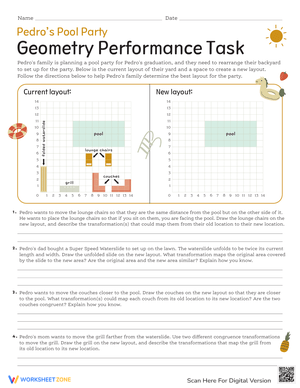
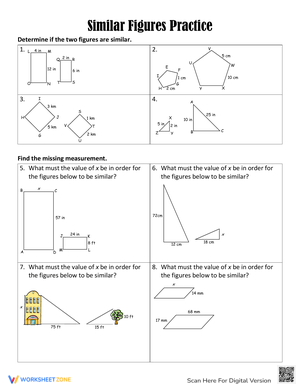
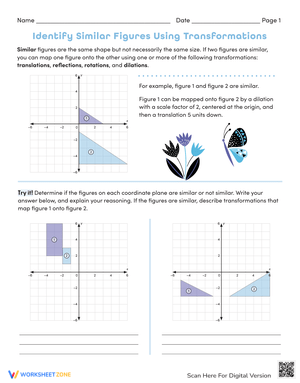
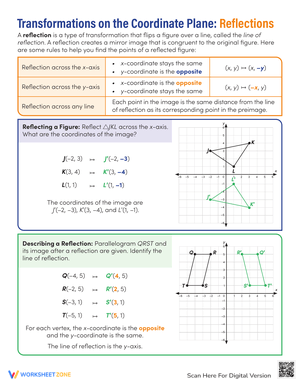
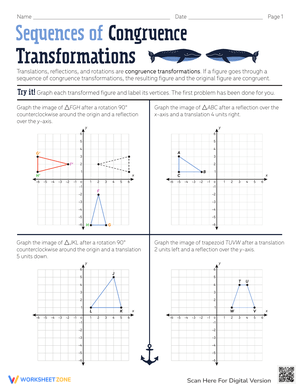
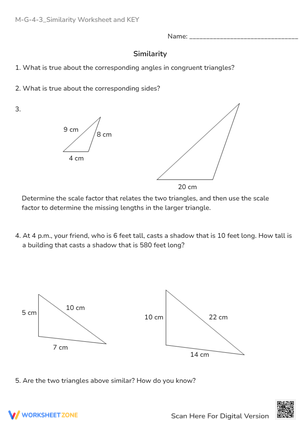
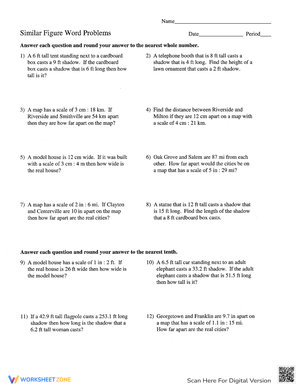
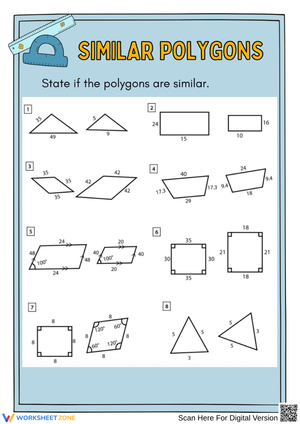
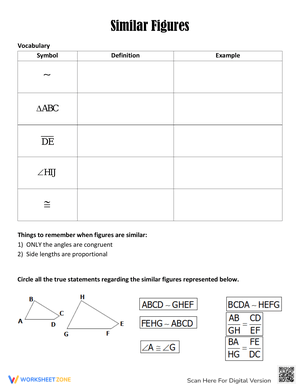
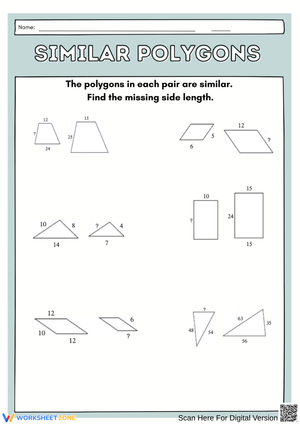
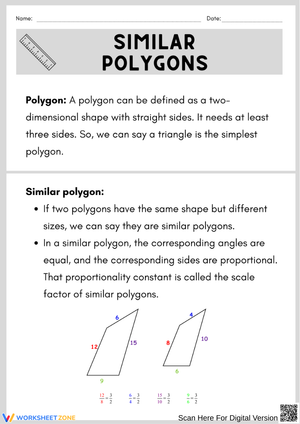
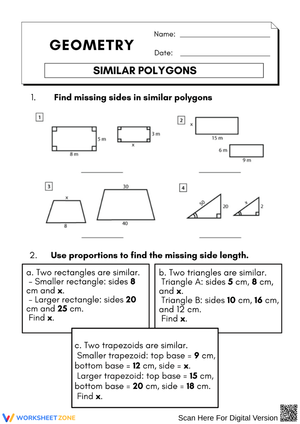
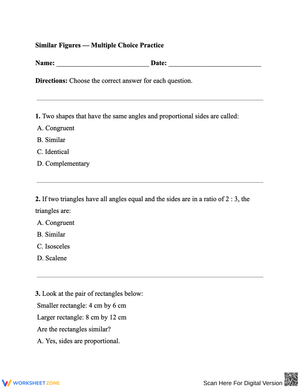
These similar figures worksheets for 8th grade move students through three distinct stages of understanding: deciding whether two shapes actually qualify as similar, justifying that decision by checking angle relationships and side-length ratios, and finally applying scale factors to find unknown measures. Each worksheet in the set targets one defined step in that sequence. Teachers get a printable resource that drops cleanly into guided practice, partner work, or quiz review without restructuring the surrounding lesson.
The Specific Skills Targeted
At 8th grade, similarity sits at the intersection of geometry and proportional reasoning — two strands that students often keep entirely separate in their thinking. These worksheets force that connection. Across the set, students work through a defined sequence of tasks:
- Identifying whether two figures are similar, using both angle relationships and side-length ratios as evidence
- Naming corresponding vertices and side pairs correctly from labeled diagrams
- Calculating scale factors in both enlargement and reduction directions
- Writing and solving proportions to find missing side lengths
- Interpreting similarity in context through scale drawings and short application problems
The set also directly addresses one distinction that consistently catches students off guard: the difference between similar and congruent figures. Students often treat "same shape" as sufficient reasoning for both terms, which creates errors the moment side lengths enter the picture. Finding similar figures worksheets for 8th grade that include congruent pairs alongside similar ones — asking students to classify each pair and explain the reasoning — makes that distinction stick in a way that a written definition rarely does on its own.
Mistakes Students Make That These Worksheets Surface Early
Three errors appear consistently in 8th grade student work on similar figures, and each one is addressable with the right kind of practice.
The first is comparing non-corresponding sides. A student might correctly identify Triangle ABC and Triangle DEF as similar, then set up the proportion by pairing AB with DE and BC with EF — matching alphabetically rather than geometrically — without checking whether those sides actually face equal angles. When the diagram has unlabeled angles, this mistake goes undetected until the answer comes back wrong. Worksheets that require students to mark corresponding pairs with matching symbols before writing any proportion catch this before it becomes a reflex.
The second is scale factor reversal. Students identify the correct ratio but apply it in the wrong direction — dividing where they should multiply, or vice versa, depending on which figure holds the unknown side. This error appears most often when a problem does not clearly specify which figure is the original and which is the scaled image. A worksheet prompt asking students to write the scale factor as "Figure A to Figure B" before calculating gives them a directional anchor that resolves much of this confusion.
The third is treating visual similarity as verification. Two rectangles that look proportional are not necessarily similar — a student who skips the ratio check because the shapes appear related has missed the mathematical point entirely. Worksheets that mix genuinely similar pairs with near-misses force students to run the numbers before reaching a conclusion. That checking habit is what the standard is ultimately after.
Smart Ways to Work These Worksheets Into Your Week
One approach that holds up well across different class structures: treat the worksheets as three batches released at different points in the unit rather than assigning everything at once. A recognition worksheet — pairs of figures, classify and justify — belongs in the first day or two of instruction, when students are still internalizing what "corresponding" means geometrically. A calculation worksheet focused on scale factors and proportion setup works best after at least two class periods of direct instruction on ratio notation. The application worksheet, with scale drawings and short word problems, should wait until students can solve a proportion without prompting on each step.
Within a single class period, the worksheets fit multiple slots. Two or three identification items make a focused bell ringer that runs under five minutes. A full calculation worksheet fills a 15- to 20-minute independent block. A mixed-review worksheet — cycling through recognition, scale factors, and an application problem — works well the class period before a unit test, when students need consolidation more than new instruction.
For similar figures worksheets for 8th grade specifically, the printable format enables something digital tools handle poorly: physical annotation. Students can mark corresponding angle pairs with matching symbols, draw arrows between sides that belong together, and write the scale factor direction directly beside the diagram before setting up any proportion. That annotation step makes student thinking visible during a walk-around check and measurably reduces the side-comparison errors described above.
Adjusting These Worksheets for a Range of Learners
The same worksheet can serve different learners with small structural adjustments — no completely separate document needed for each tier.
Students who are still building comfort with ratio notation benefit from a two-column ratio table alongside the proportion work. They list known side lengths from the diagram on one side of the table, leave the unknown blank on the other, and work through the comparison without losing track of which sides belong together. That format keeps the mathematical demand intact while reducing the organizational load that sometimes blocks entry into the problem.
On-level students work with each worksheet as given. The progression from identification items to multi-step proportion solving aligns with grade-level expectations, and the application problems offer enough challenge for students who move quickly through the calculation items.
For students ready for more challenge, add prompts to the bottom of whichever worksheet they finish: compare the perimeters of two similar triangles when the scale factor is 3, explain what happens to area as the scale factor changes, or identify the error in a student's worked solution and describe exactly where the reasoning broke down. These additions take about a minute to write on a printed copy and significantly raise the ceiling without creating a separate resource.
One honest limitation worth noting: some similar figures worksheets assume students can already read geometric notation fluently. Intervention groups who are uncertain about vertex labeling — who don't immediately understand that "Triangle ABC ~ Triangle DEF" means A corresponds to D, B to E, and C to F — need that correspondence made explicit before the proportion work begins. A brief verbal walkthrough at the start prevents a significant amount of confusion downstream.
Standard Alignment
These worksheets align to CCSS 8.G.A.4, which states that a two-dimensional figure is similar to another if the second can be obtained from the first by a sequence of rotations, reflections, translations, and dilations. In classroom terms, that standard places similar figures within the transformations strand — meaning students who have already worked with dilations arrive with a useful mental model for what scale factor means geometrically. Worksheets that present one figure as a scaled version of another reinforce exactly what 8.G.A.4 describes, whether or not the word "dilation" appears on the page. The standard also connects backward to 7.RP.A.2 (proportional relationships), which makes these worksheets practical for 8th graders who need to reactivate ratio reasoning before they can work fluently with proportions in a geometric context.
Frequently Asked Questions
Do students need prior experience with dilations before starting these worksheets?
Not as a hard prerequisite, but prior exposure helps. Students who have worked with dilations already understand that multiplying by a scale factor produces a larger or smaller version of a shape — a conceptual foundation that makes proportion work more intuitive. Students without that background can still succeed; they may need more time connecting the visual size difference to the numerical scale factor. Starting with recognition items before moving to calculation is the practical sequence regardless of what students already know.
How do these worksheets handle figures that are not actually similar?
The strongest worksheets include non-similar pairs intentionally — two figures that look proportional but whose side ratios don't match, or two shapes with equal corresponding angles but inconsistent side lengths. Those items distinguish surface similarity from mathematical similarity. A worksheet that presents only confirmed similar pairs removes the verification step, and verification is the core reasoning skill the standard targets. Teachers should check for non-examples before selecting a worksheet to make sure students practice the full task, not just the calculation piece.
Can these worksheets serve both initial instruction and later review?
Yes. Using similar figures worksheets for 8th grade this way takes a bit of planning but is worth it. A recognition worksheet assigned early in the unit can reappear as a warm-up before the test — students who annotated their copies the first time can revisit their own work and see where their thinking has changed. Mixed-review worksheets that cycle through identification, scale factors, and application in one session are especially reusable: they work for guided instruction the first time through and for independent review before an assessment.
What should an answer key include beyond the final numerical answers?
At minimum, a useful key shows the proportion setup alongside the result. For missing-side problems, seeing the correct ratio written out tells a teacher whether a student who arrived at the right answer actually used the right method — and it gives an intervention-group student a clear model to reference before attempting the problem again. Keys that list only final values leave teachers reconstructing the intended method mid-lesson, which costs time better spent on the reteaching conversation itself.













 Interactive Worksheet Maker
 Quiz Maker
 Word Search Maker
 Crossword Puzzle Maker
 Word Scramble Generator
 Sentence Scramble Generator
 Handwriting Worksheet Generator
 Name Tracing Generator
 Fill In The Blank Generator