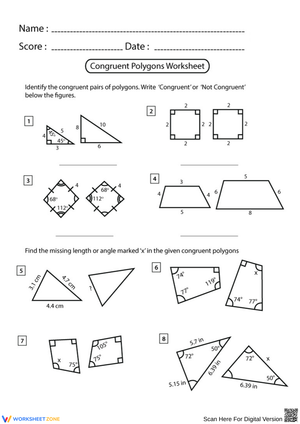
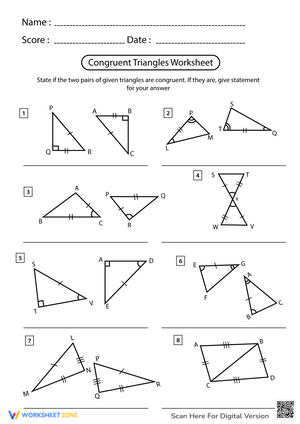
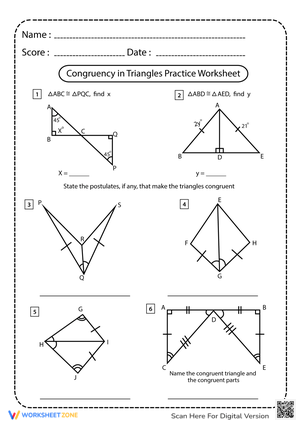
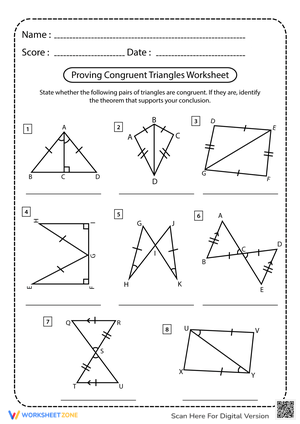
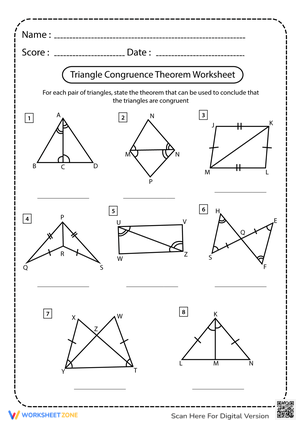
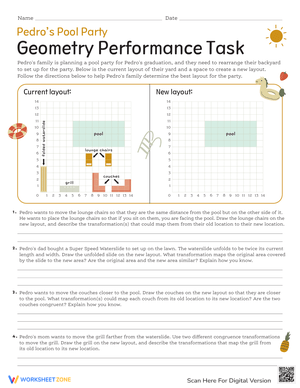
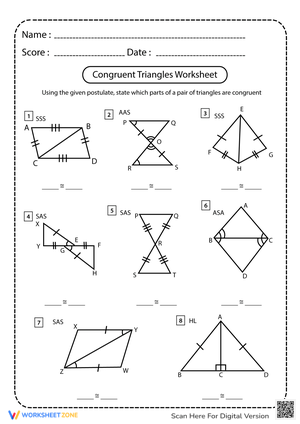
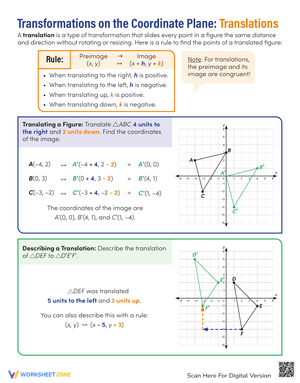
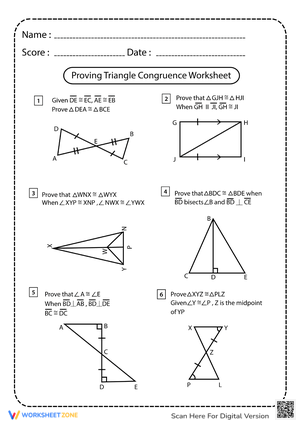
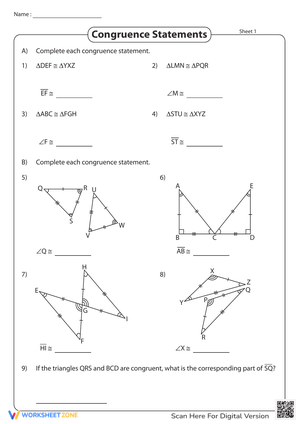
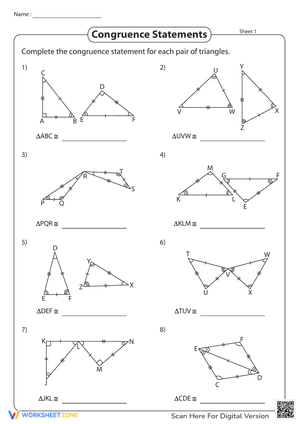
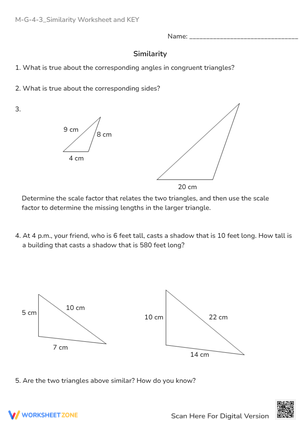
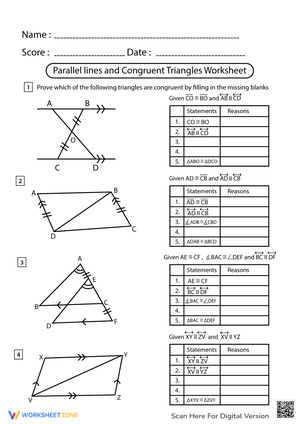
These congruent figures printable worksheets for 8th grade give students the written, grid-based practice they need to move from visual intuition about shape identity toward precise, transformation-based proof — the shift that 8th grade geometry specifically demands.
Skills These Worksheets Build
The work in each worksheet centers on rigid transformations: translating, reflecting, and rotating figures on a coordinate plane, then using those movements to establish congruence. Students record vertex coordinates before and after each transformation, write the algebraic rule describing the movement, and identify which sequence of transformations connects two given figures. Several worksheets present two congruent figures already placed on the grid and ask students to work backward — naming the transformation sequence rather than executing a given one. That reverse task is harder than it sounds, and students who can do it fluently have genuinely internalized congruence rather than just memorized coordinate rules.
The transformation types covered across the set include:
- Translations — moving a figure a fixed number of units horizontally, vertically, or both, expressed in (x + a, y + b) notation
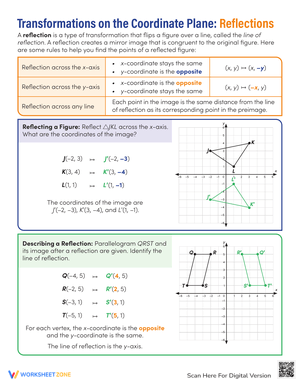
- Reflections — producing a mirror image across the x-axis, y-axis, or a named horizontal or vertical line
- Rotations — turning a figure 90°, 180°, or 270° clockwise or counterclockwise around a specified center point
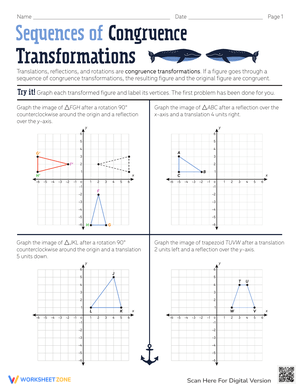
- Multi-step sequences — combining two or three of the above to map complex figure pairs, with the intermediate figure required as a drawn and labeled step
Each worksheet also addresses the congruent-versus-similar distinction directly. At 8th grade, dilation arrives in the same semester as rigid transformations on most pacing guides, and the two concepts blur quickly for students who aren't forced to make the distinction explicit. Worksheets that ask students to classify figure pairs — congruent, similar, or neither — and justify the classification in writing keep that boundary sharp.
What Goes Wrong When Students Work Through These Problems
Reflection errors are the most consistent mistake in this unit. When reflecting across the y-axis, students are supposed to negate the x-coordinate and leave y unchanged. A large number of students invert this on the first attempt, negating y instead — not because they're guessing, but because they reason (incorrectly) that "y-axis means something changes about y." Having students write the reflection rule in plain English before applying it — "the figure flips left-right because the y-axis is vertical, so x changes sign" — breaks this pattern more reliably than repeating the algebraic rule.
Rotation errors tend to be messier. The 90° counterclockwise rotation maps (x, y) to (−y, x), but students taught to "swap and negate" often negate the wrong coordinate or negate both. The error compounds when they try to apply the rule twice for a 180° rotation instead of using the simpler (−x, −y) rule. The coordinate recording built into these worksheets surfaces the mistake immediately — a wrong vertex value in the table is visible before it becomes a misplotted point on the grid.
The subtler error is conceptual rather than procedural. Students who correctly identify two figures as congruent will sometimes describe a transformation sequence that includes a dilation — "I reflected it and then scaled it to match." That phrasing reveals they believe the reflection changed the figure's size, which means the meaning of rigid transformation hasn't fully landed. This surfaces in written responses and not on multiple-choice checks, which is exactly why requiring students to write out transformation sequences matters.
Fitting These Worksheets Into the Lesson Week
These congruent figures printable worksheets for 8th grade work best as the written follow-through after a demonstration-based lesson opening. Show the rotation on the board using graph paper or a projected coordinate plane, model the coordinate calculation for one vertex, then distribute the worksheet so students apply the same transformation type across a full set of problems. The physical act of plotting, drawing the transformed figure, and writing the algebraic rule in the answer box reinforces the demonstration in a way that passive observation does not.
Single-step transformation worksheets work well as exit tickets — five problems that show you by the end of class whether students can execute a translation or reflection independently before encountering two-step sequences the next day. Multi-step worksheets are better used during guided practice: have students work in pairs, one student executing the first transformation and sketching the intermediate "ghost figure" lightly in pencil, the other handling the second transformation from that midpoint. That division of labor forces both students to communicate about the intermediate state of the figure and dramatically reduces the number of misplaced final vertices that come from trying to hold two movements in working memory simultaneously.
Standard Alignment
These worksheets align directly to CCSS 8.G.A.2, which requires students to understand that a two-dimensional figure is congruent to another if the second can be obtained from the first by a sequence of rotations, reflections, and translations — and to describe that sequence. The standard's operative verb is describe, not merely identify, which is why the worksheets require written coordinate notation alongside the plotted result. Adjacent standards addressed across the set include 8.G.A.1 (properties preserved under rigid transformations: line segments, angles, parallel lines) and 8.G.A.3 (the effect of dilations, translations, rotations, and reflections on coordinates), both of which provide the algebraic underpinning for the transformation work students practice on each worksheet.
Adjusting for Mixed Readiness in the Geometry Classroom
For students still building fluency, start with worksheets that isolate a single transformation type — specifically reflections across the x-axis or y-axis, where the rule is direct and the visual result is easy to verify by folding a piece of tracing paper along the axis. Provide a coordinate rule reference alongside the worksheet so students spend their attention on applying the transformation rather than on retrieving three different rules at once. Once single-step accuracy is solid, move to translations before introducing rotation, which has the steepest learning curve of the three.
Students who move through single-step problems quickly benefit from the reverse-reasoning worksheets: two figures on the grid, no instructions, just the prompt "describe all rigid transformations that map Figure A onto Figure B." Require at least two transformations in the answer and push back on students who find a single translation that technically works — ask them to find a second route using reflection and rotation. That constraint reveals that transformation sequences are not unique, a concept with genuine implications at the high school level that rewards early exposure.
For mixed-readiness classes, the congruent figures printable worksheets for 8th grade covering multi-step sequences can be split without giving students different handouts: students who need more support complete the first transformation and describe the second in words; students at grade level complete both transformations in coordinate notation and draw the final image. Same figure pairs, same mathematical territory, adjusted demand.
Frequently Asked Questions
What transformation types do the worksheets cover?
The set covers all three rigid transformations — translation, reflection, and rotation — in both single-step and multi-step formats. Some worksheets provide pre-labeled vertex coordinates so students focus entirely on applying the algebraic rule; others present figures drawn on a blank coordinate grid so students must read coordinates before beginning. The multi-step worksheets combine all three transformation types and require students to draw and label the intermediate figure between each step.
How do these worksheets handle the congruent-versus-similar distinction?
Several worksheets in the set include classification problems where students examine a figure pair and decide whether the relationship is congruent, similar, or neither, with written justification required. The instructions direct students to check for dilation: if the figures match in shape but not in size, a change of scale was involved, making them similar rather than congruent. This keeps the distinction active throughout the unit rather than treating it as a one-day topic.
Do students need prior coordinate plane work before starting?
Students need solid four-quadrant fluency — plotting and reading points accurately in all four quadrants — before these worksheets produce productive practice. The transformation rules are introduced through the worksheet instructions, but students who are still uncertain about how to locate a point like (−4, 3) will spend most of their time on that step rather than on the transformation itself. A brief four-quadrant plotting warm-up before the first congruent figures printable worksheets for 8th grade session clears that obstacle for most students within a few minutes.













 Interactive Worksheet Maker
 Quiz Maker
 Word Search Maker
 Crossword Puzzle Maker
 Word Scramble Generator
 Sentence Scramble Generator
 Handwriting Worksheet Generator
 Name Tracing Generator
 Fill In The Blank Generator