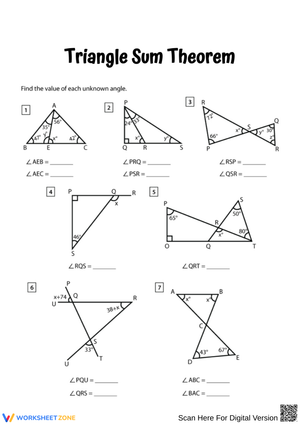
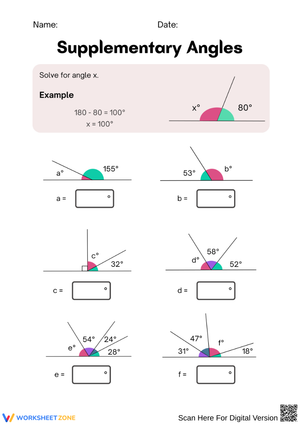
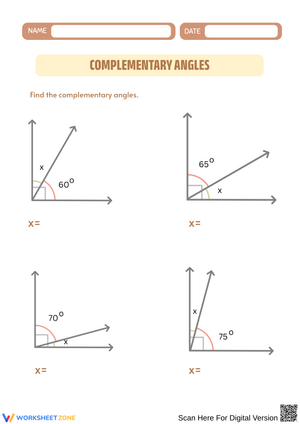
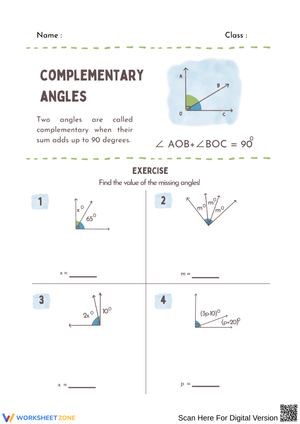
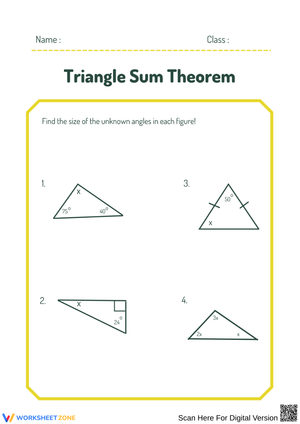
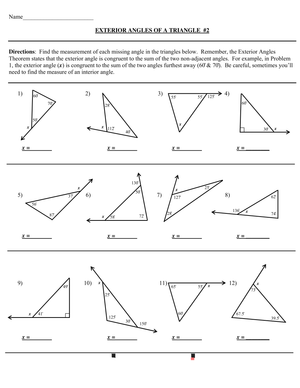
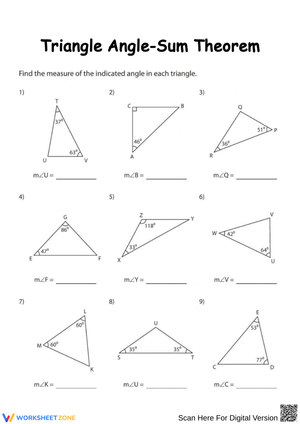
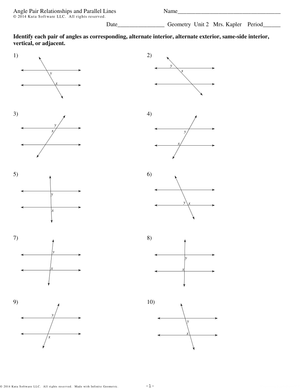
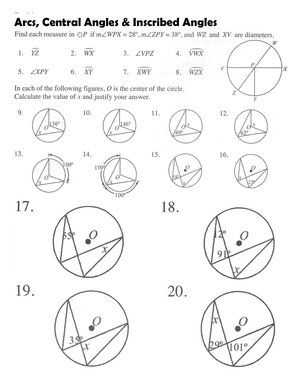
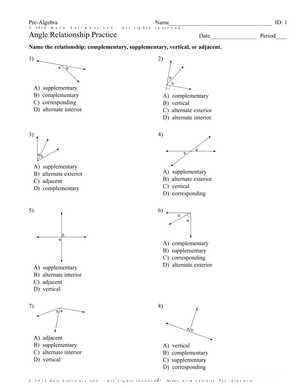
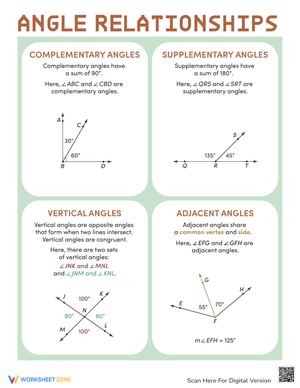
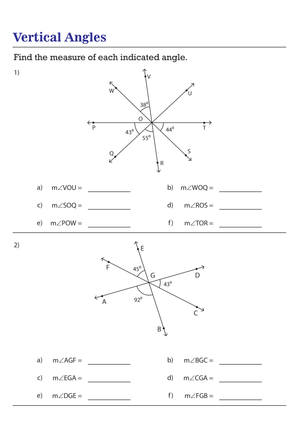
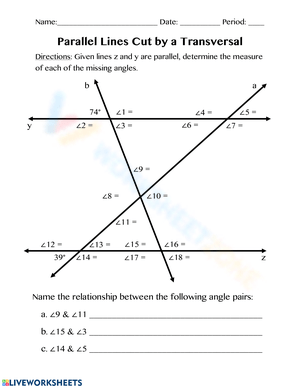
These 8th grade angles worksheets resources mark a specific shift in geometry instruction — away from labeling diagrams and toward using angle relationships to write and solve equations. At this level, students need repeated exposure to the logic behind the relationships, not just the mechanics of identifying them. This set gives teachers printable practice that fits cleanly into daily routines without extra prep.
The Specific Skills Targeted
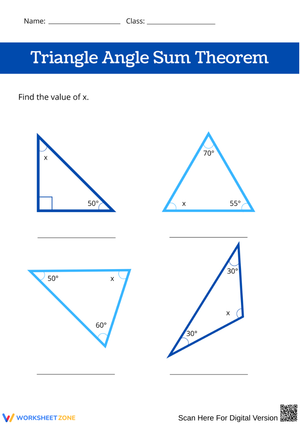
Grade 8 angle work centers on relationships students can justify, not just identify. The progression moves from recognizing angle pairs to explaining why a rule holds, then applying that rule inside an equation. Each worksheet in the set addresses one or more of the following:
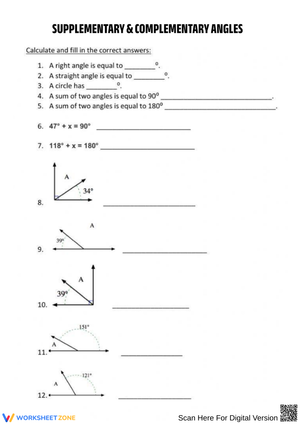
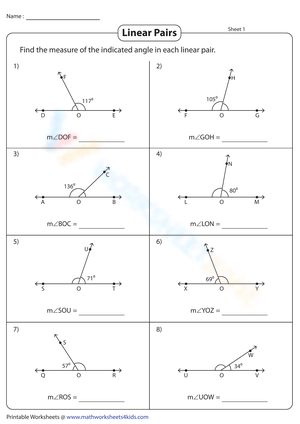
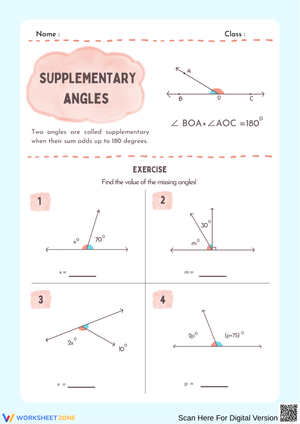
- Complementary and supplementary angles: finding missing measures when two angles sum to 90 or 180 degrees, including identifying linear pairs on a diagram
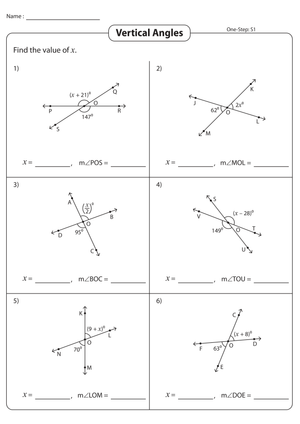
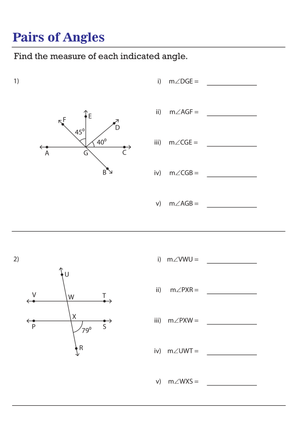
- Vertical angles: recognizing equal measures created at intersections and setting up equations when expressions replace numerical labels
- Adjacent angles: combining or separating angle parts within a shared side, including multi-step items where students work with angle addition
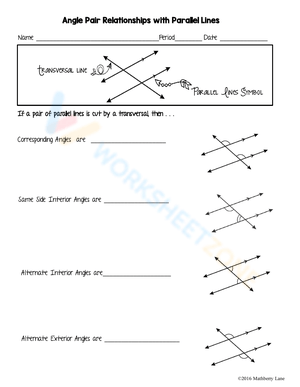
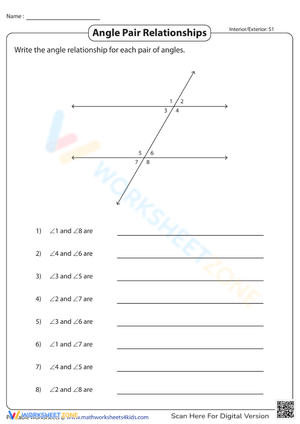
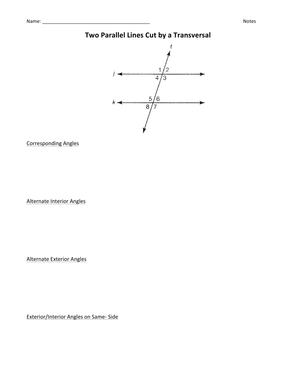
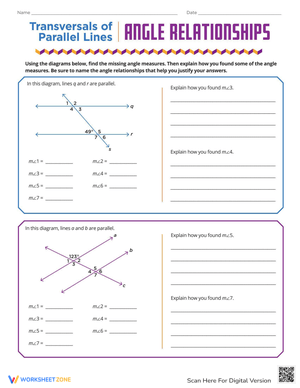
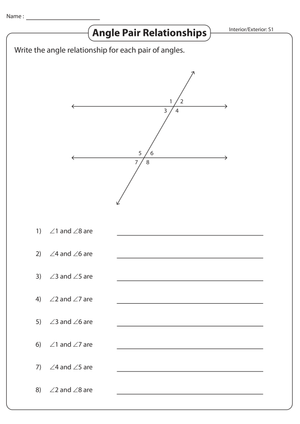
- Transversal relationships: identifying corresponding, alternate interior, alternate exterior, and co-interior angle pairs when a transversal crosses parallel lines
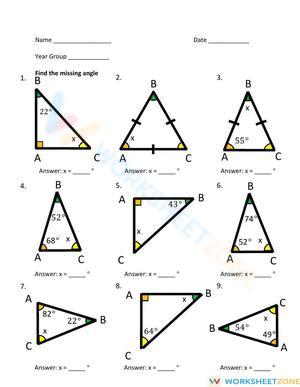
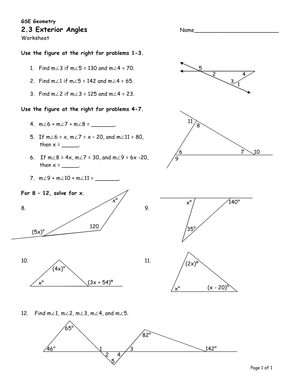
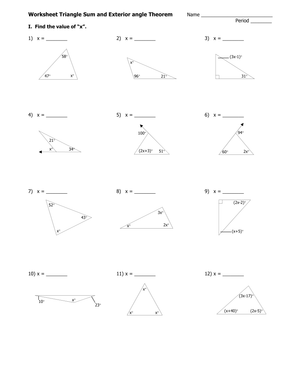
- Algebra with angle measures: writing and solving equations where variable expressions represent angle measures — the skill that connects this geometry unit to the algebra work students do all year
Keeping a sorted collection of 8th grade angles worksheets materials organized by these skills makes it easier to match a specific worksheet to a lesson target rather than hunt for usable problems mid-period.
Frequent Errors Worth Anticipating Before You Hand These Out
The most persistent mistake at this level is treating angle relationships as visual guesses rather than as rules. A student who understands that vertical angles look equal in a clean textbook diagram will still write unequal measures when the diagram is rotated or when one angle is labeled with an expression. The visual habit overrides the conceptual one, and worksheets with non-standard orientations are the fastest way to surface it.
A second consistent error involves confusing supplementary and complementary. Students who have the definitions memorized will still write 180 minus the given measure for a complementary pair when the problem features a right-angle corner marked on the diagram — the 90-degree marking goes unnoticed entirely. Watch for that pattern on the first few worksheets, especially when a diagram includes more than one angle pair at the same vertex.
Transversal problems generate a third category of errors. Students frequently identify co-interior angles as alternate interior angles because both pairs sit inside the parallel lines. The distinction — same side of the transversal versus opposite sides — requires deliberate diagram reading, and that habit builds through repeated exposure rather than one explanation. Each worksheet that includes transversal diagrams is an opportunity to reinforce that step explicitly.
Building These Worksheets Into Your Weekly Lesson Plans
Bell ringers are the easiest entry point. Three to four problems reviewing the previous day's angle relationship take about seven minutes and keep vocabulary active between lessons. That's a more efficient use of the first minutes of class than reteaching from scratch on a Wednesday because students haven't touched the concept since Monday.
After direct instruction, a short set of targeted questions — maybe six problems focused on one relationship — gives students a contained place to practice while the teacher circulates and listens. That's the window where most misconceptions surface before they harden. A full worksheet works better for independent practice later in the period or as homework when students have already had a chance to ask questions.
Substitute plans are another place where printable angle practice earns its keep. A PDF with a clear structure and no ambiguous directions can hold a class through a full period without requiring the substitute to explain the geometry. That's a genuine practical reason to maintain a folder of sorted angle worksheets before a unit begins, not during it.
Standard Alignment
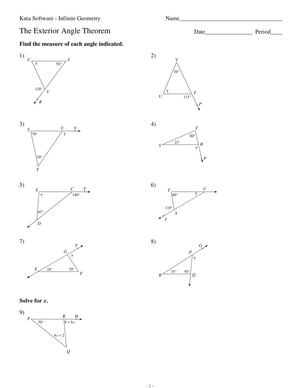
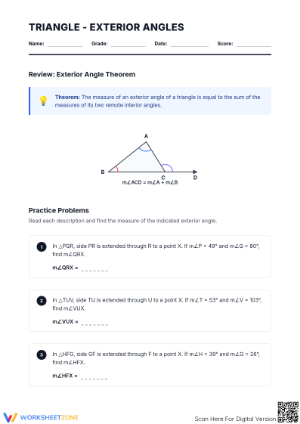
The core standard for this content is CCSS 8.G.A.5, which asks students to use informal arguments to establish facts about angle relationships — specifically the angles created when parallel lines are cut by a transversal, and exterior angle relationships in triangles. Transversal worksheets map directly to this standard. Supplementary, complementary, vertical, and adjacent angle work primarily builds from 7.G.B.5, which most eighth-grade programs revisit at the start of the geometry unit before extending into parallel-line scenarios.
In classroom terms, 8.G.A.5 asks for more than calculation. Students need to explain why angle pairs are equal or supplementary, not just state the measures. Worksheets that include a justification line — a blank where students write the rule they applied — address that expectation more directly than fill-in-the-blank formats alone.
Adjusting the Worksheets for a Range of Learners
For students still developing fluency with angle vocabulary, start with worksheets that isolate one relationship per diagram. Clean, large diagrams with fewer labels reduce the chance that a student fails a problem because of diagram confusion rather than a conceptual gap. Once a student consistently names the relationship before solving, introduce diagrams with multiple angle pairs at the same intersection.
Students who handle standard problems quickly benefit from worksheets where every angle measure involves a variable expression — for example, one angle labeled 3x + 15 and its vertical partner labeled 5x minus 7. These problems require setting up an equation, solving for x, and substituting back to find the actual angle measure. That's where a well-chosen 8th grade angles worksheets earns its place in an algebra-geometry bridge unit, because the same equation skills students practice in their algebra strand appear directly inside a geometric context.
A practical organizational move: sort angle practice into three groups — introductory worksheets that build vocabulary and basic identification, on-level worksheets with mixed relationship types, and extension worksheets with multi-step algebraic expressions. Pulling from the right group based on where a student actually is, rather than where the calendar says they should be, makes small-group reteaching faster to execute.
Frequently Asked Questions
Which angle relationships matter most at 8th grade?
Supplementary, complementary, vertical, and adjacent angle pairs form the foundation, and most programs solidify them at the start of the Grade 8 geometry unit. Angles formed by a transversal are the key extension — that content is specific to 8th grade in most CCSS-aligned curricula and appears on most state assessments. Algebra-based angle problems are also essential because they connect geometry to the equation-solving work students are doing simultaneously in their algebra strand.
How should teachers sequence these worksheets across a unit?
Start with worksheets that target one angle relationship at a time — students need to name the rule before they can apply it under pressure. Move next to worksheets that mix relationship types without variables, then into algebraic angle problems. A short unit typically works through four to six distinct worksheets: one or two focused on basic pairs, one on transversal diagrams, one mixing all relationship types, and at least one requiring students to write and solve equations. Having both a review worksheet and an intervention worksheet for each major skill gives teachers room to respond when a class needs more time on one concept.
What helps students who consistently misread geometry diagrams?
A well-formatted 8th grade angles worksheets with clean, uncluttered diagrams reduces the problem — but the diagrams alone won't fix the habit. The most effective approach pairs the worksheet with an explicit first step: before solving, students mark the angle pair they are working with using a colored pencil or by tracing the relevant rays. That small physical action slows down diagram misreading without changing the mathematics on the worksheet.
Can these worksheets substitute for teacher-led instruction on angle relationships?
No. Worksheets consolidate and extend what students have been taught; they do not introduce it. The most common mistake in geometry instruction is assigning practice before students have heard a clear explanation of why a rule holds. A student who hasn't grasped why alternate interior angles are equal will not develop that understanding by filling in missing measures twelve times. The worksheet works after the concept is established, not in place of that work.













 Interactive Worksheet Maker
 Quiz Maker
 Word Search Maker
 Crossword Puzzle Maker
 Word Scramble Generator
 Sentence Scramble Generator
 Handwriting Worksheet Generator
 Name Tracing Generator
 Fill In The Blank Generator