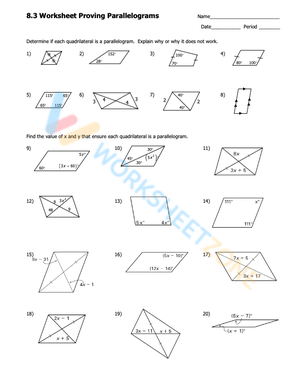
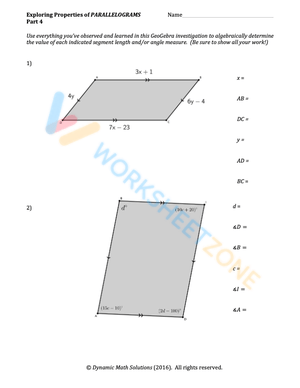
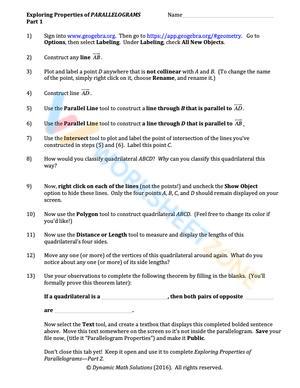
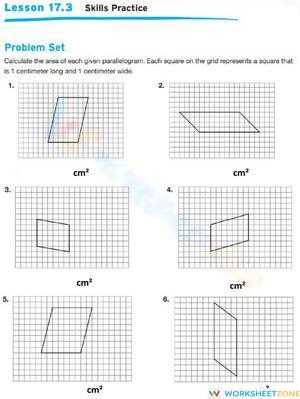
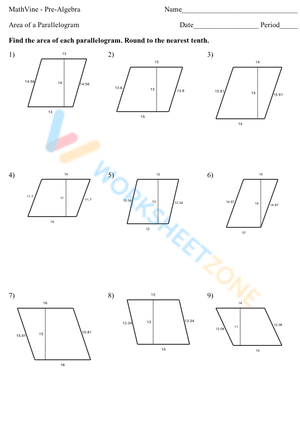
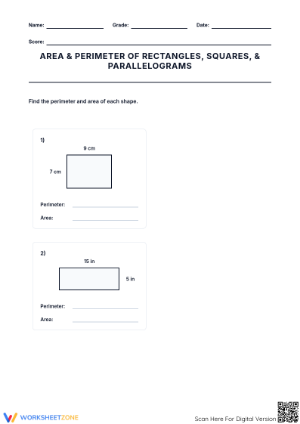
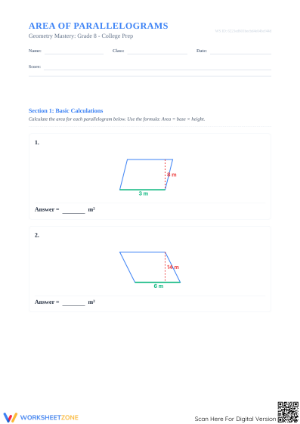
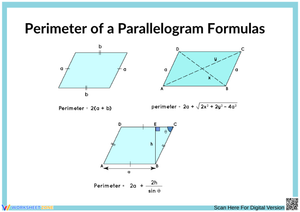
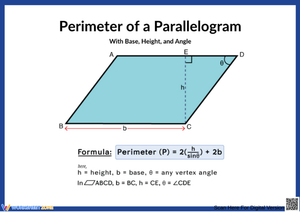
These parallelogram worksheets for 8th grade give geometry teachers a ready-to-print set that covers the full range of properties students are expected to apply — from opposite-angle congruence to diagonal bisection to area with a perpendicular height. The resources move past shape identification and into the kind of reasoning work that prepares students for mixed geometry assessments.
Skills These Worksheets Build
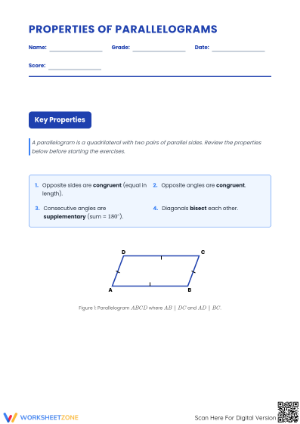
The set is built around the four core properties and two measurement skills that define parallelogram work at the middle school level. Students don't just label — they apply each property to find missing values, set up equations, and explain their reasoning.
- Opposite sides congruent: students write and solve equations when sides carry algebraic expressions rather than simple numbers, then substitute back to confirm the actual length.
- Opposite angles congruent: students find missing angle measures using the congruence relationship without relying on a protractor.
- Consecutive angles supplementary: students recognize that two angles sharing a side sum to 180° and set up the equation from that relationship.
- Diagonals bisect each other: students solve for half-lengths and full diagonal measures using the bisection property alone.
- Perimeter: students use opposite-side congruence to fill in unknown lengths before adding, rather than leaving two sides blank and guessing.
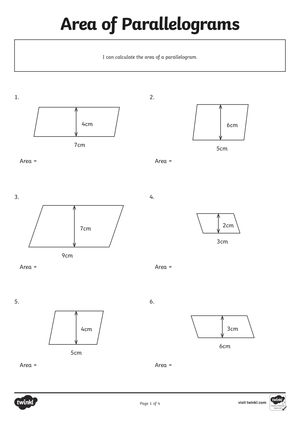
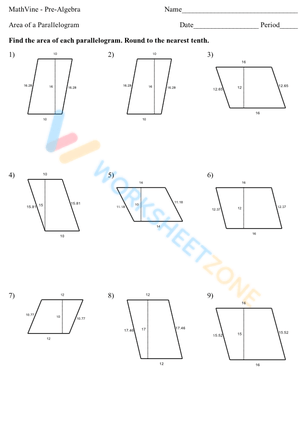
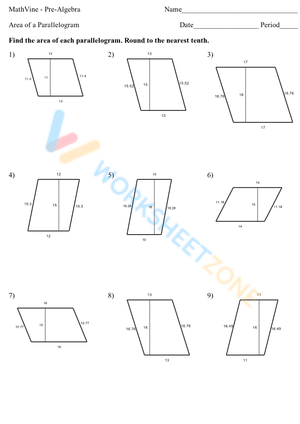
- Area: students multiply base by perpendicular height — and every area worksheet pairs the correct measurement with a visible slanted side so students have to make an active choice about which dimension to use.
Several worksheets in the parallelogram worksheets for 8th grade set also place figures on coordinate grids, adding the step of computing or counting segment lengths before applying a property. That format surfaces whether a student truly understands opposite-side congruence or is simply recognizing a tick-mark pattern on a labeled diagram.
Mistakes Students Make That These Worksheets Surface
The most stubborn error in this unit appears in area problems. A parallelogram with a base of 10 and a slanted side of 7 will produce a written answer of 70 from a meaningful share of 8th graders, even when the perpendicular height of 6 is clearly marked on the diagram. Students see two labeled dimensions and multiply without checking which one forms a right angle with the base. The worksheets counter this by presenting diagrams where the slanted side carries a measurement specifically to force a decision — both dimensions are labeled, and students who guess will pick the wrong one. Working that problem type aloud at least once, with a student narrating why the slanted measurement doesn't qualify as height, produces better retention than any written rule.
Diagonal bisection trips students differently. They learn the property correctly but then apply it to any four-sided figure without verifying the figure is a parallelogram. Worksheet items that mix quadrilateral types push back against that overgeneralization. A second common procedural slip: when algebraic expressions appear on opposite sides — say, 3x + 5 and 2x + 11 — students often solve for x correctly and then report x as the answer rather than substituting to find the actual side length. Including a follow-up line that explicitly asks "what is the side length?" catches that shortcut before it becomes a quiz-day habit.
How to Work These Worksheets Into Your Lesson Plans
The most efficient entry point is the second day of a parallelogram unit — after students have seen the properties introduced but before they have applied them independently. A single labeled diagram paired with four quick questions ("which sides are equal?", "what do angles A and C share?", "what do angles A and B sum to?") activates the properties in about five minutes and costs nothing in terms of new instruction.
During guided practice, project one worksheet and work the first two problems together before releasing students. For the area worksheet, spend a moment asking someone to explain aloud why the slanted side doesn't count. That spoken explanation — especially when a student produces it rather than a teacher — sticks longer than a rule copied into a notebook.
Other natural placements in the weekly structure:
- Algebra-geometry bridge days: the algebraic expression problems fit cleanly when students are first learning to write geometric equations — same equation-solving moves, new context.
- Small-group reteach: pull the diagonal-bisection or consecutive-angle worksheets for students who missed those question types on the first assessment, rather than re-teaching the full unit.
- Friday review: a mixed-property worksheet covering area, angles, and perimeter gives a cumulative check before moving on to rectangles and rhombi.
- Exit checks: two or three problems from the end of any worksheet function as a fast formative read without requiring a separate assessment document.
Adjusting These Worksheets Across Ability Levels
For students who are still shaky on the properties themselves, start with worksheets that include a reference box listing all four properties at the top. That reference doesn't solve problems for them — it removes the simultaneous recall burden so students can focus on applying the right property rather than retrieving it from memory under pressure. The cognitive load of "which property applies here?" and "how do I use it?" together is often what derails students who understand each step individually. Once students demonstrate consistent fluency without looking, the reference box becomes unnecessary.
Students who need more challenge benefit from the coordinate-grid worksheets and from items that layer two properties in one problem — for example, finding an angle first, then using that angle to establish a supplementary relationship and solve for a variable. An extension that consistently works: ask those students to write their own parallelogram problem using algebraic expressions for all four sides, then verify that the expressions are consistent with the properties before swapping with a partner. That verification step demands considerably more structural reasoning than solving a given equation.
When parallelogram worksheets for 8th grade are used as intervention tools, the most effective approach is targeting one property per session rather than combining all four. Students who missed the unit the first time rarely have a complete conceptual blank — they usually have one specific gap, most often area or diagonal bisection. A focused worksheet on that one property, followed by a two-problem check, confirms the gap faster than a full mixed review and makes small-group time more efficient.
Standard Alignment
These worksheets align with CCSS 8.G.A, which directs 8th graders to understand, apply, and explain geometric properties through reasoning and multi-step problem solving. The algebraic expression items also reinforce CCSS 8.EE.C.7 — writing and solving linear equations — in a geometric context. That connection matters because many students who solve equations fluently in isolation freeze when the same equation structure appears inside a geometry problem. The coordinate-grid worksheets extend into 8.G.B, where students use coordinate representations to reason about relationships between figures. For teachers following the Illustrative Mathematics Grade 8 sequence, this set fits in the unit structure where students examine quadrilateral properties before moving into transformation-based reasoning about congruence.
Frequently Asked Questions
What exactly is the perpendicular height, and why can't students use the slanted side for area?
The perpendicular height is the straight-down distance between the two parallel bases — it meets the base at a right angle. The slanted side is an edge of the figure, and its length is always greater than the perpendicular height unless the parallelogram happens to be a rectangle. Multiplying base by slanted side gives a number larger than the actual area because you are computing as if the figure were taller than it is. Diagrams in these worksheets label both dimensions deliberately so students have to choose, not guess, which one belongs in the formula.
Do these worksheets come with answer keys?
Every worksheet in the set includes a full answer key. For multi-step problems, the key shows the equation students needed to write before solving — not just the final number — which makes it straightforward to identify exactly where reasoning broke down when reviewing work with a small group or during a quick conference.
Are these appropriate as a lead-in before teaching rectangles and rhombi?
Yes. Students who work through this set develop the property knowledge that rectangles, rhombi, and squares all build on — each special type inherits every parallelogram property and then adds constraints of its own. Using the parallelogram worksheets for 8th grade as the "shared properties" phase before introducing special parallelograms gives the unit a clear logical sequence: establish what is true of all parallelograms, then show how each special case tightens those relationships further.
Do these work in a digital classroom?
The PDF format uploads cleanly to most classroom management platforms. Students can annotate diagrams digitally using standard PDF tools, which preserves the mark-up habits that geometry problems reward — marking right angles, labeling congruent sides with tick marks, writing equations directly on the figure. Printed versions work equally well, since the diagrams are sized for standard paper with enough blank space to show work alongside each figure.













 Interactive Worksheet Maker
 Quiz Maker
 Word Search Maker
 Crossword Puzzle Maker
 Word Scramble Generator
 Sentence Scramble Generator
 Handwriting Worksheet Generator
 Name Tracing Generator
 Fill In The Blank Generator