




























Views
Downloads

Multi-Step Equations Worksheet | Grade 7 Essential

Paste this activity's link or code into your existing LMS (Google Classroom, Canvas, Teams, Schoology, Moodle, etc.).
Students can open and work on the activity right away, with no student login required.
You'll still be able to track student progress and results from your teacher account.
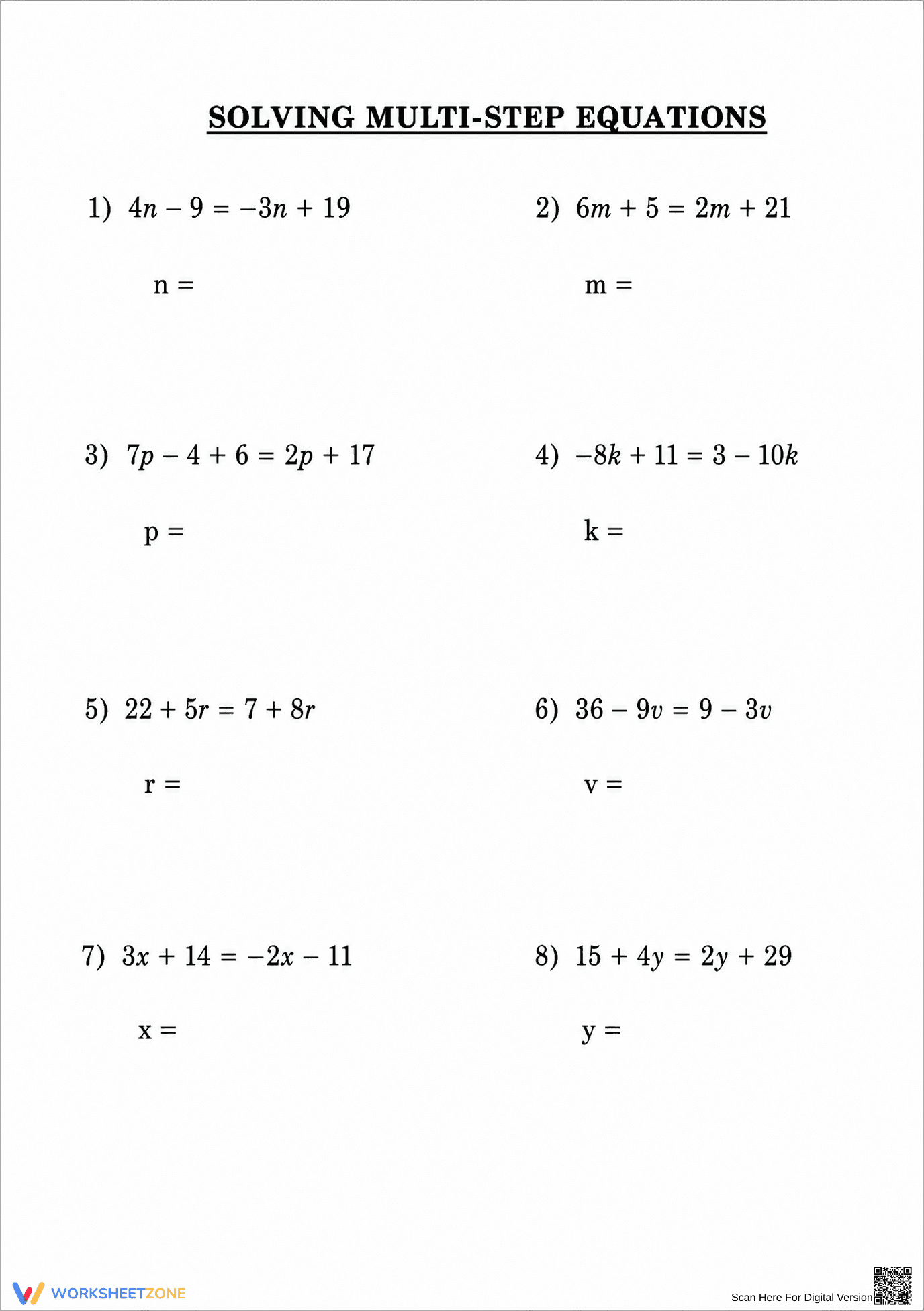
This Grade 7 algebra worksheet provides targeted practice for students learning to solve multi-step linear equations. By working through problems with variables on both sides and integer operations, students develop the procedural fluency required for higher-level mathematics. It ensures learners can isolate variables efficiently using inverse operations to find the correct solution.
At a Glance
- Grade: 7 · Subject: Algebra
- Standard:
CCSS.MATH.CONTENT.8.EE.C.7.B— Solve linear equations with rational number coefficients and variables on both sides- Skill Focus: Multi-step equation solving
- Format: 1 page · 8 problems · Answer key included · PDF
- Best For: Independent practice or quick formative assessment
- Time: 15–25 minutes
What's Inside
This single-page PDF features 8 high-quality algebraic equations. Each problem is clearly spaced to allow students to show their work, focusing on equations that require multiple steps, including combining like terms and moving variables across the equal sign. The layout is clean and distraction-free, making it ideal for students who benefit from a focused workspace during independent math blocks.
Zero-Prep Workflow
- Print: Generate copies for your entire class in under 1 minute.
- Distribute: Hand out the single-page sheet for immediate student engagement.
- Review: Use the included answer key to grade or peer-review in less than 5 minutes.
Total teacher preparation time is less than 2 minutes, making it an excellent choice for emergency sub plans or last-minute review sessions.
Standards Alignment
The primary focus is `CCSS.MATH.CONTENT.8.EE.C.7.B`, which requires students to solve linear equations with rational number coefficients, including those whose solutions require expanding expressions and collecting like terms. This standard is fundamental for algebraic mastery and prepares students for Grade 8 and High School Algebra. Both standard codes can be copied directly into lesson plans, IEP goals, or district curriculum mapping tools.
How to Use It
Use this worksheet as a "Check for Understanding" halfway through a unit on linear equations. After direct instruction on inverse operations, assign these 8 problems to gauge student mastery of variables on both sides. Alternatively, use it as a timed warm-up activity to build computational speed. Completion typically takes between 15 and 25 minutes depending on student proficiency and prior knowledge.
Who It's For
This resource is tailored for Grade 7 and 8 students who are transitioning from basic one-step equations to complex algebraic manipulation. It is particularly helpful for students needing extra practice with negative integers and variable isolation. Pair this with a visual anchor chart showing the "balancing the scale" method for solving equations to support visual learners.
According to the RAND AIRS 2024 report, procedural fluency in solving multi-step equations is a critical predictor of success in high school Algebra I. This worksheet aligns with CCSS.MATH.CONTENT.8.EE.C.7.B, focusing on the specific skill of isolating variables when they appear on both sides of an equation. Research from Fisher & Frey (2014) emphasizes the importance of guided to independent transitions, which this 8-problem set facilitates by providing a consistent difficulty level that allows for repetitive success. By mastering these linear relationships, students build the cognitive framework necessary for understanding functions and systems of equations. This resource provides the structured repetition needed to move from conceptual understanding to automaticity in algebraic manipulation, ensuring students are prepared for the rigorous demands of the National Assessment of Educational Progress (NAEP) mathematics framework and future STEM coursework.


