




























Views
Downloads

Halloween Linear Equations Maze | Grade 6 Essential

Paste this activity's link or code into your existing LMS (Google Classroom, Canvas, Teams, Schoology, Moodle, etc.).
Students can open and work on the activity right away, with no student login required.
You'll still be able to track student progress and results from your teacher account.
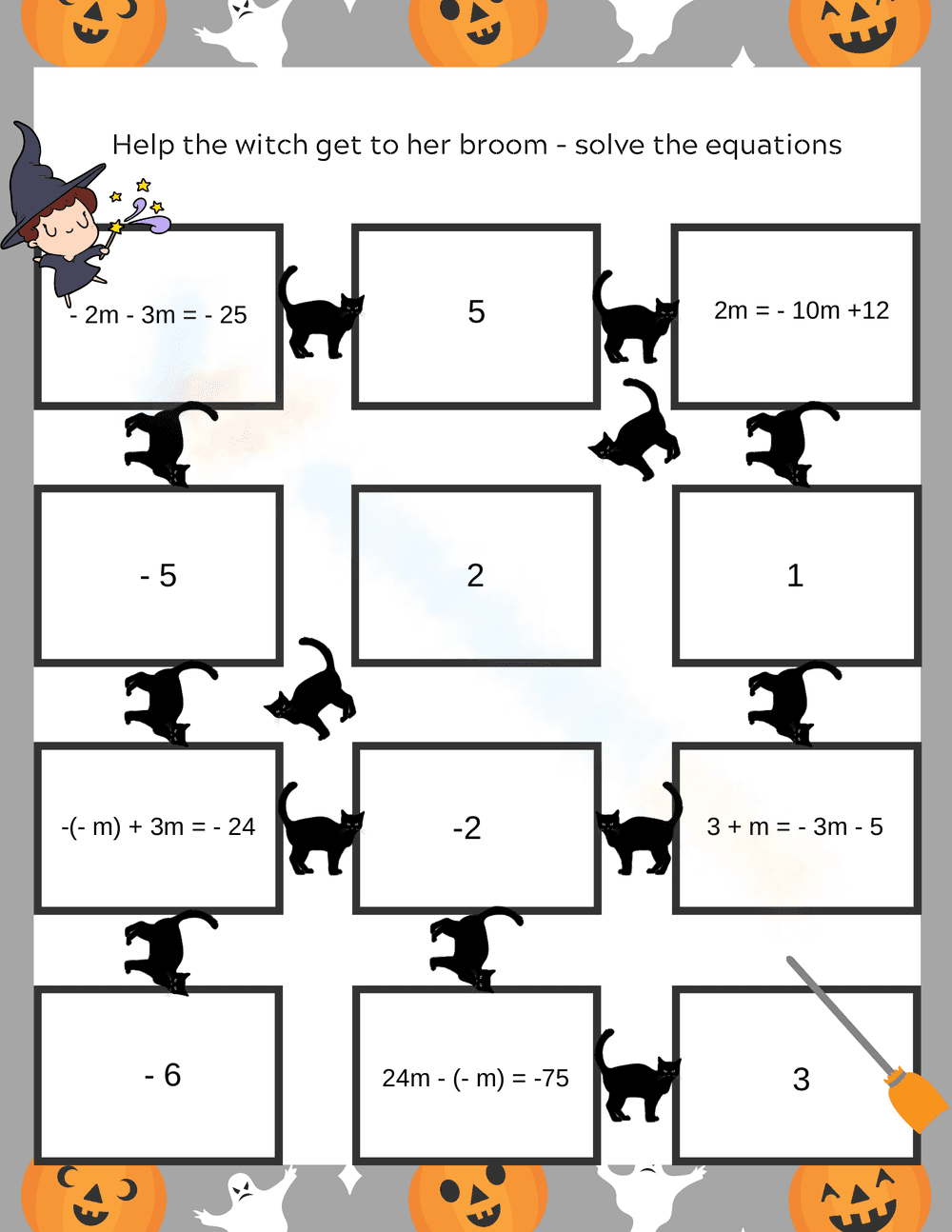
Mastering algebraic manipulation becomes an engaging seasonal challenge with this Halloween-themed math maze. Students solve a series of linear equations involving negative numbers, combining like terms, and variables on both sides to navigate the witch toward her missing broom. This activity transforms standard equation practice into a self-correcting path-finding mission that builds fluency and confidence.
At a Glance
- Grade: Grade 6 · Subject: Mathematics
- Standard:
CCSS.MATH.CONTENT.6.EE.B.7— Solve mathematical problems by writing and solving equations of the form x + p = q- Skill Focus: Solving multi-step linear equations
- Format: 1 page · 6 problems · Answer key included · PDF
- Best For: Seasonal bell-ringers or fast-finisher activities
- Time: 15–20 minutes
What's Inside
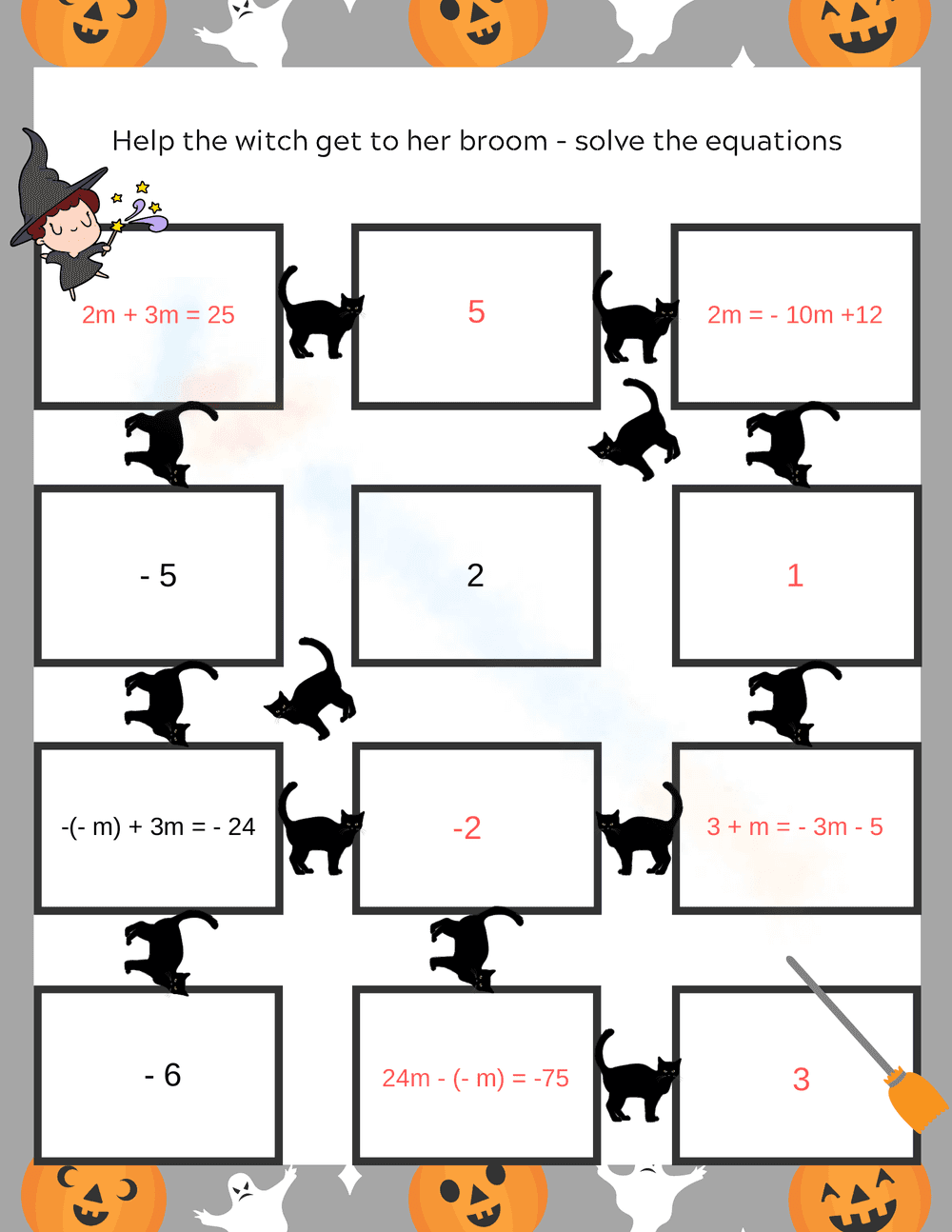
This single-page PDF features a high-interest maze layout decorated with festive Halloween graphics. The worksheet contains 6 distinct algebraic equations that require students to isolate variables using inverse operations. The path is determined by the correct numerical solution found in the adjacent boxes. A full-color answer key is provided, allowing for immediate feedback or student self-grading during independent work time.
Zero-Prep Workflow
- Print (1 minute): Simply print the single-page PDF for your entire class or upload it to a digital annotation tool for paperless practice.
- Distribute (30 seconds): Hand out the maze as a transition activity or a thematic Friday math center. No additional manipulatives or setup required.
- Review (30 seconds): Use the included visual answer key to check student paths at a glance, making it an ideal resource for emergency sub plans.
Standards AlignmentThis resource aligns with `CCSS.MATH.CONTENT.6.EE.B.7`: "Solve real-world and mathematical problems by writing and solving equations of the form x + p = q and px = q for cases in which p, q and x are all nonnegative rational numbers." While the maze introduces negative integers and variables on both sides, it serves as an excellent bridge toward 7th and 8th-grade algebraic standards. Both standard codes can be copied directly into lesson plans, IEP goals, or district curriculum mapping tools.
How to Use It
This worksheet is best utilized during the "You Do" phase of a gradual release model. Assign it after direct instruction on combining like terms and inverse operations. For a formative assessment, observe which students struggle with the negative signs in equations like -2m - 3m = -25. Most students will complete the maze within 15 to 20 minutes, making it a perfect warm-up during the week of Halloween.
Who It's For
This activity is designed for Grade 6 students beginning their journey into formal algebra, though it remains highly relevant for Grade 7 and 8 review. It is particularly effective for kinesthetic learners who benefit from the visual movement of a maze. Pair this worksheet with a digital equation balancer or an anchor chart on the "Golden Rule of Algebra" for a complete instructional block.
According to research by Fisher & Frey (2014), providing students with structured, low-stakes practice like this math maze is essential for moving skills to long-term mastery. By embedding CCSS.MATH.CONTENT.6.EE.B.7 into a gamified format, the cognitive load is reduced, allowing students to focus on calculation precision. The maze format provides an inherent feedback loop; if a solution does not appear in a connecting box, students are prompted to revisit their work and identify errors. This self-monitoring behavior is a hallmark of successful mathematical thinkers and is supported by NAEP frameworks emphasizing procedural fluency. This worksheet ensures Grade 6 learners remain engaged with rigorous content through high-interest thematic design.


