


























Views
Downloads
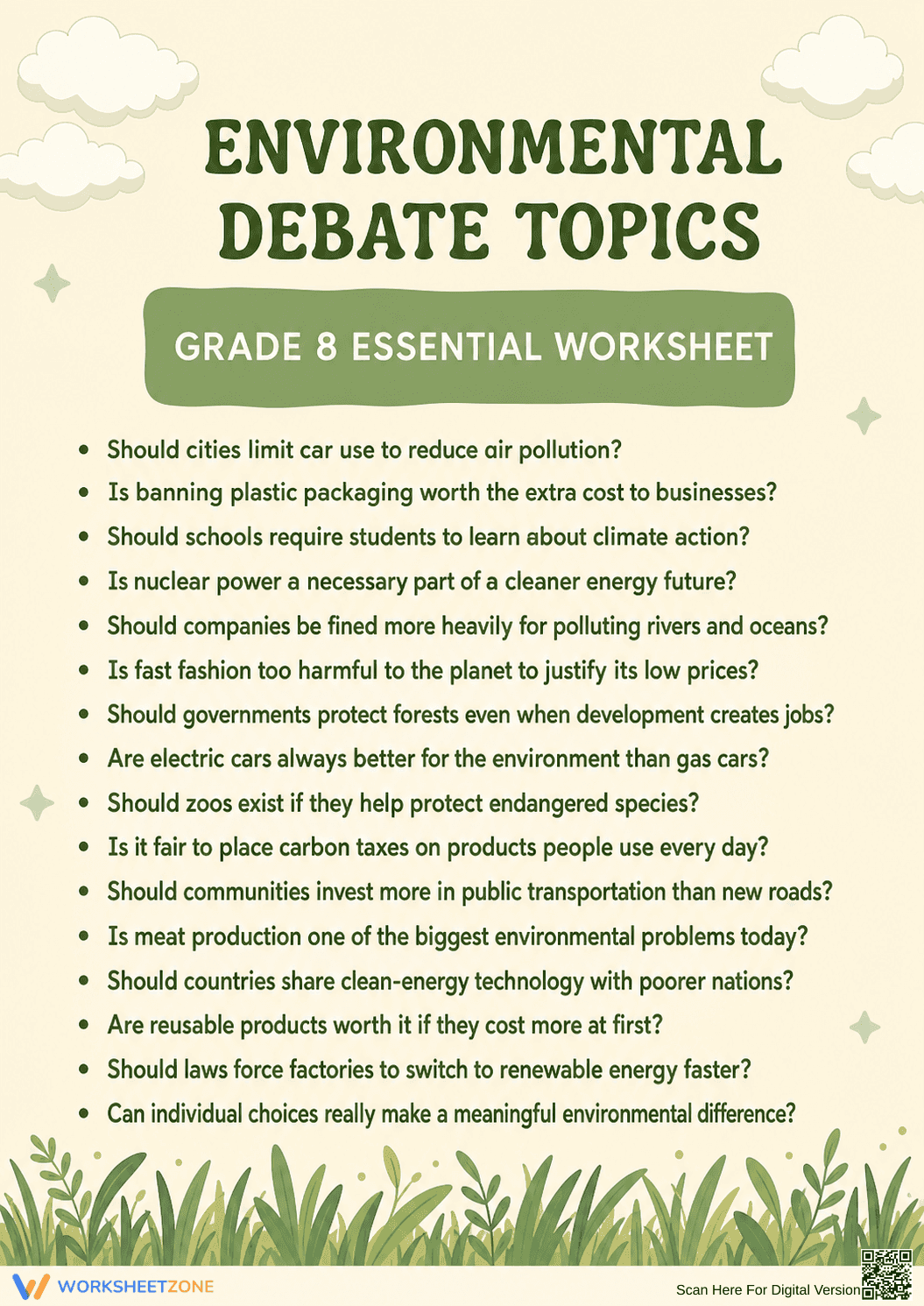

Grade 8 Environmental Debate Topics — Printable Worksheet
Paste this activity's link or code into your existing LMS (Google Classroom, Canvas, Teams, Schoology, Moodle, etc.).
Students can open and work on the activity right away, with no student login required.
You'll still be able to track student progress and results from your teacher account.
This Grade 8 environmental science worksheet provides students with thought-provoking debate prompts to develop critical argumentation skills. By engaging with complex topics like climate change and resource management, learners construct evidence-based claims while exploring the intersection of human society and the natural world.
At a Glance
- Grade: 8 · Subject: Science
- Standard:
MS-ESS3-4— Construct an argument about human impact on Earth- Skill Focus: Argumentation & Ethics
- Format: 1 page · 16 problems · No answer key · PDF
- Best For: Socratic Seminars and Sub Plans
- Time: 20–45 minutes
This single-page resource contains a curated list of 16 controversial prompts covering diverse environmental themes. Topics range from the viability of nuclear energy and the ethics of animal testing to the impact of fast fashion and carbon taxes. The clean, organized layout allows for easy distribution and immediate classroom use without additional teacher preparation.
The zero-prep workflow for this resource is designed for maximum efficiency. First, print the single-page PDF in under 30 seconds. Next, distribute the list to students or project it on a screen for a whole-class warm-up. Finally, facilitate a structured debate or small-group discussion using the prompts with zero additional prep time. Total teacher preparation takes under two minutes, making it an ideal emergency sub plan or a quick transition activity between units.
The primary alignment is MS-ESS3-4, which requires students to construct an oral and written argument supported by empirical evidence and scientific reasoning to support or refute an explanation or a model for a phenomenon or a solution to a problem. It also supports collaborative discussion standards. Both standard codes can be copied directly into lesson plans, IEP goals, or district curriculum mapping tools.
Use this resource during a unit on human impact as a formative assessment of student understanding. Assign one prompt to small groups for a 10-minute speed debate to observe how they cite evidence and handle counter-arguments. Alternatively, use it as a pre-writing brainstorming tool for a formal persuasive essay on environmental policy or corporate accountability. Expect the activity to take 20 to 45 minutes depending on the depth of discussion.
This worksheet is tailored for middle school students in Grade 8, particularly those in environmental science or civics courses. It is highly effective for gifted and talented learners who require higher-order thinking tasks. Pair this with a graphic organizer for claim-evidence-reasoning to provide additional scaffolding for students who need help structuring their verbal arguments.
Research from Fisher & Frey (2014) emphasizes that structured academic talk is essential for deep conceptual understanding in science. This worksheet facilitates that process by providing 16 high-interest prompts aligned to MS-ESS3-4, focusing on the plain-English skill of constructing evidence-based arguments about human-environment interactions. By engaging in these debates, students move beyond rote memorization to evaluate the complex trade-offs between economic growth and ecological preservation. The ability to evaluate social and ethical implications of scientific issues is a hallmark of scientific literacy. This resource provides the necessary framework for students to practice these critical evaluations in a low-stakes, high-engagement format. The inclusion of diverse topics ensures that every student finds a point of entry into the conversation, promoting inclusive classroom participation and rigorous intellectual discourse.


