


























Views
Downloads

Essential Communication Techniques Worksheet | Grade 8
Paste this activity's link or code into your existing LMS (Google Classroom, Canvas, Teams, Schoology, Moodle, etc.).
Students can open and work on the activity right away, with no student login required.
You'll still be able to track student progress and results from your teacher account.
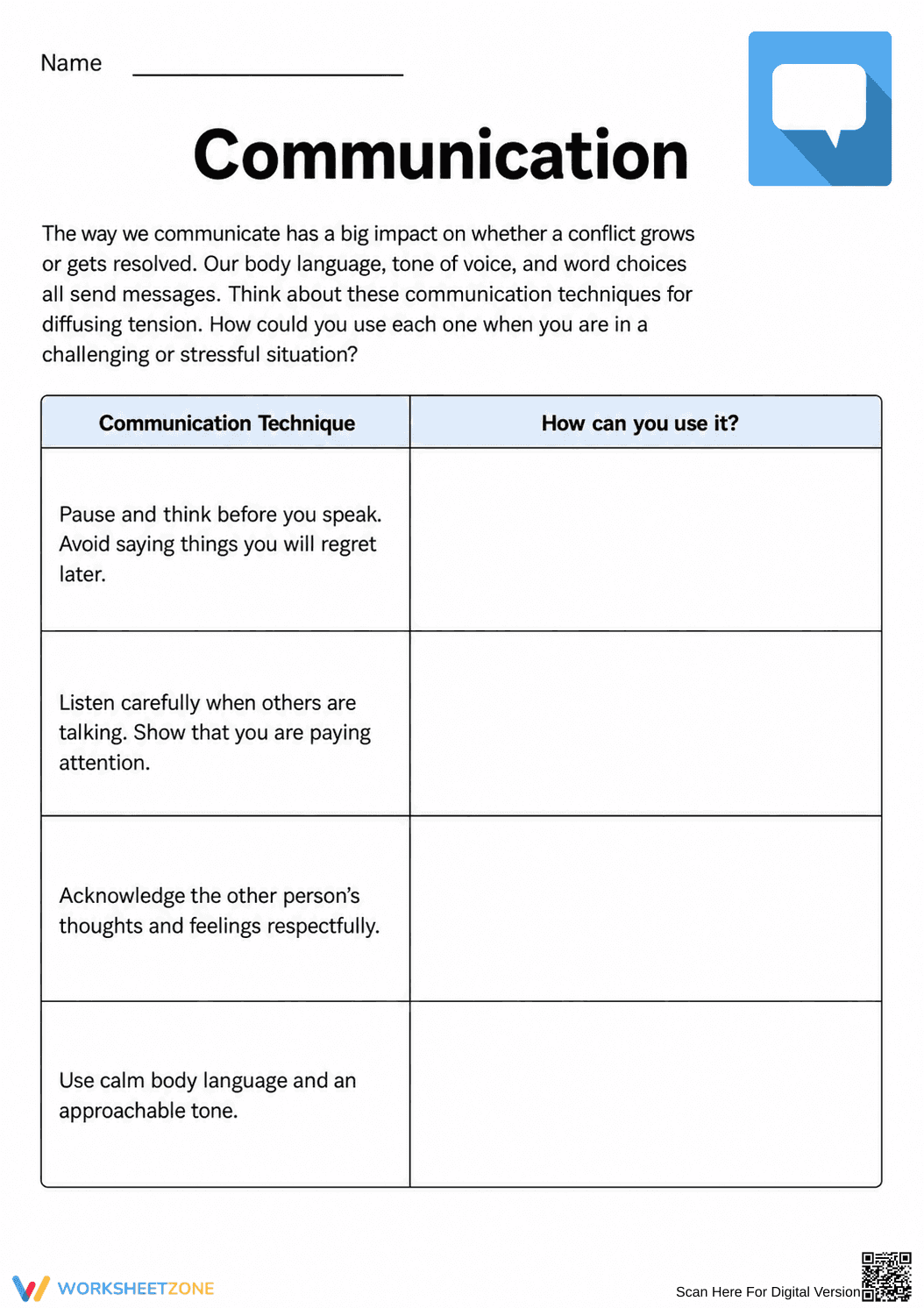
This Grade 8 communication techniques worksheet empowers students to de-escalate interpersonal tension through intentional verbal and non-verbal strategies. By reflecting on specific prompts, learners develop the self-regulation and social awareness necessary to resolve conflicts constructively. It transforms abstract social-emotional concepts into actionable steps for classroom and real-world success.
At a Glance
- Grade: 8 · Subject: Social Skills
- Standard:
CCSS.ELA-LITERACY.SL.8.1— Engage effectively in collaborative discussions, building on others' ideas and expressing their own.- Skill Focus: Conflict De-escalation
- Format: 1 page · 4 reflection tasks · Discussion-based · PDF
- Best For: Social-Emotional Learning (SEL) and behavior intervention
- Time: 15–20 minutes
What's Inside
This single-page PDF features a structured reflection table designed for middle school students. It presents four core communication techniques: pausing before speaking, active listening, validating others' feelings, and maintaining calm body language. Each technique is paired with an open-ended response box where students describe a specific, real-life application for that strategy. The layout is clean and distraction-free, ensuring students focus on the critical thinking required for behavioral change.
Zero-Prep Workflow
- Print: Generate copies of the single-page PDF for your entire roster in less than 1 minute.
- Distribute: Hand out the sheets during a morning meeting, SEL block, or as a bell-ringer activity to settle the class.
- Review: Facilitate a 5-minute group share-out to review student responses and reinforce the techniques.
This resource is an ideal "grab-and-go" sub plan or a restorative justice tool for students returning from a conflict. Total teacher preparation time is under 2 minutes.
Standards Alignment
The primary standard addressed is `CCSS.ELA-LITERACY.SL.8.1`, which requires students to come to discussions prepared, having read or researched material under study; explicitly draw on that preparation by referring to evidence on the topic, text, or issue to probe and reflect on ideas under discussion. This worksheet provides the necessary preparation for respectful peer-to-peer dialogue. Both standard codes can be copied directly into lesson plans, IEP goals, or district curriculum mapping tools.
How to Use It
Use this worksheet as a formative assessment during a Social-Emotional Learning (SEL) unit on conflict resolution. Observe how students articulate the application of each technique to identify those who may need additional role-playing support. Alternatively, assign it as a pre-discussion reflection before a high-stakes Socratic Seminar to establish norms for respectful disagreement. Expected completion time ranges from 15 to 20 minutes depending on the depth of student reflection.
Who It's For
This resource is tailored for Grade 7 through Grade 9 students, particularly those in inclusive classrooms or behavior intervention programs. It serves as an excellent companion to an anchor chart on "I-Statements" or a direct instruction lesson on active listening. It is also highly effective for school counselors working with small groups on social skills development and emotional intelligence.
Effective communication instruction is a cornerstone of modern social-emotional frameworks. According to the RAND AIRS 2024 report, explicit instruction in de-escalation techniques significantly reduces classroom disruptions and improves student-teacher relationships. This worksheet targets the CCSS.ELA-LITERACY.SL.8.1 standard by requiring students to prepare for collaborative interactions through structured reflection. By focusing on the plain-English skill of diffusing tension through body language and active listening, the resource bridges the gap between theoretical social skills and practical application. Research from Fisher & Frey (2014) suggests that providing students with specific linguistic and behavioral frames—such as those found in these 4 tasks—increases the likelihood of skill transfer to high-stress environments. This evidence-based approach ensures that students are not just learning about communication but are actively planning for its implementation in their daily lives.


