These on nitrogen cycle printable worksheets for 7th grade give science teachers a direct path from abstract concept to something students can actually mark, sequence, and put into words. The challenge with nitrogen is that most of the cycle plays out underground or inside microscopic bacteria — students can watch water evaporate off a puddle, but they cannot observe nitrification happening in the soil. Each worksheet in the set gives those invisible processes a visible shape without simplifying the science past the point of accuracy.
The Five Processes These Worksheets Keep in Focus
At the 7th grade level, the nitrogen cycle typically lands inside an ecosystems unit, right after food webs and energy flow. That placement matters. Students arrive already knowing that organisms eat each other — the harder conceptual leap is understanding that matter, not just energy, also cycles continuously through living and nonliving systems. Five processes carry almost all the instructional weight, and each worksheet returns to them across different task formats:
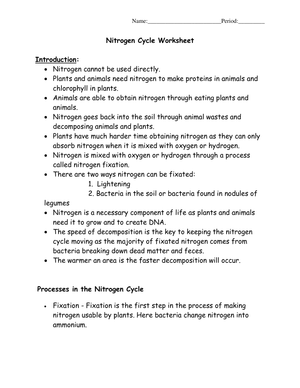
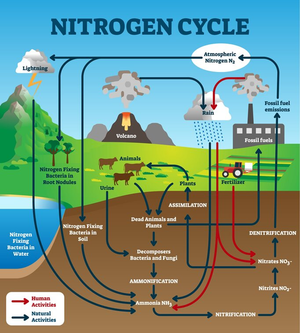
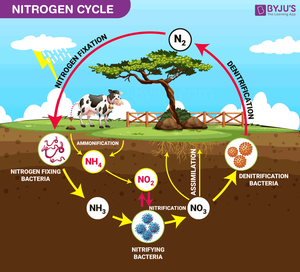
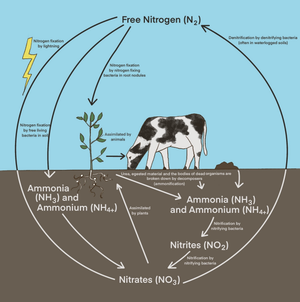
- Nitrogen fixation: bacteria in soil and root nodules (along with lightning) convert atmospheric N2 into compounds plants can absorb.
- Nitrification: soil bacteria convert ammonia into nitrates, the primary form plants take up through their roots.
- Assimilation: plants pull nitrogen from soil into proteins and DNA; animals acquire it by consuming plants or other animals.
- Ammonification: decomposers break down dead organisms and waste, returning organic nitrogen to the soil as ammonia.
- Denitrification: bacteria convert soil nitrates back into N2 gas, releasing nitrogen to the atmosphere.
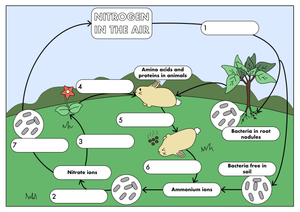
Nitrogen fixation gets the most instructional time because it is the least intuitive step. Students need to understand that bacteria in soil and root nodules do most of this conversion work — not the plants themselves. Assimilation is the bridge to things students already care about: every protein in the human body required usable nitrogen at some point. Teachers who use on nitrogen cycle printable worksheets for 7th grade during this unit consistently find that diagram tasks are what finally get students to place the return steps — ammonification, denitrification — in the right location rather than vaguely gesturing toward "soil."
Mistakes Students Make That These Worksheets Help You Catch
Two errors show up in nearly every class working through this content. The first: students draw arrows directly from the atmosphere to plants, skipping bacteria entirely. Ask them to explain and they will say "plants breathe in nitrogen" — a reasonable-sounding guess, but exactly wrong. Diagram labeling tasks expose this gap because students have to place bacteria explicitly on the page. A diagram with no bacteria is diagnostic information a teacher can act on the same day, not something that surfaces only on a summative test.
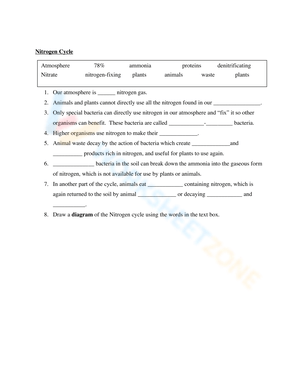
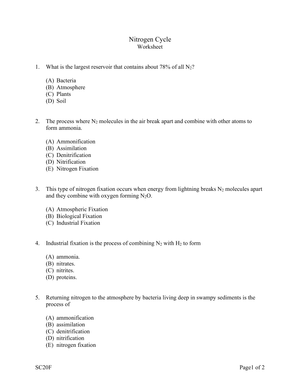
The second consistent error is swapping nitrification and nitrogen fixation. Both involve bacteria and both names begin with "nitr-," so students conflate them across every assessment format. Vocabulary matching tasks that require a written distinction — not just a circled answer — are more effective here. A student who can write "fixation converts N2 gas to ammonia, while nitrification converts ammonia to nitrates" has actually separated the two concepts. A student who chose the right bubble on a multiple-choice question may not have.
A third pattern: students treat denitrification as the end of the cycle, as though nitrogen disappears back into the air and stops there. Sequencing activities address this directly. When students arrange the steps on paper, they see that the return of N2 to the atmosphere sets up the next round of fixation — there is no exit point from the cycle, only a continuous loop.
Smart Ways to Build These Worksheets Into Your Week
A three-phase approach works well for this topic. On the first day, project a nitrogen cycle diagram and run a 12- to 15-minute explanation: why nitrogen matters for proteins and DNA, why most organisms cannot pull it directly from the air, and what bacteria do that no other organism can. On the second day, students work through a labeling and vocabulary worksheet — they are attaching names to the processes they heard described, which is retrieval practice with immediate feedback. On the third day, a sequencing or short-response worksheet moves them from naming to explaining. The exit question on day three — "Which two steps in the cycle depend most on bacteria, and why?" — functions as a formative check that tells you whether a re-teach is necessary before the unit assessment.
The station rotation model works equally well in a single 50-minute period. Four stations — diagram labeling, vocabulary matching, step sequencing, and short constructed response — rotate groups every 10 to 12 minutes. Students tend to move quickly through vocabulary and slow down at constructed response. That slowdown is worth noticing: it reveals which students are retrieving the cycle's logic and which are still guessing at process names.
One shortcut that helps students remember the cycle across formats: fix, use, return. Bacteria and lightning fix atmospheric nitrogen into usable compounds. Plants and animals use those compounds to build living matter. Decomposers and bacteria return nitrogen to soil and air. That three-word frame helps students reconstruct the cycle's reasoning even when they temporarily lose track of a specific term.
Standard Alignment
These worksheets align to NGSS MS-LS2-3, which asks students to develop a model describing the cycling of matter and flow of energy among living and nonliving parts of an ecosystem. Nitrogen cycle instruction is one of the most direct classroom paths to that standard because students must show how a single element moves across atmospheric, soil, plant, animal, and decomposer compartments in a continuous loop. In most 7th grade life science sequences, MS-LS2-3 is addressed in the second or third unit, after food webs establish the energy flow piece and before ecosystem disruption work begins. The diagram labeling and sequencing tasks in this set build the modeling skills the standard calls for: students are constructing and explaining a representation of the cycle, not just reading a description of it.
Adjusting the Worksheets for Different Student Levels
For students who need more support, the most effective adjustments are structural rather than content-reducing. Adding a word bank to the diagram labeling task removes the recall burden without removing the thinking — students still have to match each term to the correct location on the diagram, which requires understanding the process. Partial sentence frames help too: Plants get nitrogen by... and Decomposers return nitrogen to the soil by... give students enough of a starting point to produce a real explanation rather than leaving the response line blank.
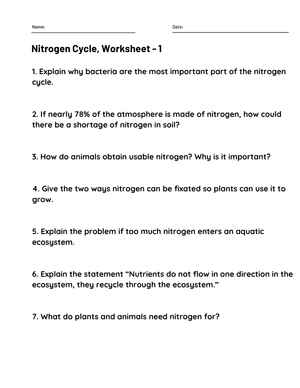
On-level students work through the matching, sequencing, and short-response tasks with minimal support. Constructed-response questions — "Why is nitrogen fixation necessary?" and "What would happen to plant growth if soil bacteria disappeared?" — work well as independent practice or as science notebook entries collected for a grade.
For advanced learners, the on nitrogen cycle printable worksheets for 7th grade extend naturally into human impact territory. Students can examine how synthetic fertilizers affect nitrogen availability in soil, why excess nitrogen in agricultural runoff leads to algal blooms in waterways, or why farmers rotate legume crops with other plants to manage soil nitrogen without chemical inputs. These questions push students toward genuine ecological reasoning rather than cycle memorization.
Frequently Asked Questions
What prior knowledge should 7th graders have before starting these worksheets?
Students should have a basic understanding of ecosystems — that organisms interact with their nonliving environment and that matter moves through food webs. Familiarity with cells, proteins, and DNA helps students connect nitrogen to living matter in a meaningful way. These worksheets do not require prior chemistry knowledge, though students who have encountered atoms and molecules will engage more readily with the nitrogen fixation process.
How do I handle students who finish the diagram worksheet quickly?
The constructed-response prompts built into the set work well as extension tasks for early finishers. A student who completes the diagram in 8 minutes still needs to explain, in writing, why bacteria are necessary for the cycle to function. That question slows down even students with strong memorization skills because explanation requires more than recognition.
Are answer keys included with this set?
Yes. The on nitrogen cycle printable worksheets for 7th grade in this set include answer keys for every diagram labeling and vocabulary task. Short constructed-response prompts come with sample answers showing what a complete explanation looks like, which is useful when evaluating student work and deciding whether a response earns full or partial credit.
Can these worksheets serve test-review purposes rather than initial instruction?
They work well for both. During initial instruction, labeling and vocabulary tasks build the language students need. For review, the sequencing and short-response worksheets surface gaps before a unit exam without requiring the teacher to build a separate activity. Many teachers use the short-response worksheet as the review session the day before the test, then address the weakest processes in a 10-minute whole-class discussion the following morning.












 Interactive Worksheet Maker
 Quiz Maker
 Word Search Maker
 Crossword Puzzle Maker
 Word Scramble Generator
 Sentence Scramble Generator
 Handwriting Worksheet Generator
 Name Tracing Generator
 Fill In The Blank Generator