These photosynthesis worksheets for 7th grade give life science teachers print-ready resources that move students from basic recall — naming the inputs and outputs of the process — to the harder work of explaining what those inputs and outputs mean inside a living system. The set fits cleanly into a standard middle school life science unit, hitting the concepts students are most likely to see on a unit assessment and the misconceptions most likely to surface in class discussion.
What the Set Covers
Each worksheet targets a specific piece of the content rather than cramming everything into one sitting. That separation keeps the cognitive load manageable — students are not simultaneously decoding the equation, labeling a diagram, and writing an explanation while trying to hold all three tasks in working memory at once. The skills across the set include:
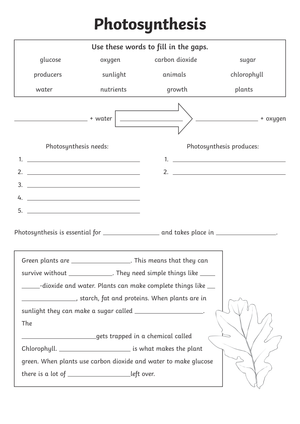
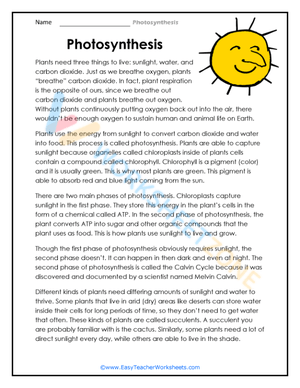
- Input and output identification: carbon dioxide, water, and light as reactants; glucose and oxygen as products
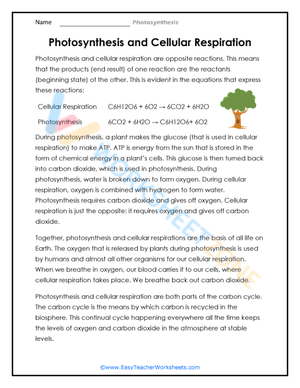
- Equation interpretation: reading 6CO2 + 6H2O + light → C6H12O6 + 6O2 and translating it into plain language, not just copying symbols onto a line
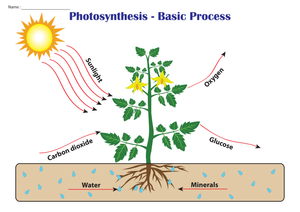
- Diagram labeling: marking the leaf, chloroplasts, stomata, and the direction of gas and water movement through a plant structure
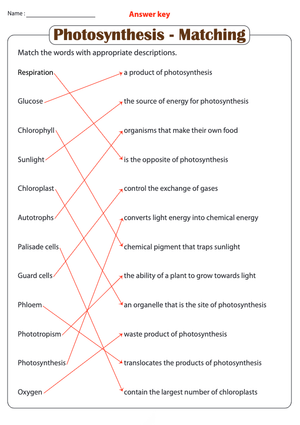
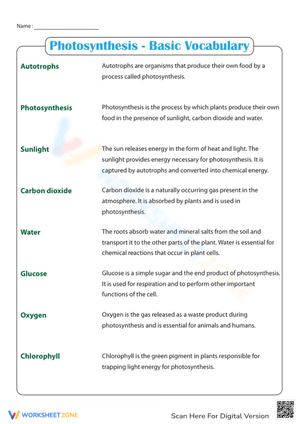
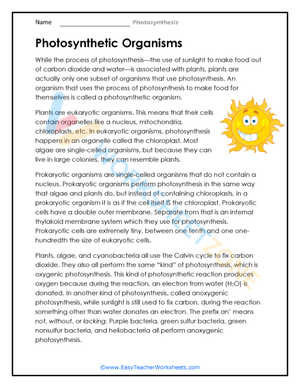
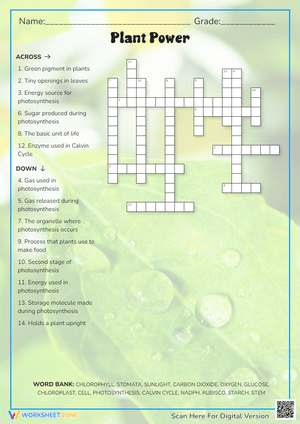
- Vocabulary in context: photosynthesis, chlorophyll, chloroplast, glucose, and stomata used in sentences and explanations — not just matched to definitions
- Process explanation: short written responses asking students to describe what happens and why, not just list parts
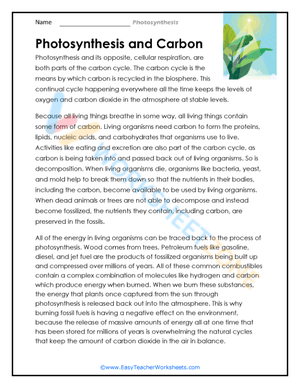
- Comparison thinking: how photosynthesis and cellular respiration connect — one stores energy in glucose, one releases it
Diagram labeling carries particular weight at this grade level because 7th grade science expects students to connect plant structures to plant function. A labeling task that places chloroplasts inside a leaf cell, with arrows showing CO2 entering through stomata and oxygen exiting, does more instructional work than a matching activity alone — students have to reason about direction and location, not just recall terms.
Student Errors Worth Catching Early
The most persistent misconception at this level is that plants eat soil. Students arrive with this idea from everyday observation — they watch adults water plants and add fertilizer, and they reasonably conclude those inputs are the food. It takes more than one lesson to dislodge. Each worksheet that repeatedly asks "Where does the plant get its carbon?" or "What do the roots actually deliver to the leaf?" forces students to confront that idea directly, rather than restate memorized vocabulary around it without ever addressing the underlying confusion.
A second error appears when students read the equation: many assume oxygen is an input because they know humans need to breathe it in to survive. On a fill-in task, students who correctly write "carbon dioxide" for one blank will still write "oxygen" for the incoming gases. Prompts that ask students to draw directional arrows — what enters the leaf, what exits — surface this confusion more reliably than blank-filling alone. There is also a reversal problem between photosynthesis and cellular respiration that shows up most clearly in short written explanations. A student might write that the plant "breaks down glucose to make food," which flips the entire process. Built-in compare-and-contrast questions catch that reversal before a unit quiz does.
Working These Worksheets Into Your Science Block
The most practical entry point for photosynthesis worksheets for 7th grade instruction is the warm-up slot. A Monday diagram labeling task takes under ten minutes, gets students back into the content after the weekend, and gives teachers an immediate read on who retained the key vocabulary. Mid-unit, the equation interpretation worksheet works well as guided practice right after direct instruction — students translate the symbols into words while the board diagram is still visible, then close their notes and write one sentence explaining what happens. That sequence — direct instruction followed immediately by a written paraphrase — consistently produces better retention than having students copy the equation and move on.
For station rotations, the set splits naturally: one station for diagram labeling, one for vocabulary sorting, one for equation work, and one short-answer station with a compare-and-contrast question on photosynthesis and respiration. With groups of three or four students rotating every eight to ten minutes, a 40-minute period covers the full set with time for a brief whole-class debrief. The short-answer station produces written work teachers can collect at the door — four or five sentences from each student is enough to see whether they understand the process or are stringing terms together without meaning behind them.
Standard Alignment
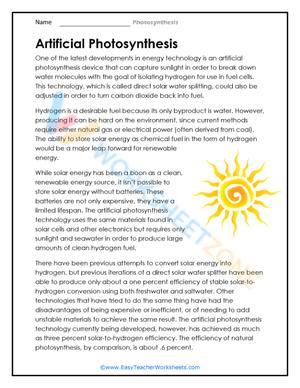
These photosynthesis worksheets for 7th grade align to NGSS MS-LS1-6, which asks students to construct a scientific explanation based on evidence for the role of photosynthesis in the cycling of matter and flow of energy into and out of organisms. At the 7th grade level, that standard requires students to go beyond identifying reactants and products — they need to explain why the process matters in a system. The short-answer items and comparison questions in the set directly address that "construct an explanation" requirement, which is often where students lose points on assessments because they can describe the process but cannot connect it to energy storage or matter cycling.
Adjusting the Work for Different Learners in the Room
For students who struggle with reading demands, the diagram and equation worksheets carry most of the instructional weight without requiring dense text comprehension. Adding a word bank to any fill-in task removes the retrieval barrier so students can focus on the science concept rather than spelling under pressure. For short-answer items, a sentence frame such as "Plants use ___ and ___ to make ___, and they release ___ as a product" gives a starting structure without giving away the answer. These adjustments keep the cognitive target intact — understanding the process — while reducing the language load for students who need it.
On the other end, stronger students finish labeling tasks quickly and need somewhere meaningful to go. The comparison questions on photosynthesis and cellular respiration, along with extension prompts asking students to predict what happens to a plant kept in complete darkness for a week, provide enough depth to keep those students working without requiring a separate enrichment assignment. A student who can explain why that dark-closet plant eventually stops producing glucose — and trace that back to the absence of light energy — has understood the content at a level well above the standard minimum.
Frequently Asked Questions
What question formats appear across the worksheets?
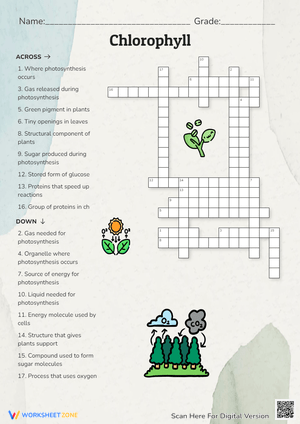
Each worksheet focuses on one format: diagram labeling, vocabulary used in context, equation interpretation, or short constructed response. That separation means teachers can assign exactly what fits a given lesson moment — a labeling task during direct instruction, a short-answer item as an exit ticket — without working through a mixed-format resource from start to finish every time.
How do I use these with students who already know the vocabulary but can't explain the process?
Start with the equation interpretation worksheet and ask students to rewrite the equation in plain English without using the words "photosynthesis," "glucose," or "chlorophyll." That constraint forces them to demonstrate actual understanding rather than vocabulary substitution. Follow with the short-answer items, which ask students to explain cause-and-effect relationships — what happens to glucose after it's made, why oxygen exits the leaf — rather than just defining terms they've already memorized.
Can these be used for review before a unit test?
The photosynthesis worksheets for 7th grade set works well as a structured review because each worksheet isolates a different skill, which lets teachers identify exactly where individual students are still uncertain. Running a vocabulary worksheet one day, an equation check the next, and a short constructed-response item the day before the test gives students spaced practice without a full re-teach. Revisiting the same core content through different formats — diagram, equation, written explanation — also mirrors how well-designed assessments actually test the concept, so students enter the test having already practiced the retrieval process in multiple ways.
Is an answer key included?
Yes. Each worksheet includes a corresponding answer key with sample responses for the short-answer items. For constructed responses, the keys provide enough detail to support consistent grading across multiple class sections without requiring teachers to build their own rubric from scratch.












 Interactive Worksheet Maker
 Quiz Maker
 Word Search Maker
 Crossword Puzzle Maker
 Word Scramble Generator
 Sentence Scramble Generator
 Handwriting Worksheet Generator
 Name Tracing Generator
 Fill In The Blank Generator