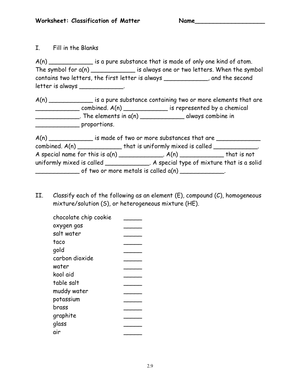
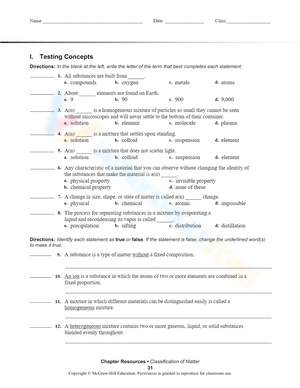
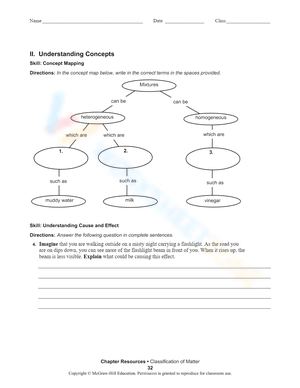
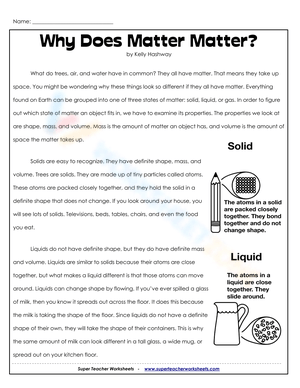
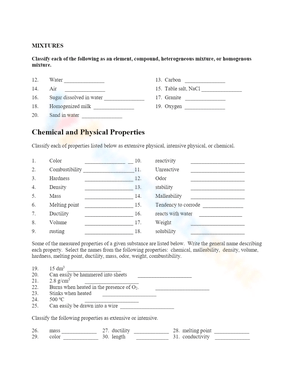
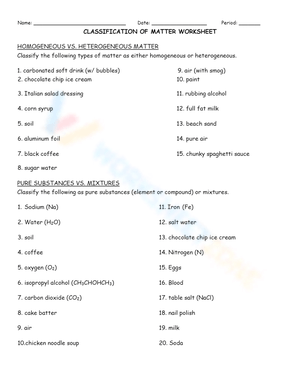
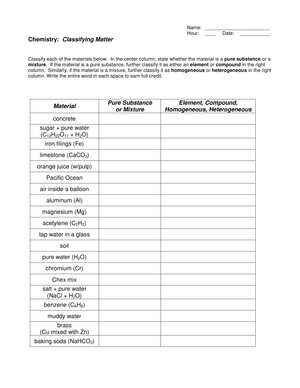
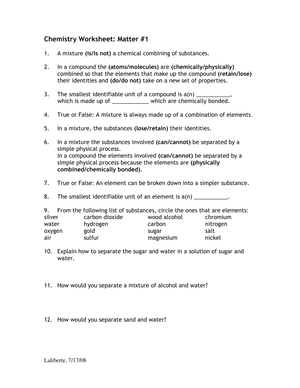
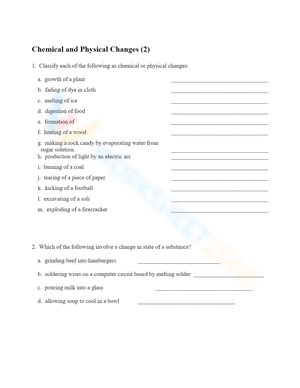
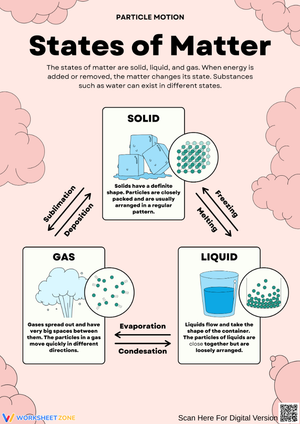
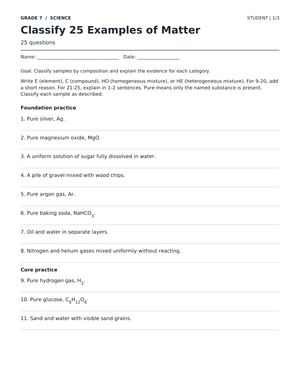
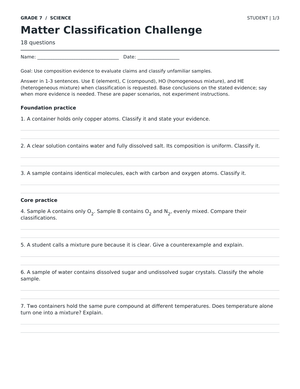
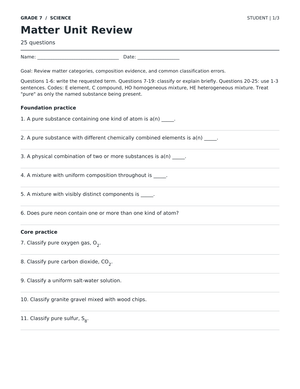
These 7th grade classifying matter worksheets resources give teachers printable, ready-to-use chemistry practice that moves students past simple recognition and toward genuine category reasoning. The set targets the core classification framework most 7th grade physical science curricula introduce together: the distinction between pure substances and mixtures, then the sub-categories of elements, compounds, homogeneous mixtures, and heterogeneous mixtures. Students cite observable physical properties as evidence behind each classification decision — which is the actual skill the content standard asks for, not a bonus add-on.
The Classification Sequence Students Work Through
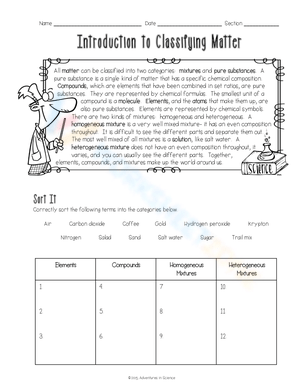
Each worksheet moves students through the same logical branching structure that underlies chemical classification. The first decision — pure substance or mixture — anchors everything that follows. From there, students branch: is the pure substance composed of one type of atom, or is it a bonded compound? Is the mixture visually uniform throughout, or does it show variation in particle distribution? Practicing that sequence repeatedly builds a reliable mental model rather than a growing list of memorized examples that students can't transfer to an unfamiliar sample.
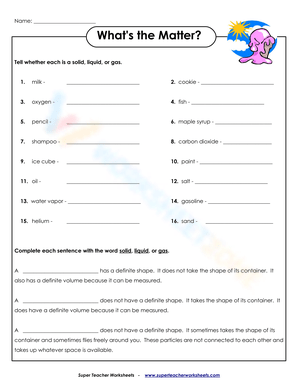
Physical properties carry the classification work throughout. Students examine color, texture, particle uniformity, state of matter, and whether a sample can be separated by physical means. When the task requires a physical property alongside a category label, students can't rely on recognition alone — they have to name what they actually observe. That constraint is what separates these tasks from vocabulary drills.
- Core vocabulary in context: matter, pure substance, mixture, element, compound, homogeneous, heterogeneous, solution, solute, solvent
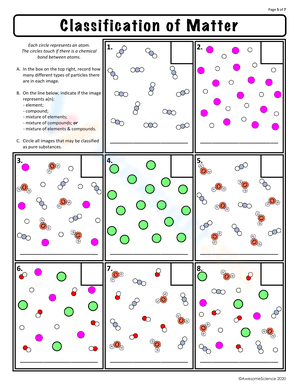
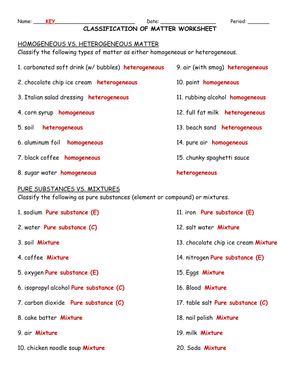
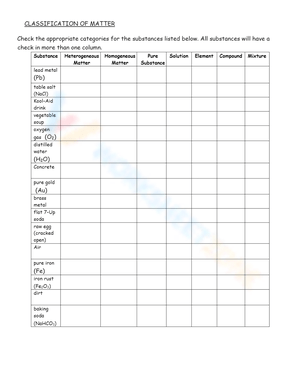
- Sorting tasks using descriptions, diagrams, or short lists of familiar materials — salt water, air, granite, aluminum, trail mix, baking soda solution, distilled water
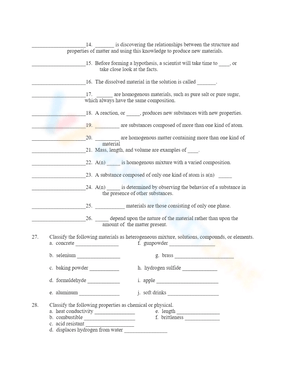
- Written justifications that name physical properties as evidence, not just category labels
- Household and classroom-safe examples introduced before less-familiar chemical names
- Answer keys for immediate self-correction or fast teacher checking
Classification Errors That Show Up in Student Work
The most consistent error in this unit is also the most instructive: students classify visually uniform samples as pure substances. Air comes back labeled "pure substance" on a regular basis — as do salt water, clear vinegar, and lemonade. Students who can define mixture correctly in a vocabulary activity will still apply the label incorrectly when they encounter a sample that looks undifferentiated. The worksheet tasks surface this pattern early by grouping several uniform-looking mixtures together and requiring a written physical-property justification for each decision. When a student writes "salt water is a pure substance because it looks clear," that sentence identifies exactly where the next mini-lesson needs to go.
A second reliable error crosses the compound-mixture boundary. Students learn that table salt is NaCl — a compound — and then classify salt water as a compound as well, reasoning that the identity of the dissolved substance determines the label for the whole sample. They conflate the composition of a component with the composition of the mixture. A task that explicitly asks "what type of matter is the whole sample?" rather than "what is salt?" tends to catch this confusion before a quiz does.
Less common but worth watching for: a pattern-matching habit where students mark all solids as pure substances and all liquids as mixtures. Sorting tasks that include solid mixtures like granite and soil — alongside liquid elements like mercury — disrupt that assumption directly without significantly raising the difficulty of the worksheet.
How to Work These Worksheets Into Your Chemistry Unit
The resources fit multiple parts of the lesson cycle without requiring major planning adjustments. A warm-up during the first 8 minutes of class works well as a focused sorting task: three samples, two categories, one physical property cited as evidence. That routine takes under 10 minutes and gives an immediate read on whether students retained the previous day's categories. If three students label air as a pure substance on Monday morning, that's the conversation that opens the lesson.
For new-content days, one worksheet works well inside a gradual-release format. Model two examples under the document camera, naming the physical properties you're observing as you go. Have students work a short section independently, then pull answers back into a whole-class discussion — not just "the answer is homogeneous mixture" but "what did you observe that pointed you there?" That discussion step is where the most durable learning happens, and each worksheet gives it a concrete anchor point.
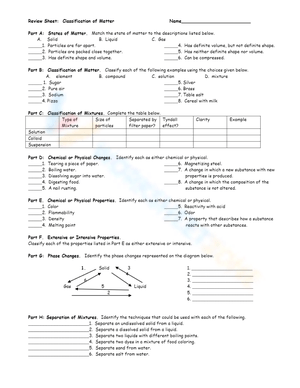
Station work is another strong fit. One station can run a sorting-chart worksheet, a second can run a short-answer justification worksheet, and a third can present unfamiliar chemical samples — calcium carbonate, bronze, hydrogen gas — requiring students to apply familiar categories without the recognition cue of a known name. The 7th grade classifying matter worksheets resources handle all three station types without additional design work from the teacher.
Answer keys make self-correction routines practical. Students who catch and explain their own errors immediately — before moving on — retain classification distinctions more reliably than students who wait for graded papers to return. The keys also make these worksheets workable during substitute coverage, since directions and correct answers are both present without the teacher writing a separate explanation.
Making the Set Work Across Different Student Levels
For students still consolidating vocabulary, a posted word bank removes the language barrier without reducing the classification task itself. A sentence frame displayed on the board — This sample is a [category] because it [observable property] — gives those students a structure for written responses without doing the chemistry thinking for them. The decision about which observable property to name still belongs entirely to the student.
Students who move through sorting tasks quickly benefit from a generative extension: instead of classifying teacher-supplied examples, they produce their own. Writing "bronze is a homogeneous mixture because the tin and copper distribute evenly throughout the alloy" requires a more precise understanding of the category than checking a box does. The examples a student chooses and the properties they cite also work as an informal assessment — they reveal whether understanding is genuine or whether the student has memorized the answers without internalizing the reasoning.
The homogeneous-heterogeneous distinction consistently trips up mid-level students — those who have the pure-substance/mixture boundary solid but haven't fully internalized what "uniform throughout" means at the observable level. For those students, returning to the visual criterion explicitly and repeatedly — if you can see distinct components, it's heterogeneous; if it looks the same throughout, then determine whether it's a pure substance or a mixture — closes the gap faster than additional sorting practice alone. The 7th grade classifying matter worksheets set gives those students repeated contact with that distinction across different task formats, which is exactly what the concept requires.
Standard Alignment
These worksheets align with NGSS MS-PS1-1, which asks students to develop models to describe the atomic composition of simple molecules and extended structures. In classroom terms, that standard grounds classification work in evidence: students describe and categorize matter using observable and measurable properties rather than labels they've memorized from a chart. When a student writes that salt water is a homogeneous mixture because it has uniform appearance but can be separated through evaporation — a physical process that wouldn't change the components of a pure substance — that response reflects exactly what MS-PS1-1 expects.
The crosscutting concept of Patterns connects directly here as well. Students are learning that macroscopic patterns — what matter looks and behaves like at the visible level — reflect underlying composition. The classification sequence each worksheet practices is the hands-on application of that concept at the middle school level, and returning to it across multiple worksheets gives the crosscutting connection genuine instructional weight rather than a footnote mention.
Frequently Asked Questions
What classification categories do these worksheets cover?
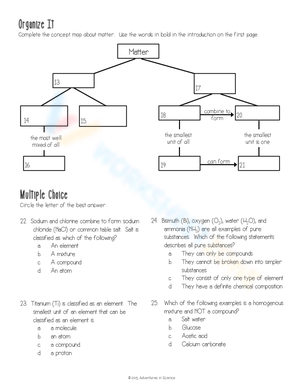
Each worksheet focuses on the four-part taxonomy most 7th grade curricula use: pure substances (elements and compounds) and mixtures (homogeneous and heterogeneous). Physical property evidence appears as a required component of the classification tasks throughout the set, not just in a single section.
Can these worksheets function as formative assessments rather than just practice?
The short-response and written-justification tasks produce exactly the kind of student reasoning that reveals misconceptions before a quiz or lab. When a student's explanation shows they're classifying all uniform-looking samples as pure substances, that's actionable information for the next instructional move. The 7th grade classifying matter worksheets format works well as a pre-quiz check precisely because written explanations can be scanned quickly across a full class set to identify who needs reteaching and who is ready to move forward.
Do the worksheets include answer keys?
Each worksheet includes an answer key. Keys support fast teacher checking, student self-correction routines, and substitute coverage without requiring additional planning work from the classroom teacher.
How long does each worksheet take to complete?
Most students finish each worksheet in 10 to 20 minutes depending on format. Sorting and labeling worksheets run shorter; written-justification worksheets run closer to 20 minutes. That range makes the set flexible for bell ringers, homework, station rotations, or end-of-unit review depending on how the lesson is structured.












 Interactive Worksheet Maker
 Quiz Maker
 Word Search Maker
 Crossword Puzzle Maker
 Word Scramble Generator
 Sentence Scramble Generator
 Handwriting Worksheet Generator
 Name Tracing Generator
 Fill In The Blank Generator