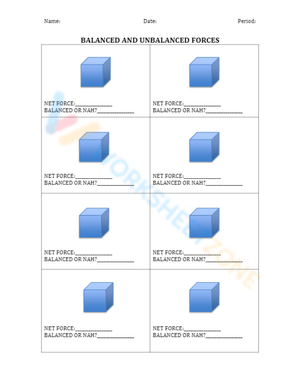
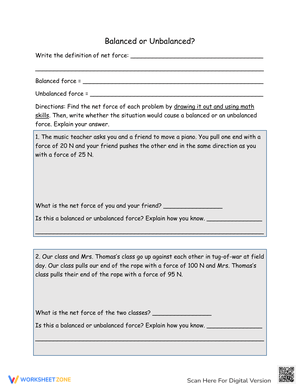
These balanced and unbalanced forces worksheets for 7th grade give teachers printed evidence of student thinking at the point in a unit when net force is something students can define but haven't yet applied with any consistency. Most seventh graders arrive knowing that pushes and pulls affect motion. What takes longer to stick is the distinction between an object that is moving and one whose motion is changing — and that gap is exactly where force reasoning breaks down in class after class.
The Specific Skills Targeted
Each worksheet moves students through the same deliberate three-step sequence: identify all forces acting on an object, compare direction and magnitude to determine net force, then state the motion result. That order isn't decorative. Students who skip straight to guessing the motion outcome — without actually working through the force comparison — are the ones who score inconsistently across item types. Building the steps into the structure of each worksheet makes the reasoning visible to both student and teacher.
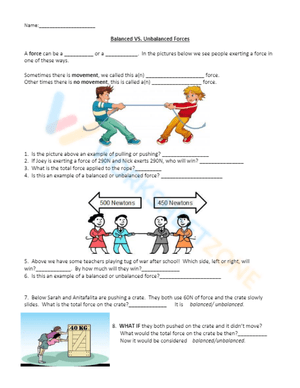
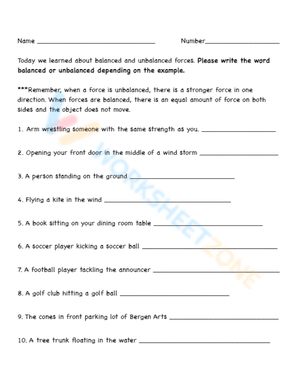
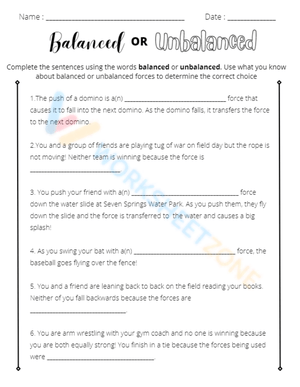
- Force sorting: Students classify scenarios as balanced or unbalanced based on written descriptions and given force values.
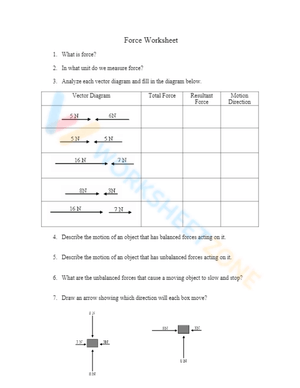
- Diagram reading: Students interpret force arrows and determine whether opposing forces cancel.
- Net force calculation: Students subtract forces acting in opposite directions and name the direction of the result.
- Short written explanation: Students describe why an object remains stationary, continues at constant speed, or undergoes a change in motion.
- Real-world application: Students apply force reasoning to recognizable situations — tug-of-war, a cart coasting on a flat surface, a soccer ball immediately after it leaves a foot.
When a student explains why a shopping cart gliding at steady speed across a flat parking lot still has forces acting on it — just balanced ones — they've moved past surface-level recall into actual force reasoning. The familiar context gives the math somewhere to land.
The variety across item types on balanced and unbalanced forces worksheets for 7th grade matters for a specific reason: students can sometimes answer multiple-choice sorting questions using process of elimination without doing any net force reasoning at all. When that same student has to calculate 8 N left minus 5 N right and explain the resulting motion in a sentence, the teacher gets much stronger evidence of actual understanding.
Common Misconceptions to Watch For and Correct
The error that surfaces most reliably: students assume any moving object has unbalanced forces on it. A student watching a hockey puck glide at constant speed across ice will write "unbalanced" because the puck is moving. That student has fused motion with acceleration — the same conceptual knot physics had to formally untangle in the 17th century, and seventh graders won't resolve it by memorizing a vocabulary term. A worksheet item showing force arrows equal in size and opposite in direction on a moving object, then asking "are the forces balanced or unbalanced? How do you know?" puts that misconception directly on the table where it can be addressed.
A second consistent error involves direction. Students see 10 N to the right and 10 N to the left, recognize the matching number, and still mark "unbalanced" — because they evaluated magnitude without tracking direction. Items that require students to label the direction of each force arrow before calculating net force interrupt that shortcut more reliably than re-explaining the rule does.
Then there's the arithmetic version: given 8 N to the right and 3 N to the left, students add the values and report 11 N. That answer isn't just numerically off — it reveals the student doesn't grasp that forces acting in opposite directions partially cancel each other. Short-answer prompts asking "which forces are working against each other, and what is left over?" catch this faster than any selected-response item, and they give the teacher language to use in a follow-up conversation.
Lesson-Planning Ideas to Get the Most From These Worksheets
A reliable sequence for a standard class period: open with two or three force scenarios on the board — one clearly balanced, one clearly unbalanced, one that requires actual calculation to resolve. Students talk through them in pairs while the teacher listens for the language students use to justify their answers. Then move to the first worksheet independently. A brief whole-class review of the most-missed items, specifically before the net force calculation section, keeps the lesson from losing students once numbers and directions enter the picture.
For shorter blocks, one worksheet works cleanly as a ten-minute warm-up, followed by a new teacher-written scenario on the board as an exit ticket. That shift matters: students can't recall a specific answer from the worksheet — they have to transfer the reasoning to a new situation. The Friday before a unit test is a particularly productive time for this pattern. Fifteen minutes on a review worksheet, five minutes on an unfamiliar exit scenario, and teachers leave the day knowing exactly who needs targeted follow-up before the assessment.
In intervention or small-group settings, the diagram items work well under a document camera. The teacher annotates force arrows in real time — extending them, labeling direction, crossing out equal-and-opposite pairs — before students attempt independent calculation. Because the format stays consistent across each worksheet in the set, students who joined a unit partway through aren't learning a new item structure at the same time they're learning the concept.
Standard Alignment
NGSS MS-PS2-2 asks students to plan investigations that provide evidence that changes in an object's motion depend on the sum of forces acting on it and the object's mass. In classroom terms, that standard is pointing directly at net force reasoning — which is exactly what these worksheets practice. Students who can calculate net force, name its direction, and predict the resulting motion change are demonstrating the disciplinary core idea MS-PS2-2 targets. The short written explanation items also address the NGSS crosscutting concept of cause and effect, which the framework names explicitly at the middle school level as a target reasoning pattern for force and motion work. Balanced and unbalanced forces worksheets for 7th grade that include both calculation and explanation items give teachers evidence to document in both the DCI and crosscutting concept columns of a standards-mapping record.
Adjusting the Worksheets for a Range of Learners
The natural entry point for students who need additional support is the force-sorting section: scenarios with small whole-number values along a single axis, left and right only, no friction and no vertical forces. Once that reasoning is solid, friction and vertical forces — gravity, normal force, applied force — add meaningful complexity without changing the underlying logic the student is practicing. For the most advanced learners, multi-stage scenarios work well: a box initially at rest, then pushed with increasing force until motion begins, then maintained at constant speed by a different force combination. Asking those students to explain what must be true about the forces at each stage requires holding multiple motion states in mind simultaneously — a meaningfully harder task than a single-scenario item.
For students who handle the calculation correctly but struggle to translate it into words, a sentence stem embedded on the worksheet does more than any verbal prompt: "The net force is ___ N to the ___, which means the object will ___." That structure keeps the explanation focused without completing the thinking for the student. It also makes written responses gradeable on a consistent basis, which matters when a teacher has 90 seventh graders' worksheets to check.
Frequently Asked Questions
Do these worksheets cover both force types, or is the focus on just one?
Each worksheet addresses both balanced and unbalanced situations. Students need the contrast — seeing both outcomes side by side — to understand why zero net force and nonzero net force produce different results. A resource covering only one case removes the comparison that makes the concept stick, and comparison is what these items are built around.
Is it better to assign these during instruction or after it?
Students who encounter net force calculation for the first time on a worksheet, without any prior direct instruction, tend to add all force values regardless of direction. That reinforces the exact error the worksheet is trying to address. One teacher-led example before independent practice — even a single worked scenario on the board — makes a measurable difference in how students approach the calculation items.
Can these be assigned as homework?
Balanced and unbalanced forces worksheets for 7th grade work well as homework, with one honest caveat: students who carry the "motion equals unbalanced forces" misconception from class will practice that error uninterrupted at home. Assigning a worksheet for homework is more effective after class practice has already surfaced and addressed the main errors — not as the first exposure to independent work on the topic.
How quickly can a teacher check these during class?
An answer key handles the calculation items efficiently — both the number and direction need to be correct, and the key makes that a fast scan. For written explanation items, look for two things: whether the student identified net force correctly, and whether they connected it to a motion change rather than to motion alone. A student who writes "the net force is 5 N to the right, so the object accelerates to the right" has the reasoning. One who writes "the forces are unbalanced because the object is moving" needs a targeted follow-up conversation before the next assessment.












 Interactive Worksheet Maker
 Quiz Maker
 Word Search Maker
 Crossword Puzzle Maker
 Word Scramble Generator
 Sentence Scramble Generator
 Handwriting Worksheet Generator
 Name Tracing Generator
 Fill In The Blank Generator