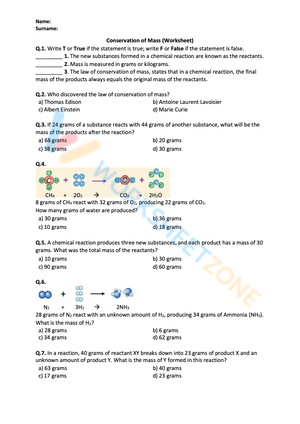
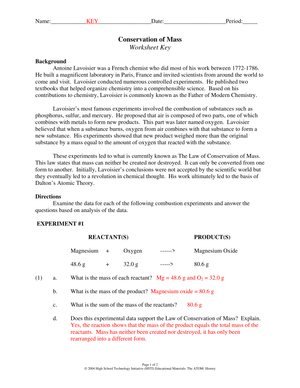
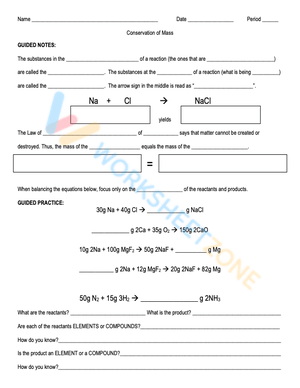
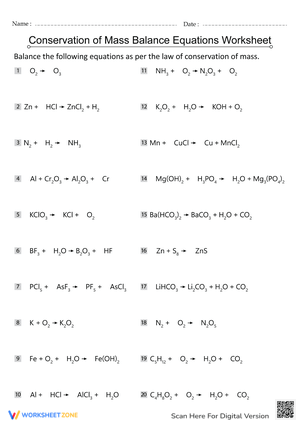
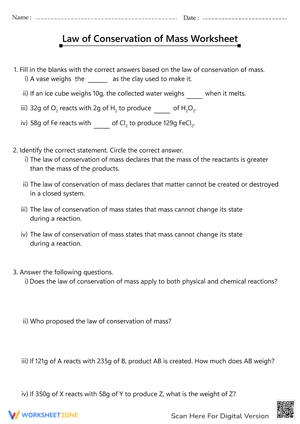
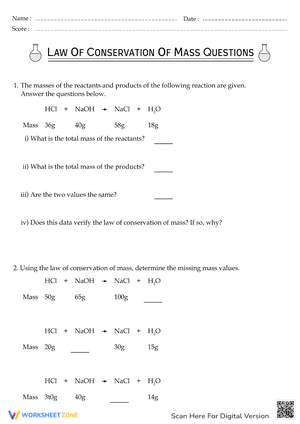
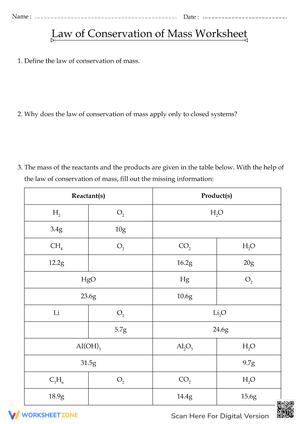
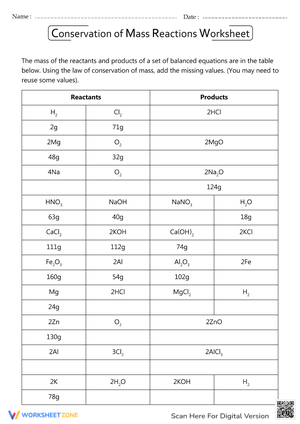
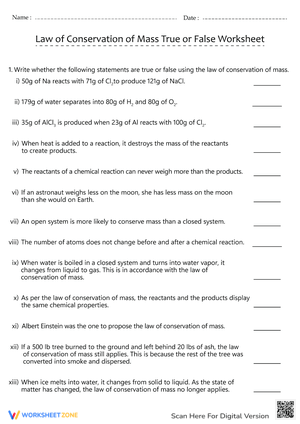
These conservation of mass worksheets for 7th grade give science teachers a focused set of resources that move students from gut-level observation — "the fizzing stopped, so where did the stuff go?" — to data-driven reasoning about matter in closed systems. The set covers what happens to total mass during physical and chemical changes, asks students to defend answers with measured evidence, and keeps the arithmetic at a level where 7th graders can spend their mental energy on the science rather than the numbers.
The Specific Skills Targeted
Each worksheet in the set works a different entry point into the same core idea: matter is neither created nor destroyed during a change. That sounds straightforward until a student watches something dissolve, hears fizzing, or sees a flame go out and assumes mass must have changed. The practice items pull students back to the data every time.
- Before-and-after mass comparison using data tables drawn from physical and chemical change scenarios
- Missing-mass calculations where students solve for an unknown total or component
- Closed-system versus open-system comparisons, with written explanations of why the two setups produce different measurement results
- Short evidence-based explanations requiring students to cite measured values, not just restate the rule
- Particle-model diagrams that ask students to account for atoms before and after a change
The explanation items matter as much as the calculation items. A student who solves a missing-mass problem by subtraction does not automatically understand why the numbers work out that way. Requiring a sentence or two of evidence-based reasoning quickly surfaces whether the concept has actually landed — or whether the student is pattern-matching without understanding.
Mistakes Students Make That These Worksheets Help Surface
The most persistent misconception at this grade level is that dissolving destroys matter. Students who watched sugar disappear into water in fifth grade often carry that image into 7th grade chemistry. When they see a before mass that matches the after mass in a dissolving scenario, many assume the data must be wrong — not their prior belief. Items that ask students to measure total system mass (water plus sugar together, not just the water afterward) break that assumption in a way a lecture rarely does.
A second pattern is what might be called the fizz problem. When students see a reaction produce gas — baking soda and vinegar is the classic example — they record a lower mass after the reaction and conclude that conservation of mass is false. Most of the time they are right about the measurement and wrong about the interpretation: the gas escaped the system; it did not disappear. Worksheets that place a sealed-bag reaction next to an open-cup reaction side by side make this distinction concrete. Students can see that the sealed bag shows equal mass before and after while the open cup does not — and then they have to explain why in writing.
A third pattern is subtler. Students who memorize "mass is conserved" as a sentence often cannot apply it to an unfamiliar scenario. If a worksheet shows a candle burning inside a sealed glass dome and asks for the total mass after the candle goes out, a student reciting the rule will write "the same." But if the question then asks where the original wax went — given that only CO₂ and water vapor remain in the dome — many students go blank. Particle-model items catch that gap quickly and give teachers a clear signal before the unit assessment.
How to Work These Worksheets Into Your Lesson Sequence
The most effective placement for conservation of mass worksheets for 7th grade is the day after a hands-on demonstration, not the day of. When students are managing sealed zip-lock bags of baking soda and vinegar, recording masses on a balance, and watching reactions happen in real time, they are already at capacity. The worksheet that follows — done the next morning as a 15-minute warm-up — is where the reasoning actually gets built. Students revisit their own data, apply it to a parallel scenario, and begin to see a transferable pattern rather than a one-time lab result.
For units where lab time is limited, the worksheets function as standalone practice without prior lab experience, though they land better when teachers walk through one example together before releasing students. The before-and-after data table items in particular benefit from a quick whole-class model: annotate a projected table together, then let students work through the remaining items independently. That step-by-step release keeps cognitive load manageable without reducing the intellectual demand of the task.
Short items from the set also work well as exit tickets. After a lesson on physical versus chemical changes, a four-question worksheet asking students to classify a change and explain what should happen to mass gives teachers a fast read on where the class stands — in about 8 minutes — before the next lesson begins. That kind of low-stakes check catches confusion before it calcifies into a wrong mental model.
Standard Alignment
These worksheets align to NGSS MS-PS1-5, which asks students to develop and use a model to describe how the total number of atoms does not change in a chemical reaction and thus mass is conserved. In classroom terms, that means students need to move beyond measuring and calculating — they need to connect mass data to what is happening at the particle level. The worksheets address both the quantitative side (comparing totals, solving for unknowns) and the model side (particle diagrams and written explanations grounded in atom accounting).
MS-PS1-5 typically appears in the second half of a 7th grade physical science unit, after students have worked with physical and chemical change identification. The worksheets fit that sequence naturally — the calculation items build on what students already know about measuring matter, while the particle-model and explanation items push into the demands of the new standard.
Adjusting the Worksheets for a Range of Learners
For students who need more support, the most effective adjustment is narrowing the explanation prompt rather than reducing the calculation challenge. Keep the same data table — same numbers, same scenario — but replace an open-ended written response with a sentence frame: "The mass stayed the same because ________." This keeps the intellectual task intact while removing the open-response anxiety that often blocks written work in science class. A worked example at the top of each worksheet, showing exactly what a complete response looks like, helps students who struggle with unstructured directions get started without requiring individual teacher redirection.
On-level students work through mixed-scenario items independently and write their own explanations without frames. Students ready for extension benefit most from critique tasks: present a false claim — "The mass decreased because some of the carbon turned into energy during the reaction" — and ask them to identify the error and correct it using evidence from the data. That task requires students to hold the correct principle, the incorrect claim, and the evidence simultaneously, which is genuinely harder than solving a missing-mass problem and closer to the kind of scientific argumentation MS-PS1-5 is actually asking for.
Frequently Asked Questions
Do students need prior lab experience before using these worksheets?
Not necessarily, but the worksheets land better when students have at least one concrete reference point — a demonstration, a short video clip, or a teacher-modeled example of a sealed-system measurement. The data table items are largely self-contained, but the particle-model questions work best when students have drawn or analyzed a simple before-and-after particle diagram at least once in class before working independently.
What do I do when a student correctly measures a mass decrease in an open-cup reaction and insists conservation of mass is wrong?
This is the most productive teaching moment in the unit, and conservation of mass worksheets for 7th grade can help you set it up deliberately rather than waiting for the confusion to surface on its own. Build the comparison in advance: give students a data set from a sealed-bag reaction showing equal masses, then a second data set from an open cup showing a decrease, and ask them to explain the difference. Most students, given both sets of evidence side by side, reason their way to "something escaped the open cup" before the teacher names it. The worksheet structures that reasoning so it becomes visible and discussable.
How does this content differ from what students cover in high school chemistry?
At the 7th grade level, the focus stays on measurement, particle models, and evidence-based explanation. Students are not yet balancing formal chemical equations or working with molar mass. The goal is conceptual: matter that seems to disappear has actually changed form or moved somewhere else in the system. Students who arrive in 9th grade still convinced that burning or dissolving destroys matter face a real gap when stoichiometry begins — conservation of mass worksheets for 7th grade close that gap while the concept is still approachable through direct observation and simple models.
Can these worksheets work as a sub plan or independent review?
Yes. Each worksheet includes enough context in the directions and data tables that students can work through it without teacher facilitation. Mixed-scenario review worksheets from the set are especially well suited to structured independent practice during a review day, a sub period, or small-group reteach sessions. The answer key supports non-science substitutes and paraprofessionals in giving students accurate, timely feedback.












 Interactive Worksheet Maker
 Quiz Maker
 Word Search Maker
 Crossword Puzzle Maker
 Word Scramble Generator
 Sentence Scramble Generator
 Handwriting Worksheet Generator
 Name Tracing Generator
 Fill In The Blank Generator