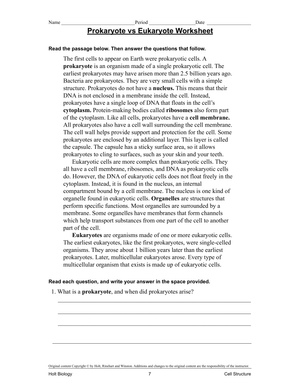
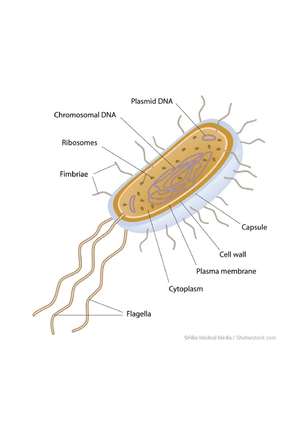
7th Grade Prokaryote and Eukaryote Cells PDF Worksheets
These 7th grade prokaryote and eukaryote cells pdf worksheets give teachers a printable resource for one of the central comparisons in middle school life science: two categories of cells, defined by internal structure, that together account for every living organism on Earth. Students label, sort, classify, and write — producing visible evidence of understanding rather than a completed vocabulary list. The set covers shared features, structural distinctions, and the organism classification work that those distinctions make possible.
The Core Comparisons These Worksheets Build
At 7th grade, the prokaryote/eukaryote distinction marks a conceptual step up from earlier cell lessons. Students are no longer just learning that cells exist or that they have parts. They are learning to sort all living things into two structural categories and to justify that sorting with evidence. These 7th grade prokaryote and eukaryote cells pdf worksheets build that precise comparative thinking across several task types.
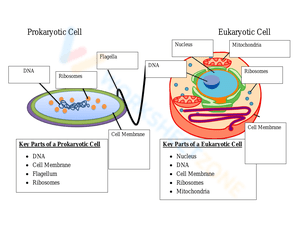
- Shared structures: identifying cell membrane, cytoplasm, ribosomes, and DNA as features present in both cell types
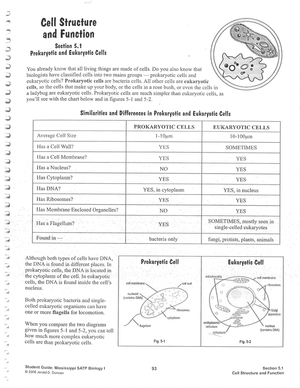
- Prokaryotic-only characteristics: no nucleus, no membrane-bound organelles — and why that matters for classification
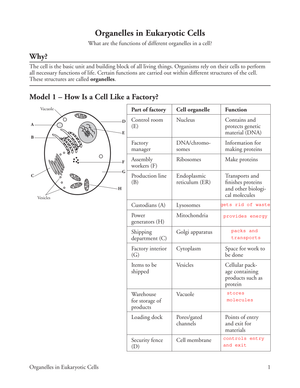
- Eukaryotic-only characteristics: nucleus present, along with organelles such as mitochondria and chloroplasts enclosed by membranes
- Organism classification: sorting bacteria and archaea as prokaryotes, and animals, plants, fungi, and protists as eukaryotes
- Venn diagram work: placing traits in the correct shared or distinct region, which surfaces misconceptions quickly
- Short constructed responses: explaining why an organism belongs to a category, not just naming it
That last task type carries more instructional weight than it appears to. A prompt like "Explain why a bacterial cell is classified as prokaryotic" requires students to recall the structural criterion — absence of a nucleus — rather than simply retrieve the term. That shift from vocabulary recall to structural explanation is where durable understanding develops, and it shows up in short-response scores well before the unit test.
Student Errors That Surface Quickly on This Topic
The most consistent misconception at this grade level is a quiet overgeneralization: students learn that prokaryotic cells have no nucleus and silently extend that to mean no genetic material at all. On short-response items, these students write that bacteria "don't have DNA" — not a vocabulary slip but a real conceptual gap. Teaching shared structures first, and having students physically underline "DNA" and "ribosomes" on a two-column feature list before the comparison begins, reduces this error before it has a chance to settle in.
A second pattern worth anticipating is organism classification by intuition. Students who correctly identify plants and animals as eukaryotes will often place fungi and protists in the prokaryote column, reasoning that "small" or "simple" must mean the other kind. The fix is deliberate: anchor classification to the structural definition — nucleus present or absent — not to organism size or perceived complexity.
There is also a reliable term-reversal error on timed assessments. Students write "eukaryotes have no nucleus" even after getting the comparison right during class practice. A short etymology note — eu means true, karyon means kernel or nucleus, so a eukaryote is literally a "true nucleus" cell — gives students a memory anchor that holds better than repeated drill. Any activity that prompts students to write the root meaning once tends to reduce that reversal error on later tests.
Building These Worksheets Into Your Lesson Sequence
The most effective entry point is a 5- to 8-minute warm-up asking students to list everything they associate with cells before any new vocabulary appears. That step surfaces prior knowledge, reveals who is already carrying the DNA-omission misconception into the room, and gives you a concrete picture of where each class actually stands. From there, spend 8 to 10 minutes on direct instruction covering shared features exclusively. Students need to internalize what both cell types carry in common before the differences will stick.
The worksheets fit into the practice block that follows. In a 45-minute period, 15 to 20 minutes is enough to work through vocabulary matching, the Venn diagram, organism sorting, and one or two short responses. Protect that short-response time — it is where comprehension gaps become visible. A 5-minute exit ticket closes the lesson: one similarity, one difference, written in the student's own words without referring back to the worksheet. That transfer step, from the worksheet to self-generated language, is where content moves toward retention.
For Friday review before a Monday quiz, the 7th grade prokaryote and eukaryote cells pdf worksheets work well as a partner-check activity where students justify each answer aloud before comparing papers. Oral justification tends to surface misunderstandings that a completed worksheet alone conceals. Each worksheet also carries self-contained instructions, which makes these reliable sub plans — no explanation of prior lessons required.
Adjusting the Work for a Range of Readiness Levels
The same materials serve students at different readiness levels with targeted changes rather than separate worksheets. For students who hit vocabulary as the primary barrier, a definition reference box alongside the Venn diagram and a word bank for the labeling section reduce working memory load and let the comparison work — the actual science — take center stage. Sentence frames such as "Both cell types have ___ because ___" help students produce accurate written responses without reducing the conceptual demand.
For students ready to push further, remove the frames and ask them to generate their own examples — organisms not named anywhere in the set — and explain their classification. A question like "Name an organism you haven't seen in any of these activities and explain which category it belongs to and why" shifts the task from recall to genuine transfer. In co-taught settings, running two versions simultaneously keeps the entire class working on the same science concepts while giving each group the level of language support it actually needs.
Standard Alignment
The skills in this set align with NGSS MS-LS1-1, which asks students to provide evidence that living things are made of cells, and with the disciplinary core idea LS1.A, which addresses how cells carry out the functions of life. The prokaryote/eukaryote comparison sits at the center of both: students examine structural differences within the category "cell" rather than treating all cells as equivalent. Many state science frameworks that follow NGSS place this comparison explicitly in 7th grade, often in the same unit as organism classification and heredity, which is exactly where it has the most instructional payoff.
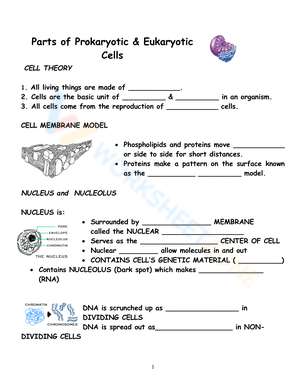
The constructed-response sections also address CCSS.ELA-LITERACY.RST.6-8.7, which asks students to integrate information from diagrams and written text into a coherent explanation. A labeled cell diagram paired with a written justification — a format that appears in each worksheet — gives students structured practice with that integration before they encounter it in a testing context.
Frequently Asked Questions
What is the most important concept for students to walk away with?
The nucleus. Its presence defines a eukaryotic cell; its absence defines a prokaryotic cell. Every other distinction — relative cell size, organelle count, organism examples — follows from that one structural criterion. Students who anchor the comparison there make far fewer classification errors than students who try to memorize a longer list of features.
Do students need prior organelle knowledge before working with these materials?
No. Each worksheet introduces the relevant vocabulary in context. The set builds from features all cells share and adds the distinguishing structures from there, so students without prior organelle exposure can follow the activities without being lost from the start.
Can the short-response sections be graded as a quiz?
Yes. The constructed-response items are phrased at an appropriate level for a formative quiz grade. The Venn diagram and labeling sections work better as practice or guided work, since students benefit from being able to refer to notes while completing those tasks.
Where do these fit in a cells unit that also covers plant and animal cell differences?
Teach the prokaryote/eukaryote comparison first — it provides the broader classification framework. Plant and animal cell differences then become a more specific comparison within the eukaryote category rather than a separate, unconnected topic. The 7th grade prokaryote and eukaryote cells pdf worksheets belong early in a cells unit, before plant and animal organelle detail adds cognitive load on top of a comparison students haven't fully consolidated yet.
How long does each worksheet take during independent work time?
Most students finish each worksheet in 15 to 20 minutes. The short-response section consistently takes the longest, and that time is worth protecting — it is where real comprehension gaps appear and where the most useful formative information comes from.
Clear All