


























Views
Downloads


Printable Percent Increase and Decrease Worksheet | Grade 7
Paste this activity's link or code into your existing LMS (Google Classroom, Canvas, Teams, Schoology, Moodle, etc.).
Students can open and work on the activity right away, with no student login required.
You'll still be able to track student progress and results from your teacher account.
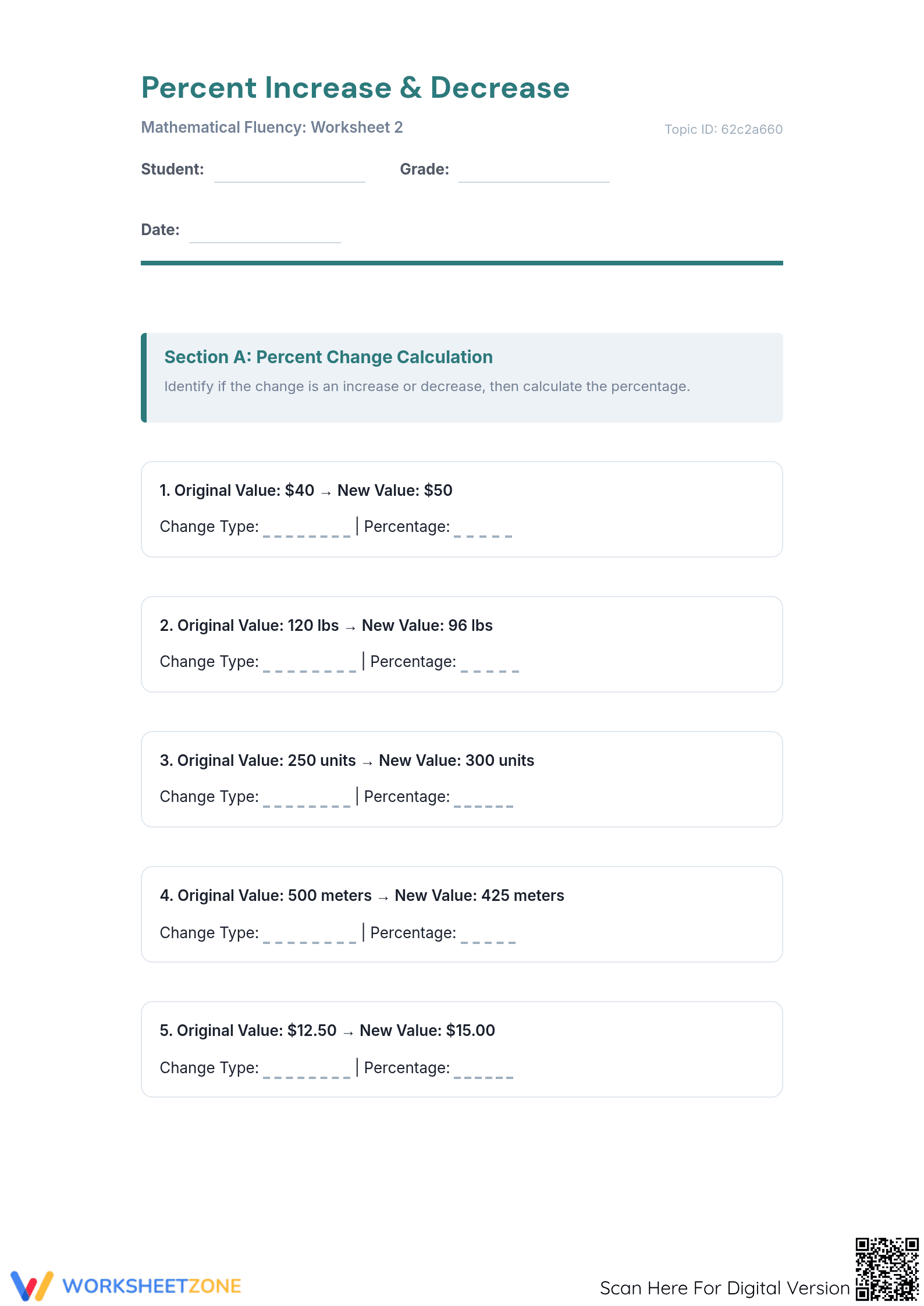
This worksheet focuses on mastering percent increase and decrease. Students progress from basic calculations to complex story problems, ensuring they can accurately determine percentage changes. By working through thirty distinct problems, learners develop the fluency needed for advanced proportional reasoning and practical applications.
At a Glance
- Grade: 7 · Subject: Math
- Standard:
7.RP.A.3— Use proportional relationships to solve multi-step ratio and percent problems including tax, markups, and markdowns- Skill Focus: Calculating and Applying Percent Increase and Decrease
- Format: 4 pages · 30 problems · Answer key included · PDF
- Best For: Independent middle school practice for proportional reasoning and financial literacy units
- Time: 45–60 minutes
What's Inside
This four-page resource features four logical sections. Section A includes ten problems on basic percent change. Section B focuses on applying changes to start values. Section C introduces eight story problems involving real-world scenarios. Finally, Section D challenges students with multi-step mastery tasks involving compound percentage shifts.
Skill Progression
- Guided Practice: The initial ten tasks provide original and new values, requiring students to identify the change type and compute the exact percentage.
- Supported Practice: Eight problems guide students to calculate final values based on specific percent increase or decrease prompts.
- Independent Practice: The final twelve problems, including real-world scenarios and multi-step challenges, require students to apply their knowledge without scaffolding.
This progression effectively follows the gradual-release model of I Do, We Do, You Do to ensure student success.
Standards Alignment
This resource is directly aligned with `7.RP.A.3`, which requires students to use proportional relationships to solve multi-step ratio and percent problems. The tasks specifically cover markups, discounts, and percent increase and decrease. This standard code can be copied directly into lesson plans, IEP goals, or district curriculum mapping tools to ensure instructional consistency and rigor.
How to Use It
Use this worksheet as a primary practice activity after a lesson on percent change. It also serves as an excellent formative assessment for 7th-grade math students. Teachers should observe students during Section B to ensure they correctly apply the change to the original amount. The estimated completion time is 45 to 60 minutes, depending on student fluency.
Who It's For
This material is designed for 7th-grade math students but is also suitable for 8th-grade review or accelerated 6th-grade learners. It is particularly helpful for students needing targeted practice with multi-step percent problems. Pairing this with a real-world shopping catalog or a financial literacy passage provides additional context for these mathematical operations.
Fisher & Frey (2014) emphasize that mathematical fluency in percent applications is a critical precursor to algebraic reasoning and financial literacy. This worksheet, aligned to the 7.RP.A.3 standard, provides a scaffolded pathway for students to internalize the relationship between original values and final outcomes. By progressing from basic 'change type' identification to complex multi-step scenarios like compound percent adjustments, learners build a robust mental model of proportionality. Research indicates that frequent, targeted practice with real-world story problems significantly improves retention and the ability to generalize mathematical concepts to non-routine contexts. The inclusion of clear sections for calculation, application, and problem-solving allows educators to identify specific areas of struggle, such as the common misconception that a 20% increase followed by a 20% decrease returns to the original value. This comprehensive resource ensures that students move beyond rote memorization toward deep conceptual mastery of percentages.


