


























Views
Downloads

Grade 7-9 Compound Probability — Printable No-Prep Worksheet
Paste this activity's link or code into your existing LMS (Google Classroom, Canvas, Teams, Schoology, Moodle, etc.).
Students can open and work on the activity right away, with no student login required.
You'll still be able to track student progress and results from your teacher account.
This comprehensive Grade 7-9 math worksheet provides students with essential practice in calculating compound probability for both independent and dependent events. By engaging with a variety of mathematical models—from spinners and number cubes to real-world scenarios—students build a concrete understanding of how multiple events interact and determine total outcomes.
At a Glance
- Grade: 7-9 · Subject: Math
- Standard:
CCSS.MATH.CONTENT.7.SP.C.8— Find probabilities of compound events using organized lists, tables, tree diagrams, and simulation- Skill Focus: Compound Probability (Independent & Dependent)
- Format: 4 pages · 26 problems · Answer key included · PDF
- Best For: Secondary math practice and formative assessment
- Time: 45–60 minutes
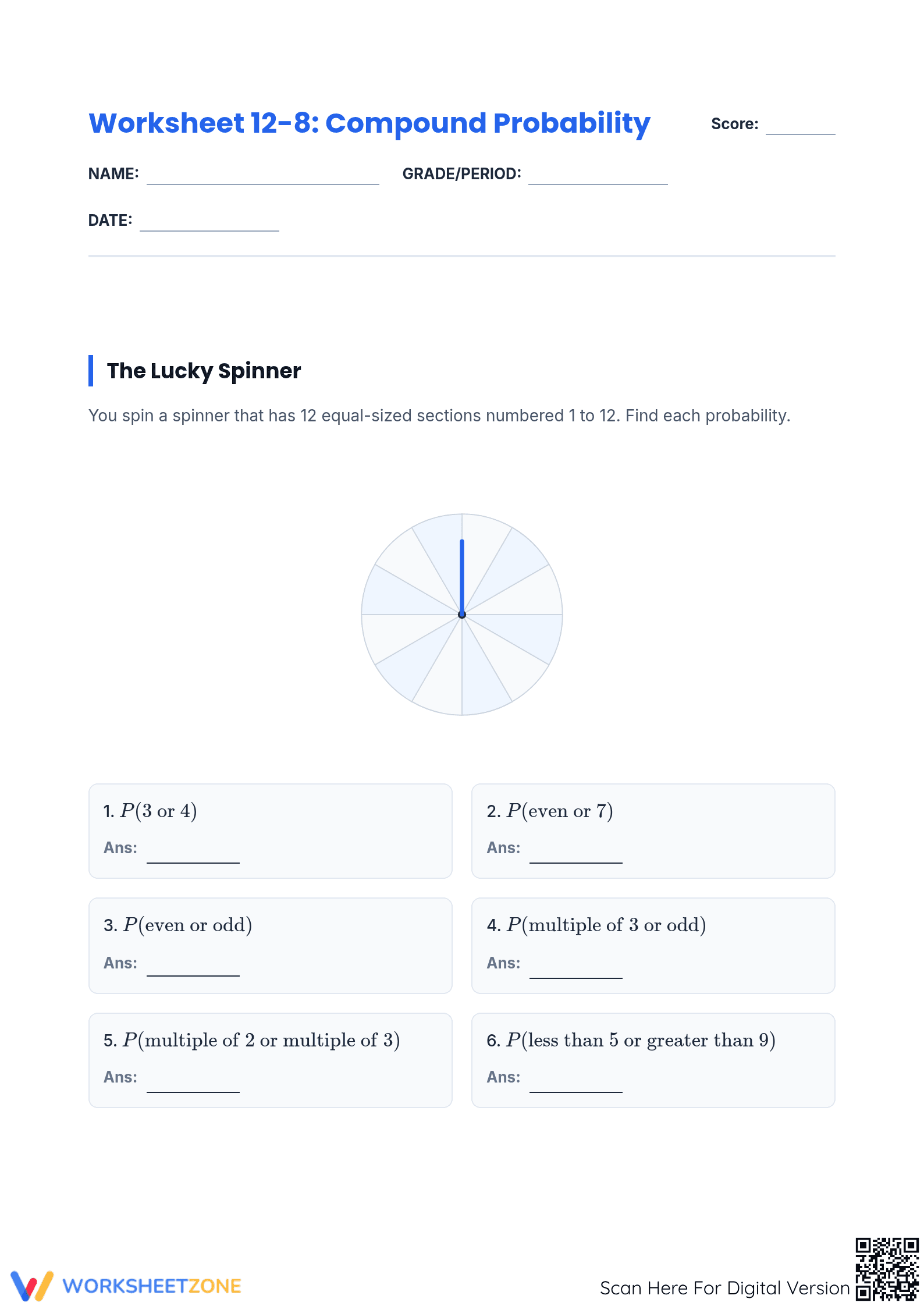
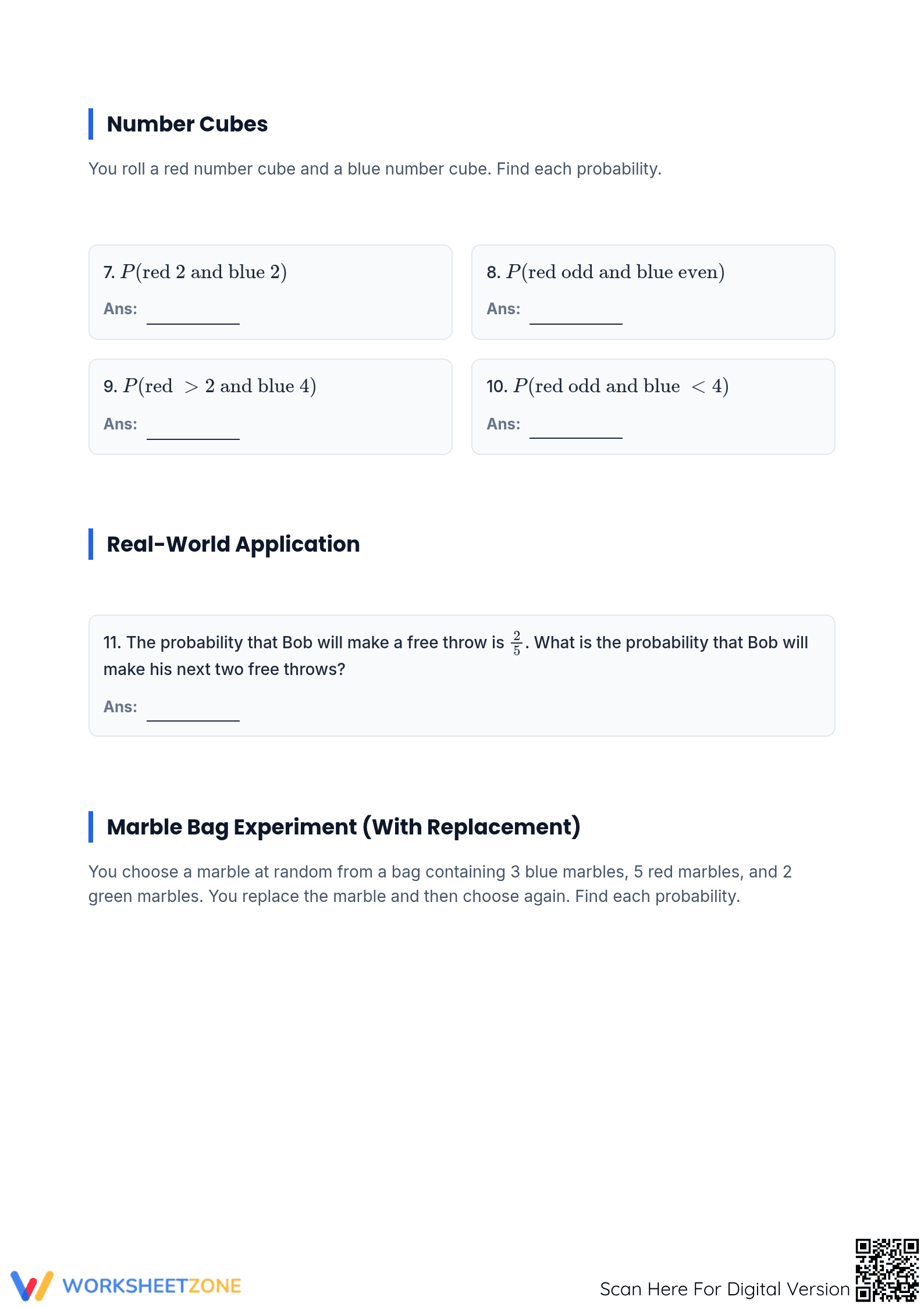
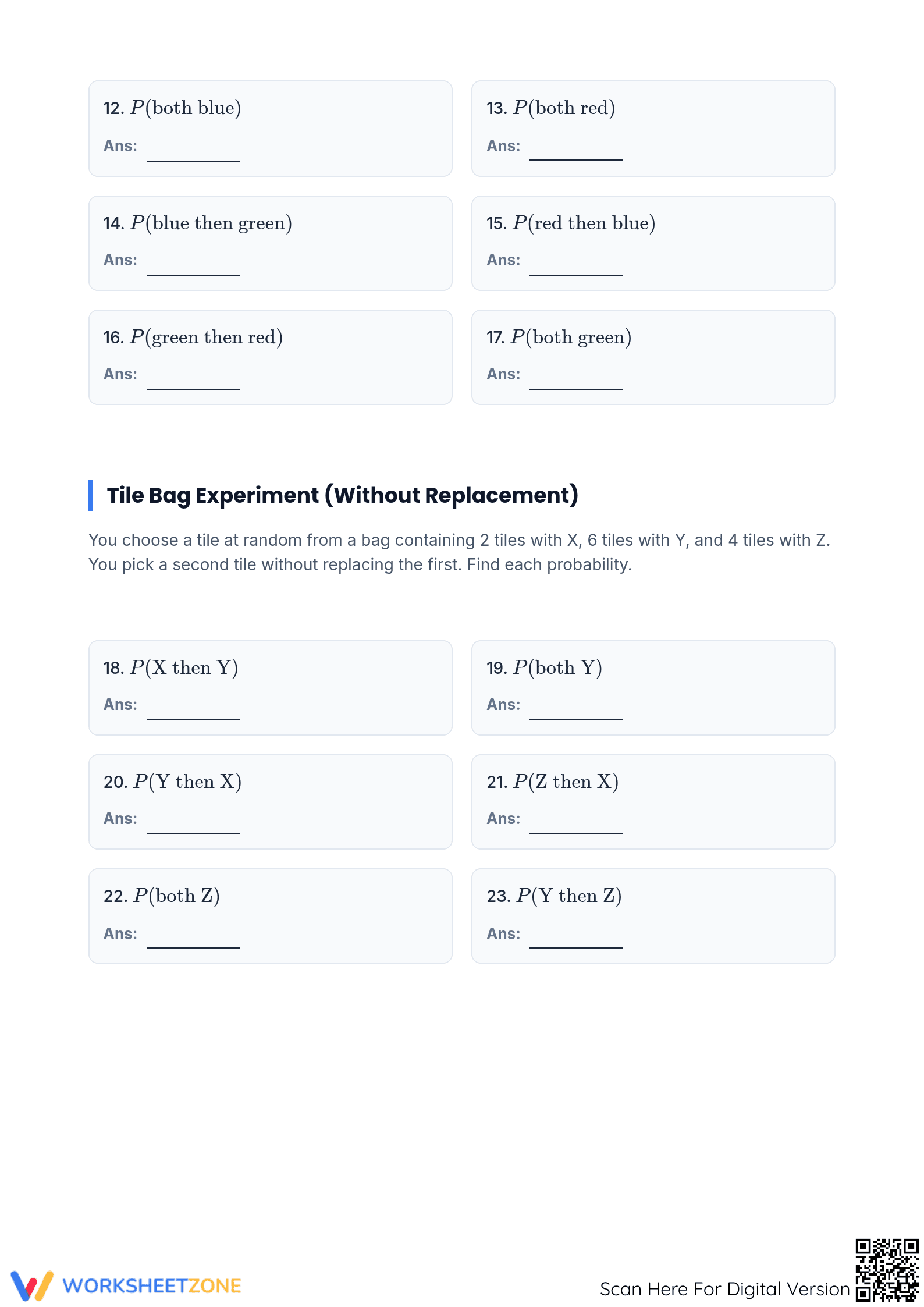
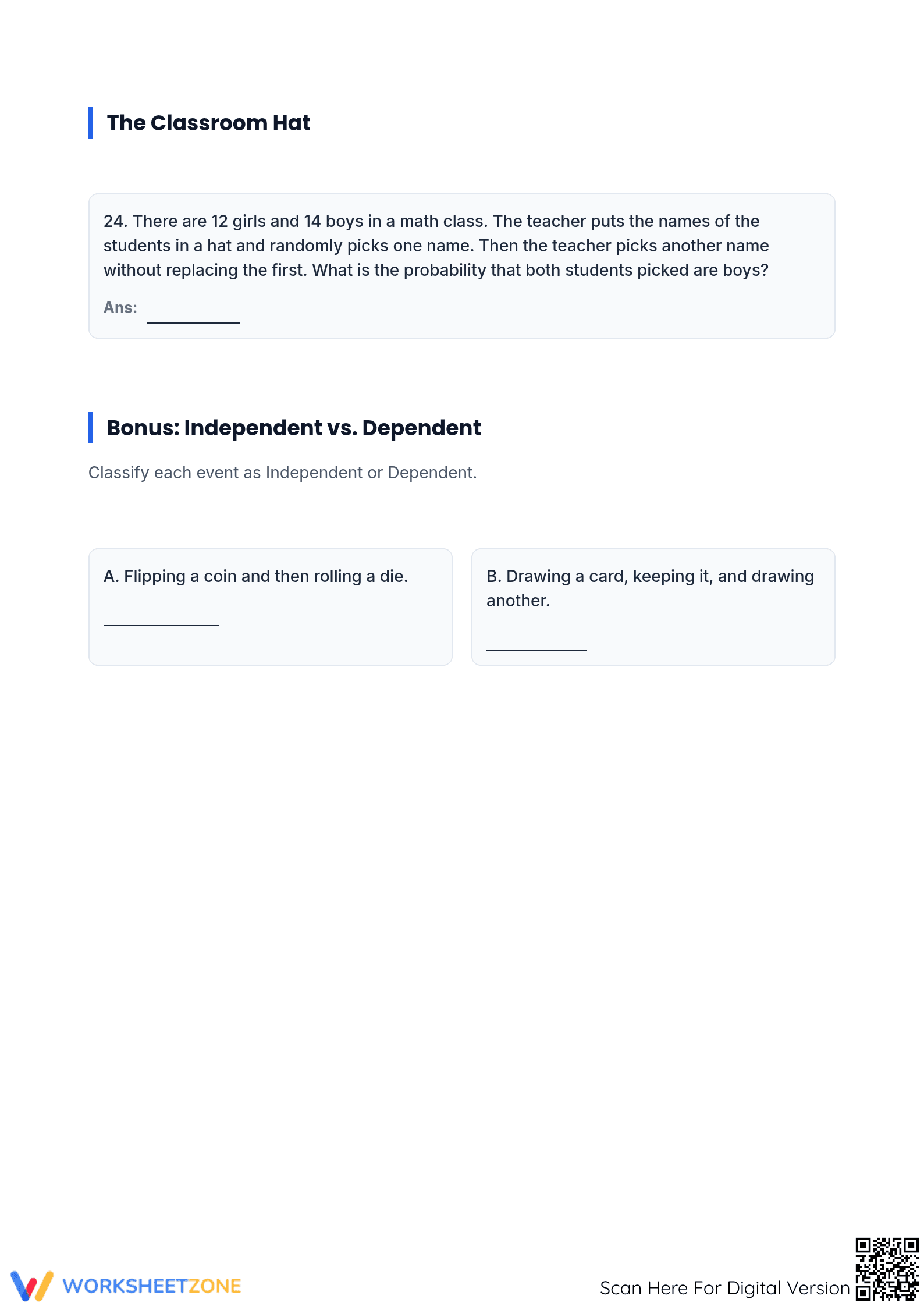
Inside this four-page set, you will find 26 carefully structured problems divided into logical sections. The worksheet begins with "The Lucky Spinner," moves into "Number Cubes," and explores "Marble Bag" experiments with replacement and "Tile Bag" experiments without replacement. It concludes with real-world applications and a bonus section for classifying events as independent or dependent, ensuring a full spectrum of skill application.
The zero-prep workflow for this resource is designed for maximum teacher efficiency. First, print the four-page PDF (approximately 1 minute). Second, distribute the worksheets to your class (1 minute). Third, use the included comprehensive answer key to review student work or facilitate peer-grading (approximately 10 minutes). With a total prep time of under two minutes, this resource is an ideal choice for emergency sub plans or last-minute instructional shifts.
This resource is strictly aligned to CCSS.MATH.CONTENT.7.SP.C.8, which requires students to find probabilities of compound events using various mathematical tools. It specifically addresses sub-standards regarding independent and dependent events, such as CCSS.MATH.CONTENT.HSS-CP.A.2. Both standard codes can be copied directly into lesson plans, IEP goals, or district curriculum mapping tools to demonstrate rigorous alignment with national requirements.
To use this worksheet effectively, assign it as a cumulative review after direct instruction on probability rules. It works exceptionally well as a formative assessment to identify students who struggle to distinguish between replacement (independent) and non-replacement (dependent) scenarios. During the lesson, observe students as they tackle the "Tile Bag" section to ensure they are correctly adjusting the denominator for the second event.
This worksheet is designed for middle and early high school students (Grades 7-9) who are developing mastery in statistics and probability. It is particularly helpful for students requiring additional visual scaffolds, as the inclusion of the spinner diagram provides a clear entry point for complex calculations. It pairs naturally with a hands-on probability lab or a digital simulation tool to reinforce theoretical concepts with empirical data.
According to the RAND AIRS 2024 analysis of secondary mathematics instruction, high-quality practice materials must provide a clear transition from simulated models to abstract problem-solving to ensure long-term retention of statistical concepts. This worksheet fulfills that requirement by grounding the abstract rules of CCSS.MATH.CONTENT.7.SP.C.8 in observable events like spinning a wheel or drawing a marble. By forcing students to differentiate between independent and dependent event structures, the resource builds the cognitive flexibility required for higher-level statistics. Educational research suggests that providing at least 20 varied repetitions of compound event calculations significantly reduces student errors in denominator adjustment during dependent event tasks. This standalone resource serves as a vital bridge between introductory probability and the complex data analysis demands of later high school mathematics curricula.


