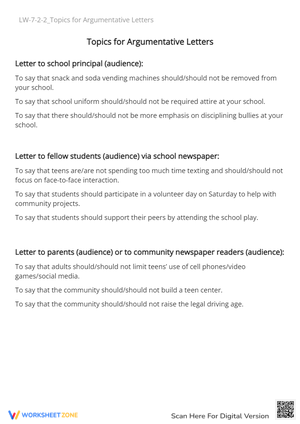
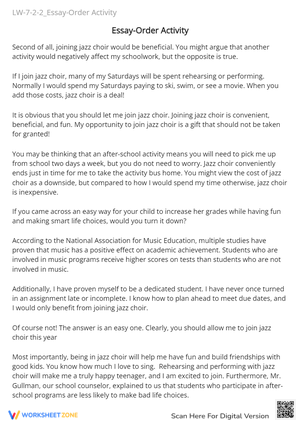
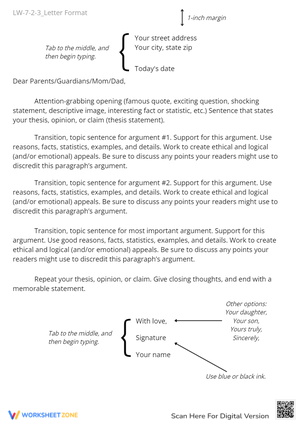
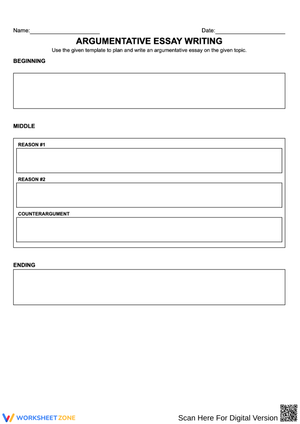
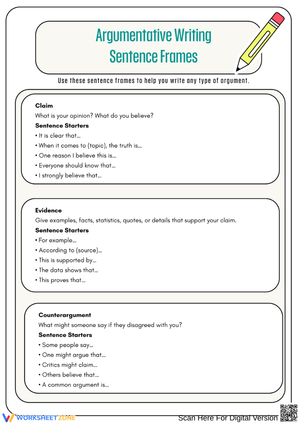
These 7th grade argument writing worksheets files give ELA teachers a practical way to break argument writing into its working parts — claim, evidence, counterclaim, rebuttal — without requiring students to produce a full draft every time they practice a skill. The set targets the specific moves that seventh graders struggle with most, and each worksheet fits into the kind of short instructional windows that fill a real school week.
The Specific Argument Skills Each Worksheet Targets
Argument writing at the seventh-grade level breaks into a handful of distinct skills, and the most useful practice targets each one separately before asking students to put everything together. These worksheets address:
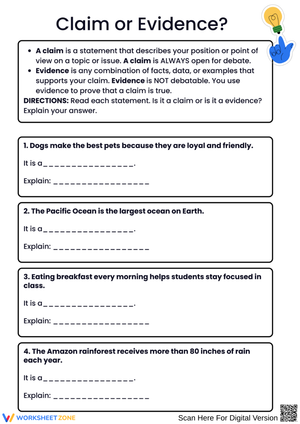
- Claim writing: Students read a prompt or short passage and write a specific, defensible claim — then revise a weak or vague version of the same claim to make it more precise.
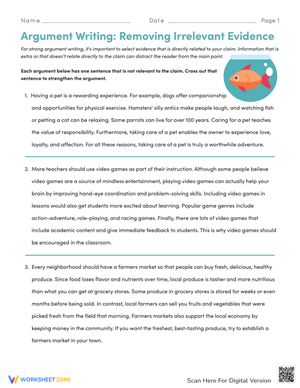
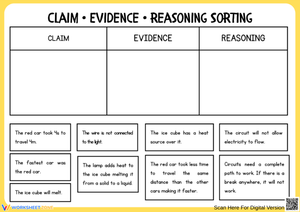
- Reasons and evidence: Students sort pieces of evidence, match details to reasons, or explain how a specific statistic or quotation actually supports the claim rather than just restating it.
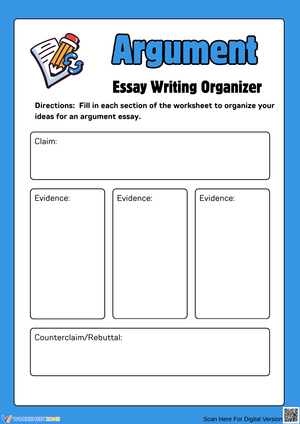
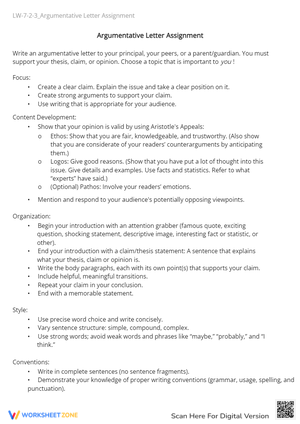
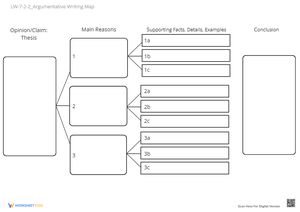
- Organization: Graphic organizers map introduction, body paragraphs with evidence, counterclaim, rebuttal, and conclusion — keeping the logical structure visible before students commit to drafting.
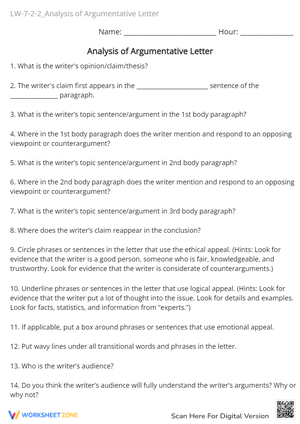
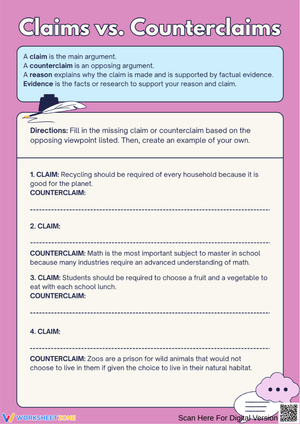
- Counterclaim and rebuttal: Students identify an opposing viewpoint, write a sentence acknowledging it, and then compose a rebuttal that defends the original claim with reasoning.
- Formal style and transitions: Short sentence-revision tasks ask students to remove first-person language, tighten vague phrasing, and replace weak transitions with precise connective language.
- Revision work: Students return to a draft paragraph and strengthen one element — a piece of evidence, a topic sentence, or a conclusion — based on a targeted checklist.
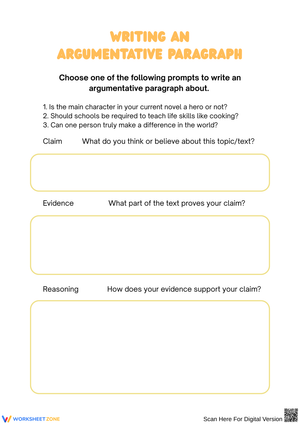
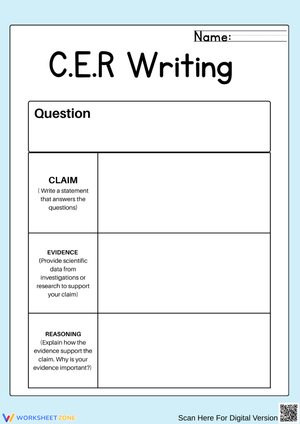
Planning worksheets include prompt analysis boxes and evidence charts that pair naturally with short nonfiction passages. The step-by-step format on each worksheet separates the thinking task from the writing task, which matters when students are still learning to select and explain evidence rather than simply list it.
Frequent Student Mistakes Worth Catching Before They Become Habits
The most persistent error in seventh-grade argument writing is not a grammar problem — it's a logic problem. Students conflate having an opinion with making a claim. They write "I think phones should be banned at school" and consider the work done. What's missing is a reason embedded in the claim itself — something that signals why the position is defensible, not just what the position is. Worksheets that ask students to revise a weak claim alongside a stronger model help them see the difference before that weaker pattern gets buried in a full essay.
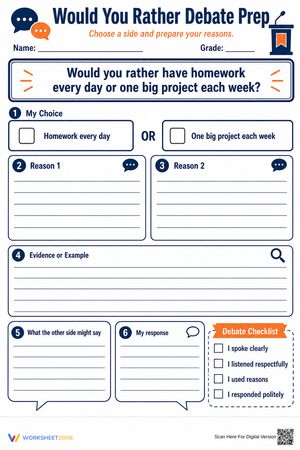
A second failure point is what some teachers call the "quote drop": a student pulls a statistic or line from a text and places it in the paragraph with no explanation. The evidence just sits there. No one names the connection. The fix is explicit — after quoting or paraphrasing, write one sentence that begins "This shows that..." and forces the student to articulate the link. Worksheets with a two-column format — evidence in one column, explanation in the other — make that habit concrete and assessable.
Counterclaims are also trouble. Most seventh graders write something like "Some people think differently, but I still believe my point is right" and call it a rebuttal. That's an acknowledgment, not a counterargument. Targeted practice that shows a model counterclaim and rebuttal side by side, then asks students to write their own in response to a given claim, closes that gap faster than repeated margin comments on full essays.
Fitting These Worksheets Into Your Weekly Lesson Plan
These worksheets move most naturally into the short instructional slots that often get filled with re-explaining directions rather than actual writing practice. A claim revision task runs about eight minutes — long enough to be substantive, short enough to fit before a class transition. A graphic organizer works well as overnight homework when students read a short passage the night before and arrive ready to draft. A peer review checklist can anchor the closing 12 minutes of a writing workshop without requiring the teacher to explain a new task from scratch.
One approach that holds up well in practice: assign a single 7th grade argument writing worksheets across two consecutive class days rather than one. On day one, students read a short nonfiction text, complete the planning section, and write their claim. On day two, they return to the same worksheet, draft the counterclaim and rebuttal, and revise one body paragraph using targeted feedback from the previous class. This two-day cycle builds writing stamina without making any single period feel like a marathon, and it gives the teacher a natural checkpoint between planning and drafting.
For small-group instruction, give the same graphic organizer to all students but adjust the level of support around it. One group works with sentence frames for the claim and topic sentences; another writes from an open outline with minimal prompting. The lesson objective stays the same. The support structure changes.
Standard Alignment
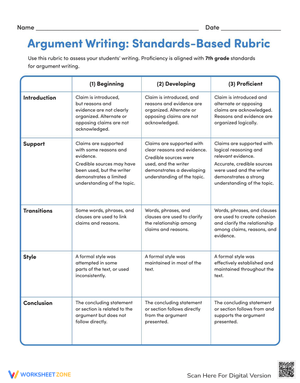
These worksheets align to CCSS.ELA-LITERACY.W.7.1, which outlines the full argument writing expectations at the seventh-grade level. That standard matters in instructional sequence terms: W.7.1 adds the explicit counterclaim requirement that does not appear in W.6.1. For many students, seventh grade is the first time a teacher has asked them to name and respond to an opposing viewpoint in writing, which explains why that skill needs the most targeted, repeated practice — not just a mention in the rubric. Each worksheet in the set addresses one or more of the W.7.1 sub-standards (a through e), so teachers match a specific worksheet to a specific instructional gap without reteaching the entire unit from scratch.
Adjusting the Set for Writers at Different Levels
7th grade argument writing worksheets files serve a full classroom best when they offer genuine entry points for writers at different stages. Students who are still working out how to write a basic claim need sentence frames, word banks for transitions, and prompts tied to a single short passage. Students who can already produce a solid claim need tasks that push toward evaluating evidence quality, writing fuller rebuttals, and revising for tone — not just verifying that the required parts are present.
For multilingual learners and students who carry heavy cognitive load during the actual writing stage, the most useful format separates the planning task entirely from the writing task. A two-part worksheet — first a chart where students record their claim, two supporting reasons, and matching evidence; then a separate section where they write the paragraph — reduces the mental work of tracking both structure and language simultaneously. Students who need that separation often produce stronger paragraphs than they would staring at a blank space under a prompt.
Peer review sheets also benefit from being tiered. A basic version asks: Is there a clear claim? Does the writer include at least one piece of evidence? Is there a counterclaim? A more advanced version asks: Does the evidence actually prove the claim, or does it only relate to the topic? Does the rebuttal explain why the counterclaim is insufficient, or merely dismiss it? Running both versions in the same room keeps peer conferences purposeful across the full range of writers.
Frequently Asked Questions
What does a useful counterclaim worksheet look like at this grade level?
A strong counterclaim worksheet presents students with a realistic opposing viewpoint — not a straw-man version that's easy to dismiss. It asks students to write one sentence acknowledging the other side and one sentence explaining why the original claim still stands. A model response belongs somewhere on the worksheet so students can compare their own writing to a concrete example rather than just a rubric descriptor.
Can these worksheets replace the full argument essay assignment?
No, and they aren't meant to. Each worksheet targets one piece of the writing process. The value is in building component skills so that when students sit down to write a complete essay, they aren't learning claim writing, evidence explanation, and counterclaiming all at the same time. These are practice for the moves, not substitutes for the full performance.
How do these worksheets work for students who shut down when they see a writing task?
Start with a worksheet that carries a very limited writing demand — one sentence, clearly prompted, with a model nearby. Claim revision tasks work well here: the student doesn't generate a claim from scratch, they read a weak one and fix it. That entry point feels manageable. Once students have a sentence they wrote that actually makes sense, the next step is less threatening. These 7th grade argument writing worksheets files reach reluctant writers most effectively when the first task is reading and sorting rather than generating text cold.
How do the worksheets connect reading and argument writing?
Several worksheets in the set pair a short nonfiction passage with the planning and evidence tasks. This pairing matters because argument writing in academic and standardized contexts is almost always evidence-dependent — students need repeated practice selecting and explaining textual evidence, not just generating opinions from personal experience. These paired worksheets fit naturally before state assessment windows or after any nonfiction reading unit where the logical next step is asking students to take and defend a position on what they read.












 Interactive Worksheet Maker
 Quiz Maker
 Word Search Maker
 Crossword Puzzle Maker
 Word Scramble Generator
 Sentence Scramble Generator
 Handwriting Worksheet Generator
 Name Tracing Generator
 Fill In The Blank Generator