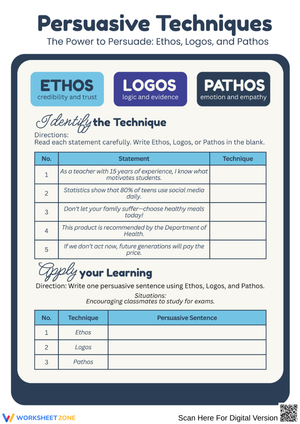
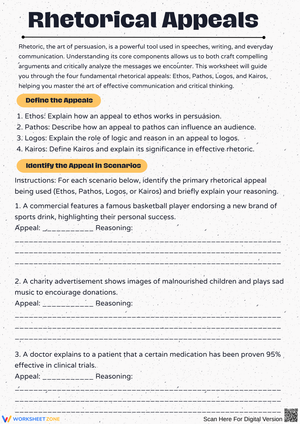
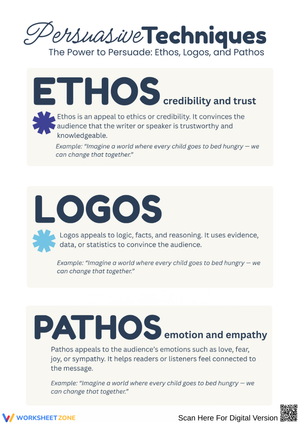
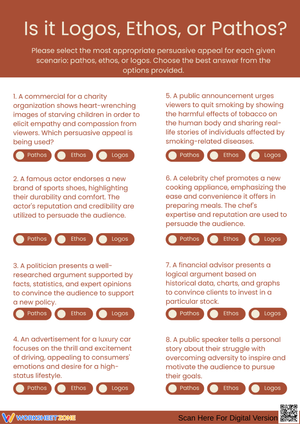
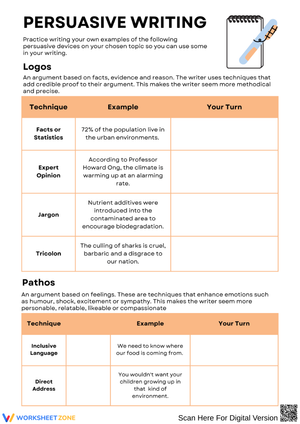
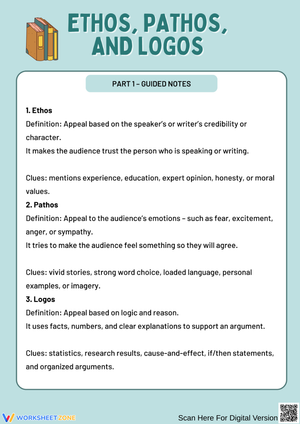
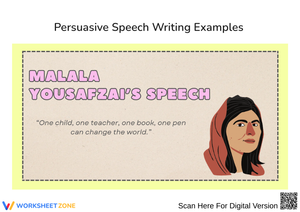
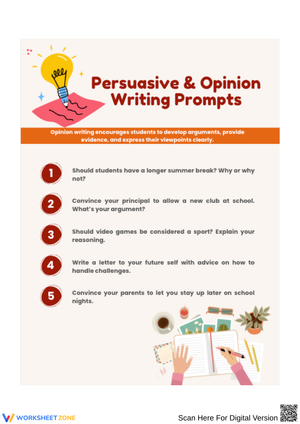
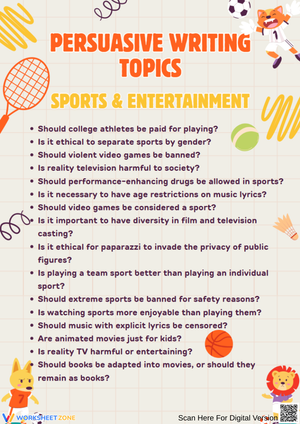
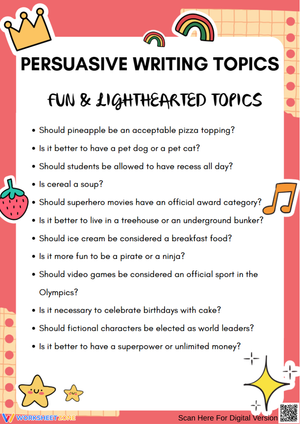
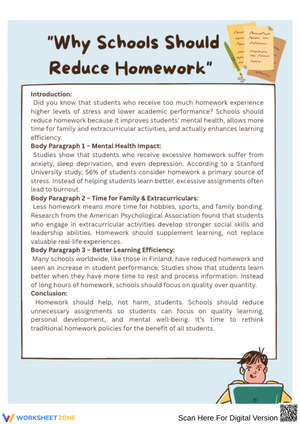
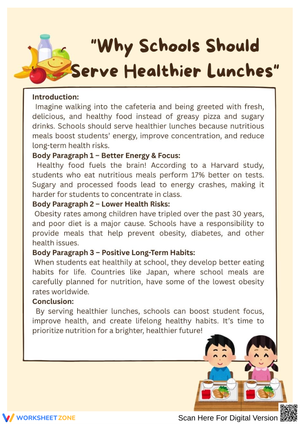
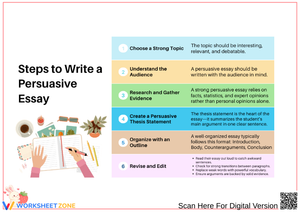
These 7th grade persuasive writing worksheets give ELA teachers targeted, printable practice that moves students past unsupported opinion statements and into structured argument. Each worksheet isolates a specific writing move — claim development, evidence selection, transition use, or revision — so instruction stays focused and progress stays visible. The set works anywhere a short, purposeful task belongs: the first ten minutes of class, a Friday review block, or a writing center rotation.
The Specific Skills Targeted
Seventh graders sit at an interesting point in their writing development. They have usually encountered the five-paragraph format, so they know what a body paragraph is supposed to look like — but they consistently flatten reasons and evidence into the same sentence without explaining the connection. These worksheets address that gap directly, giving students concrete practice with the individual moves that make a persuasive piece hold together.
- Claim writing: Students rewrite vague opinion statements as focused, arguable position sentences with a clear direction for support.
- Reason and evidence development: Each worksheet pushes students to identify what supports their claim and why that support is relevant — two separate questions that most seventh graders treat as one.
- Logical organization: Graphic organizers show the relationship between an introduction, body reasons, and conclusion before students begin drafting.
- Transition use: Dedicated practice sheets cover connecting phrases that signal a new reason, an added example, or a concession to the opposing view.
- Audience awareness: Prompts ask students to name who they are persuading and what that specific reader would need to hear — a question seventh graders rarely ask without a direct prompt.
- Revision and self-assessment: Checklists break editing into claim clarity, evidence relevance, word choice, and conclusion strength so students can evaluate one trait at a time.
One worksheet type worth pointing out: evidence-sort activities where students read a list of potential supporting details and mark which ones genuinely advance the claim and which are off-topic or too thin. Open-ended writing hides this gap — students assume any detail counts as evidence. The sort task makes that assumption visible. The printable format of these 7th grade persuasive writing worksheets makes the annotation work natural; students circle, cross out, and rank directly on the worksheet, which also gives teachers a quick read on who is distinguishing strong evidence from weak.
Mistakes Students Make That These Worksheets Help You Catch
The most persistent error in seventh-grade persuasive writing is not a weak claim — it is the missing explanation between evidence and argument. A student writes a claim, drops in a fact, then moves to the next reason as if the connection is obvious. The fact does not persuade; the explanation does. The revision checklists in this set prompt students to add a sentence after each piece of evidence using something like "This shows that..." or "This matters because..." — small language moves that close the gap between proof and persuasion.
A second pattern shows up consistently on transition worksheets: students learn a connective phrase and then overuse one of them. A class that spends fifteen minutes on "furthermore" will produce papers where every sentence starts with it. These worksheets address that by asking students to identify which transition fits the logical relationship at hand — adding a point, introducing an example, or acknowledging the other side — rather than rotating through a memorized list.
Audience awareness is the skill that drops off most noticeably when students write under time pressure. A prompt that says "write to persuade your principal" usually produces writing addressed to a generic adult, ignoring the specific authority and concerns a principal actually has. The audience-focused prompts here name the reader and ask students to consider one objection that reader would raise before they begin drafting. That single move sharpens the whole piece.
How to Build These Worksheets Into a Writing Cycle
The most effective approach is not assigning one worksheet after another in sequence. It is anchoring several worksheets to the same prompt and using each one as a separate lens on the same piece of writing.
Start with the prewriting organizer — students choose a position on a familiar school or community topic and list three reasons with supporting details. Then assign the claim-writing worksheet using that same topic, so students have existing material to work with. A body paragraph worksheet follows naturally: students draft one reason using evidence they already collected. At the end of the cycle, the revision checklist targets that same paragraph. One topic, four worksheets, one visible sequence of growth. That structure reduces cognitive load — students spend mental energy on the writing move, not on generating new content every session.
Individual worksheets also hold up as standalone tasks. A transition practice worksheet fits a 12-minute skill block before students return to independent writing. An evidence-sort worksheet works well as a Monday warm-up — low stakes, familiar format, and immediate discussion material for the first ten minutes after morning announcements.
Standard Alignment
These worksheets align to CCSS.ELA-LITERACY.W.7.1, which asks seventh graders to write arguments supporting a claim with clear reasons and relevant evidence, use organizational structures that show logical relationships among ideas, and provide a conclusion that follows from the argument. Most Grade 7 teachers address this standard mid-year, after students have had some exposure to informational writing — so the shift from explaining to persuading is new enough to require explicit instruction but not completely unfamiliar territory. The substandards W.7.1a through W.7.1e map directly to the skills in this set: claim introduction, logical organization, transition use, formal style, and purposeful conclusion.
Differentiating the Set for Mixed-Ability Classrooms
For students who freeze at a blank organizer, the paragraph frames give enough sentence-level support that the writing task stays accessible without removing the thinking. A student who understands that a reason needs evidence but struggles to produce a complete sentence on demand can use the frame as a starting point and revise from there. That keeps everyone working on the same skill even when the degree of support varies.
Advanced writers get more out of each worksheet when the task extends beyond the printed prompt. After completing a claim-and-evidence worksheet, a student who finishes early can draft a counterargument — same claim, same topic, now addressing what a skeptical reader would say. That move toward acknowledging opposition is where Grade 7 persuasive writing begins to look more like formal argument, and it gives high-performing students something genuinely harder to do rather than simply more of the same.
For intervention groups, these 7th grade persuasive writing worksheets work well when the scope narrows. Instead of three body reasons on the organizer, ask for one fully developed reason with strong evidence and a clear explanation of how it supports the claim. One solid reason teaches the skill more effectively than three underdeveloped ones, and it keeps the session from running long for students who need more processing time.
Frequently Asked Questions
How do these worksheets fit into a full persuasive writing unit?
They work best as a structured cycle. The set moves from prewriting and claim development through body paragraph drafting, transition practice, and revision — so teachers can use them sequentially across one to two weeks or pull individual worksheets to address a specific writing gap within a larger unit already underway.
Is persuasive writing the same as argumentative writing at the 7th grade level?
Not exactly. In most middle school classrooms, persuasive writing leans on audience appeal, personal voice, and accessible topics, while argument writing places greater weight on formal evidence and reasoning. These worksheets sit at that intersection — they push students to support positions with organized evidence, but they use age-appropriate topics that give seventh graders enough background knowledge to actually say something.
Can I use these resources for test preparation?
Most state writing assessments at this level ask students to take a position and support it, which means the claim-writing and evidence-selection skills covered in these 7th grade persuasive writing worksheets map directly to what scoring guides measure. The revision checklist works especially well for test prep — students practice evaluating their own writing against the same criteria a scorer would apply.
What if students rush through a worksheet without doing the thinking?
Speed usually signals that a student treated the task as a fill-in rather than a thinking exercise. The most effective response is to return to the claim-writing worksheet and ask the student to make the claim more specific: narrow the topic, name the audience, or add a qualifying phrase. A more precise claim generates stronger reasons on its own, and it surfaces whether the student actually understands the position or just wants to complete the task.












 Interactive Worksheet Maker
 Quiz Maker
 Word Search Maker
 Crossword Puzzle Maker
 Word Scramble Generator
 Sentence Scramble Generator
 Handwriting Worksheet Generator
 Name Tracing Generator
 Fill In The Blank Generator