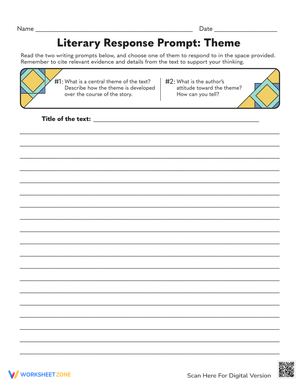
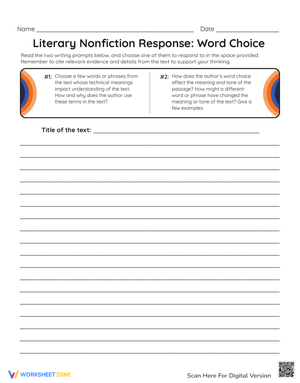
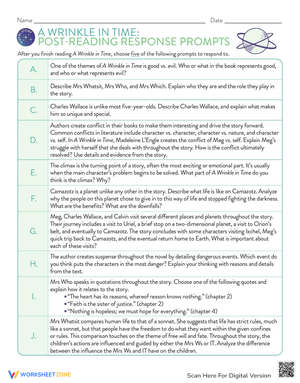
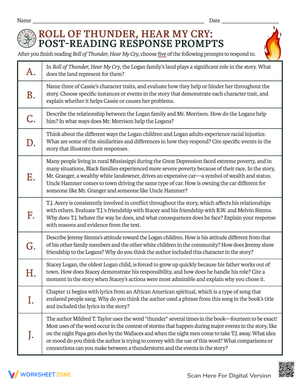
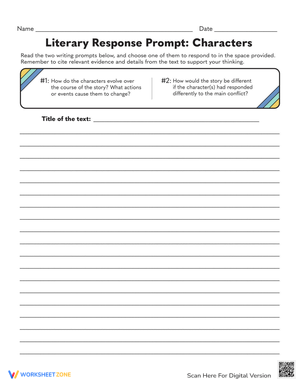
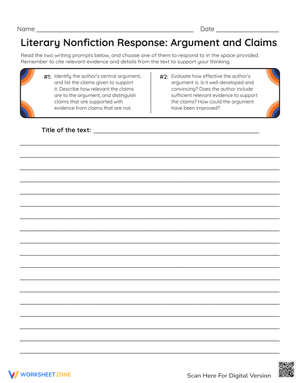
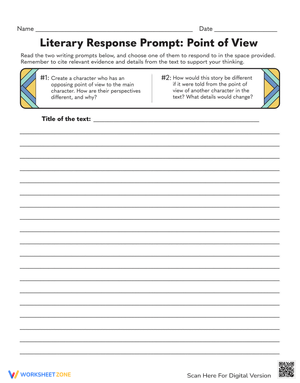
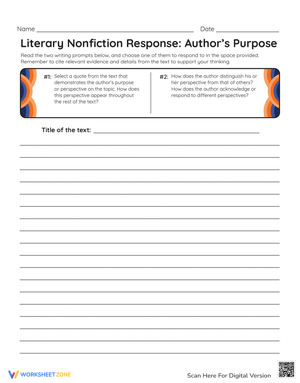
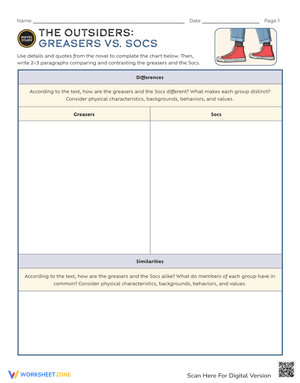
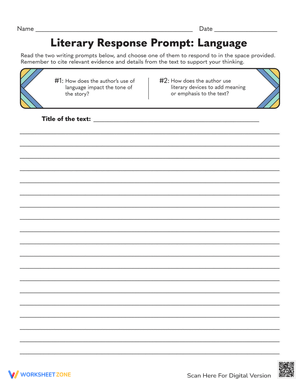
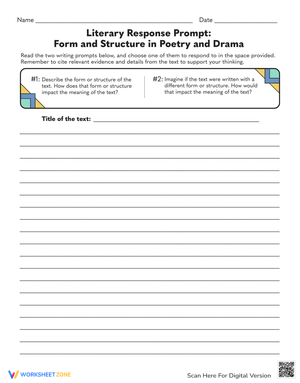
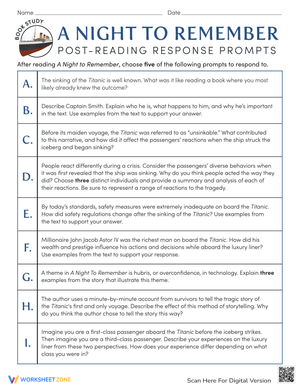
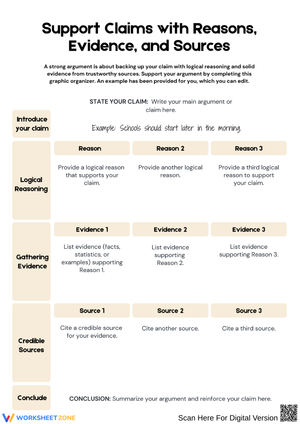
Response to literature printable worksheets for 7th grade address a precise instructional gap — the distance between a student who can retell a story accurately and one who can build an argument about it. These worksheets give students a repeatable structure for forming a claim, selecting textual evidence, and — the move most students avoid — explaining why that evidence actually proves anything. Because the format works across whole-class novels, literature circles, short story units, and independent reading, teachers aren't remaking materials every time the text changes.
The Writing Moves These Worksheets Build
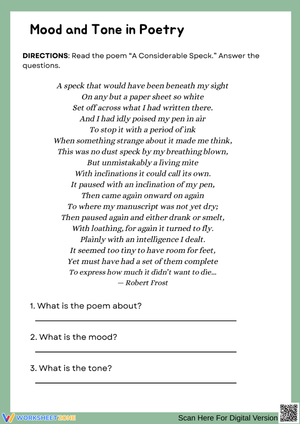
Seventh graders usually know how to summarize. The leap that's hard is understanding that a literary response requires a defensible claim, not an observation. Students write the character was determined and stop there, treating it as a complete thought. A well-built worksheet pushes them past that stopping point.
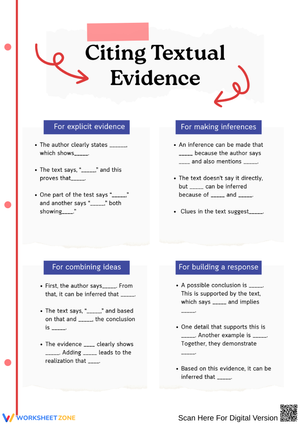
- Forming a focused claim — one that takes a position on a literary element rather than restating what happened
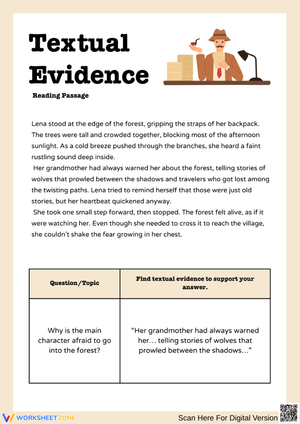
- Locating and selecting relevant evidence — distinguishing between support that proves the claim and detail that's merely adjacent to it
- Writing explanation — unpacking the connection between evidence and claim, not restating one in terms of the other
- Analyzing specific literary elements — theme, characterization, conflict, point of view, and how those elements develop across a text
- Organizing a response — at the paragraph level first, then extending toward multi-paragraph analysis
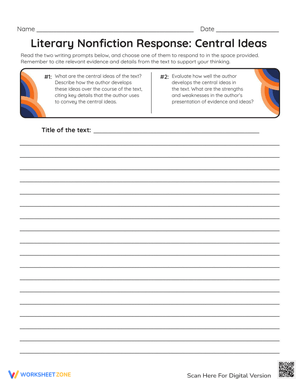
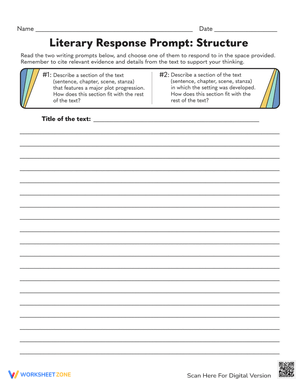
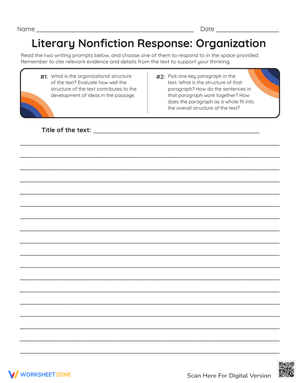
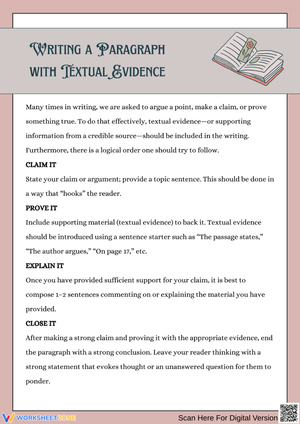
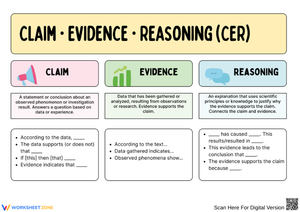
Most of the real work in grade 7 literary writing lives in the explanation step. Students find a strong passage, drop it into their response, and write "This shows she is brave" — which is just the original claim restated in different words. Worksheets that separate claim, evidence, and explanation into distinct spaces on the page make this failure visible. Students see the blank explanation box and understand that something is still missing.
Mistakes Students Reliably Make at This Stage
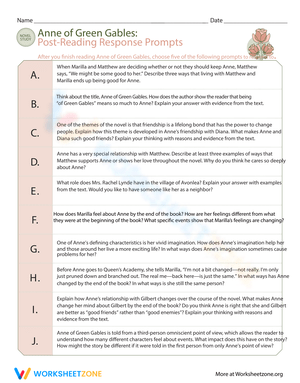
The most persistent error isn't wrong evidence — it's circular explanation. A student argues that a character changed over the course of a novel, quotes a moment from late in the text, and then writes "This shows the character changed." That's not analysis; it's a restatement. The explanation needs to say why that moment signals something about the character's internal shift — what it reveals about motivation, about relationship, about what the character now believes differently. Getting students to see this distinction requires showing it repeatedly, and these worksheets help precisely because the structure makes the absence of real explanation obvious.
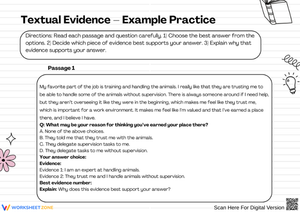
A second common problem is evidence selection. Students often grab the first relevant-sounding quotation rather than the strongest one. Building in a step where students flag three possible pieces of evidence before committing to one — something several of these worksheets do — reduces random selection and forces comparison. A student holding three passages side by side is far more likely to ask which one actually proves the claim.
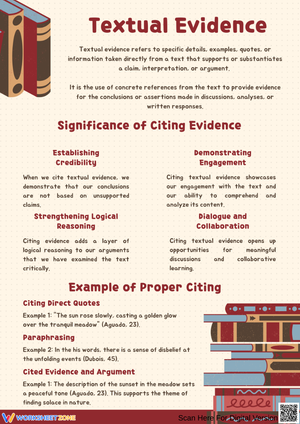
Students who struggle with academic language often resort to extended paraphrase instead of direct quotation, then explain the paraphrase rather than the text. A sentence stem like The author writes, "..." followed by This word choice suggests... keeps them anchored to specific language. Without that anchor, explanations drift — "the author shows a lot of emotion here" — which doesn't hold up as evidence-based analysis.
Fitting These Worksheets Into the Daily Flow of ELA
These worksheets work best inside a consistent routine rather than as occasional tasks. The most practical use is as a post-reading writing structure completed within the first 15 minutes of class after students finish a chapter or short story, while the text is still immediate. Whole-class modeling on the first run matters: projecting the worksheet and thinking aloud about why one piece of evidence is stronger than another sets the standard students then try to match on their own.
In literature circle weeks, each group can complete the same claim-evidence-explanation frame on the same literary element, then compare findings. This makes the analytical differences between groups concrete — not just "Group A had a different interpretation," but "Group A chose a different type of evidence to prove the same theme."
One honest constraint worth naming: students who freeze when given an open-ended prompt struggle more with blank worksheet formats than with guided ones. For those students, starting with a teacher-provided claim and asking them to supply only the evidence and explanation is a more productive entry point than a fully open frame. It isolates the part of the task where they actually need more practice.
Standard Alignment
These worksheets address CCSS.ELA-LITERACY.RL.7.1, which requires students to cite several pieces of textual evidence to support analysis of what the text says explicitly and what can reasonably be inferred. They also connect to CCSS.ELA-LITERACY.W.7.1, the standard for writing arguments with clear claims, relevant evidence, and coherent reasoning. In classroom terms, RL.7.1 is the reading entry point — students learn to locate and evaluate evidence in a text — while W.7.1 is where that reading work becomes written argument. Response to literature printable worksheets for 7th grade sit at the junction of both standards, which is why they serve reading-focused lessons and writing-focused lessons equally well.
Adjusting These Worksheets for a Range of Writers
For students who need more support, the adjustments are practical: add sentence stems at each stage of the frame, reduce the required evidence from two examples to one, and pair the worksheet with a shorter or pre-selected passage. Some teachers offer a list of four possible claims and ask struggling writers to choose the strongest one and defend it, rather than generating a claim independently. That modification keeps the analysis work intact while removing the claim-formation barrier.
Response to literature printable worksheets for 7th grade also lend themselves to extension without changing the physical worksheet. On-level students complete the frame with two pieces of evidence and a full explanation for each. Students ready for a stretch add a counterclaim — an acknowledgment of an opposing interpretation and a brief explanation of why the original claim still holds. That move appears in grade 8 and high school argument writing, so practicing it in grade 7 gives stronger writers early exposure to a move they'll need later.
Differentiating by text complexity rather than by task is often the cleanest option in a mixed-ability class. Every student uses the same worksheet structure; the reading passage varies. On-level and above-level students respond to grade 7 texts; students reading below grade level respond to a passage at their instructional level. The writing expectation stays consistent, which keeps the lesson manageable and keeps below-level students practicing the same analytical moves.
Frequently Asked Questions
What's the difference between a literary response and a summary?
A summary retells what happened in the text. A literary response makes an argument or interpretation about the text and supports it with evidence. If a student is recounting events in order, they are summarizing, not analyzing. The clearest diagnostic question to ask students: "Does your response tell me what the text means, or just what it says?"
Can I use these worksheets with any novel or short story?
The most useful response to literature printable worksheets for 7th grade are text-flexible — built around analytical moves rather than tied to a specific title. That means the same worksheet works in September with a short story, in January with a class novel, and in April during standardized test review.
How do I help students who quote the text but don't explain it?
Name the problem directly — "restating is not explaining" — and show a sample response that does it wrong, then one that does it right. Then give students a specific sentence starter for the explanation step: This matters because... or This word choice reveals that the character... Targeted sentence-level support for explanation is more effective than general feedback like "say more."
How many pieces of evidence should a 7th grader include in one response?
Two pieces of evidence with strong explanation for each is a reasonable grade 7 target. One piece of evidence with thorough unpacking is better than three pieces listed without explanation. Quality of reasoning should weigh more than quantity of citations, and these worksheets are most useful when their structure communicates that expectation clearly — giving more space to the explanation than to the evidence itself.












 Interactive Worksheet Maker
 Quiz Maker
 Word Search Maker
 Crossword Puzzle Maker
 Word Scramble Generator
 Sentence Scramble Generator
 Handwriting Worksheet Generator
 Name Tracing Generator
 Fill In The Blank Generator