




























Views
Downloads
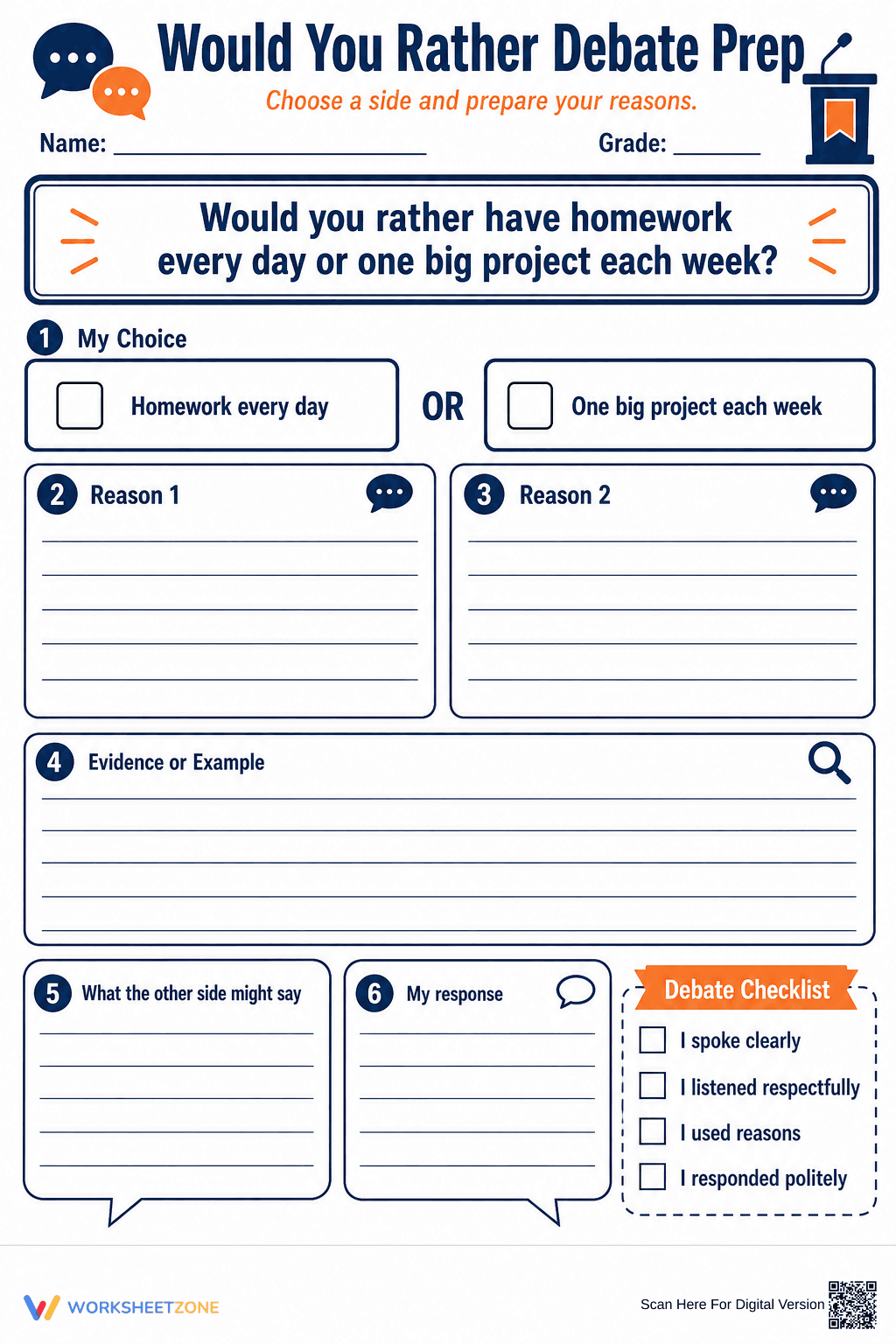

Grade 6 Debate Prep — Printable No-Prep Worksheet

Paste this activity's link or code into your existing LMS (Google Classroom, Canvas, Teams, Schoology, Moodle, etc.).
Students can open and work on the activity right away, with no student login required.
You'll still be able to track student progress and results from your teacher account.
This Grade 6 ELA worksheet equips students to construct logical arguments and anticipate counterclaims before a debate. By guiding learners through a structured scenario, this resource transforms abstract concepts into actionable speaking points. Students develop critical thinking and persuasive communication skills.
At a Glance
- Grade: 6 · Subject: ELA
- Standard:
CCSS.ELA-LITERACY.W.6.1— Write arguments to support claims with clear reasons.- Skill Focus: Argumentative Reasoning and Counterclaims
- Format: 1 page · 6 tasks · No answer key · PDF
- Best For: Pre-debate brainstorming and organization
- Time: 15–25 minutes
Inside this single-page graphic organizer, students find a structured framework for building persuasive arguments. The worksheet features six sections, prompting learners to state their choice, provide two reasons, and back them up with evidence. It includes dedicated spaces for anticipating opposing viewpoints and drafting direct responses. A built-in debate checklist serves as a self-assessment tool, ensuring students speak clearly and listen respectfully during discussions.
Zero-Prep Workflow
This resource is designed for immediate implementation with minimal setup.
- Print (1 min): Download the PDF and print a class set. The clean design ensures crisp copies.
- Distribute (1 min): Hand out the organizer as a warm-up or following your introduction to argumentative writing.
- Review (2 mins): Read the prompt aloud and point out the checklist. Students complete the rest independently.
With under two minutes of teacher prep time, this worksheet is an excellent addition to your sub plan folder.
Standards Alignment
This resource aligns to CCSS.ELA-LITERACY.W.6.1, requiring students to write arguments to support claims with clear reasons and relevant evidence. It also supports speaking standards by preparing students to present claims logically. Both standard codes can be copied directly into lesson plans, IEP goals, or district curriculum mapping tools.
How to Use It
Integrate this worksheet before a formal classroom debate. As a pre-writing activity, have students complete the organizer to gather thoughts before drafting an argumentative essay. This ensures claims are well-supported early in the process. For a formative assessment observation tip, check their "Evidence or Example" boxes while they work; this provides immediate insight into whether they can distinguish between opinions and factual details. Expect completion in 15 to 25 minutes.
Who It's For
Designed for Grade 6 ELA, this accessible layout is highly effective for Grades 5 through 8. The structured boxes provide excellent scaffolding for English Language Learners and students with IEPs who benefit from chunked assignments. Pair this organizer with an anchor chart detailing strong transition words for argumentative speaking.
Research demonstrates that structured pre-writing activities significantly improve the quality of student arguments. According to a recent EdReports 2024 analysis, instructional materials providing explicit frameworks for anticipating opposing viewpoints help students develop deeper critical thinking and resilient claims. By utilizing this graphic organizer, educators directly support CCSS.ELA-LITERACY.W.6.1, guiding students to write arguments to support claims with clear reasons. The inclusion of a self-assessment checklist reinforces metacognitive strategies, allowing learners to monitor their speaking behaviors during peer interactions. When students map out their reasoning and counterclaims before engaging in verbal debate, they experience lower anxiety and demonstrate higher academic vocabulary usage. This targeted approach ensures discussions remain focused and rigorously aligned to grade-level expectations.


