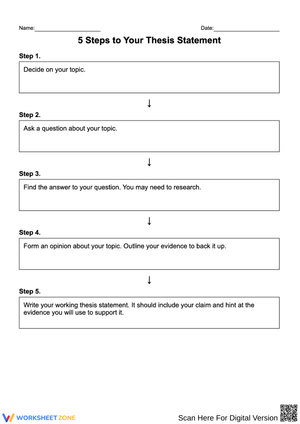
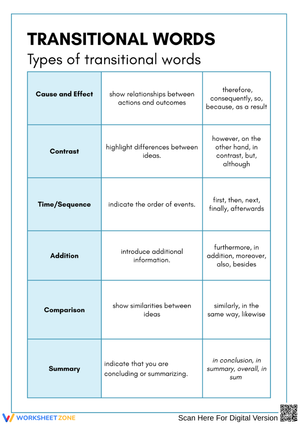
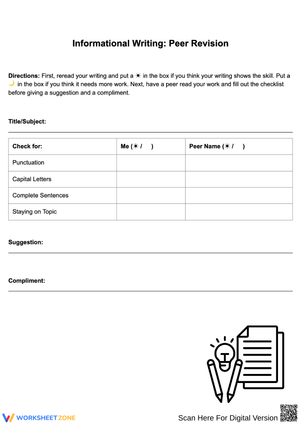
These informational writing worksheets for 7th grade give teachers a sequenced set of tools for guiding students through the full writing process—topic selection, note-taking, organizing, drafting, and revision—without needing to build each resource from scratch. The set targets Grade 7 ELA expectations directly: clear topic introductions, logically grouped ideas, relevant supporting details, precise language, and conclusions that close the piece rather than restate what came before.
What's Inside the Set
Each worksheet handles a distinct phase of the writing process rather than combining multiple steps into one task. The resources cover:
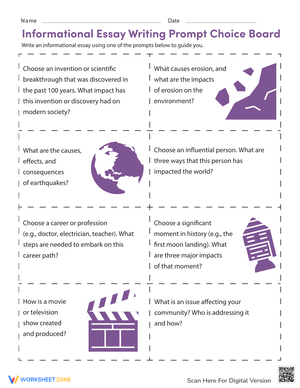
- Topic selection prompts that push students from a broad subject to a focused, writable idea
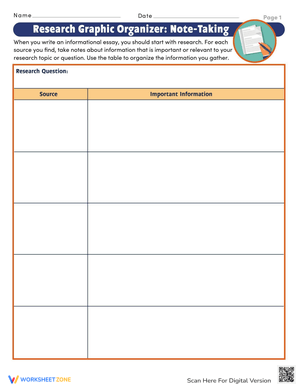
- Note-taking worksheets that require students to commit to a working main idea before logging any research details
- Text structure organizers for sequence, compare-and-contrast, cause-and-effect, and problem-and-solution
- Drafting worksheets with section labels and optional sentence starters for introductions, body paragraphs, and conclusions
- Revision checklists covering organization, transitions, formal style, and conclusion quality
- Editing worksheets for a final pass on conventions after content and organization are already solid
The topic selection step deserves particular attention at this grade level. Seventh graders who skip it consistently produce loosely connected fact collections rather than organized explanations. Note-taking worksheets reinforce this by requiring students to write a working main idea before they log a single research detail—so when students reach the organizing phase, they already know what their piece is actually arguing or explaining.
Where Grade 7 Informational Writers Consistently Get Stuck
The most persistent problem in seventh grade informational writing isn't mechanical—it's structural. Many students interpret "organized" as "I have three paragraphs." A student writing about renewable energy might produce one paragraph on solar power, one on wind power, and one on hydropower, and consider the piece logically arranged. The text structure organizers address this directly: they ask students what the relationship between ideas is, not just what topics they plan to cover. A student who realizes the point of their piece is that all three energy types are effective alternatives to fossil fuels will build body paragraphs around categories of comparison, not a list of topics.
Conclusions are the second consistent weak point. The pattern appears across grade levels but is especially pronounced at Grade 7: students finish the body paragraphs, reach the conclusion, and rewrite the introduction with minor word substitutions. A revision checklist item that reads "Does my conclusion move the reader beyond restating what I already explained?" is more instructionally precise than a general note to "improve your conclusion." Showing one strong conclusion next to one restatement during a five-minute mini-lesson before drafting day is usually enough to make the distinction visible—students who see that comparison often catch their own version of the error during revision without further prompting.
Building These Worksheets Into Your Lesson Plans
A 10-day writing unit maps cleanly onto this set. Days one and two cover topic selection and initial research using the note-taking worksheet. Days three and four focus on text structure selection and organizer completion. Days five and six are for drafting with paragraph-level support worksheets. Days seven and eight are for revision and peer conferences using the checklist. Days nine and ten cover editing and final copy. Students who follow that sequence know which tool comes next at the start of each class period, which cuts the daily ramp-up that tends to eat into workshop blocks before any actual writing gets done.
Outside a full unit, individual worksheets slot into shorter instructional windows without friction. A text structure organizer makes a solid 15-minute mentor text activity: students read a short informational excerpt, identify the structure the author used, and fill in the matching organizer with the author's information. A revision checklist sharpens peer conferences by giving partners something specific to mark rather than defaulting to "it sounds good." The note-taking worksheet also works as a focused research day plan that a substitute can manage without needing to introduce a new writing concept.
One classroom pattern worth building into any plan: use the same organizer format across two or three consecutive assignments before switching to a new one. When students already know where the main idea goes and how supporting details are grouped on the page, that cognitive load goes toward actual writing decisions rather than toward reading the worksheet. The first time any new organizer is introduced, expect it to run slower than planned—that's consistent—but the second and third uses move efficiently because students are using the tool, not decoding it. Informational writing worksheets for 7th grade work best when each worksheet becomes part of a predictable routine rather than a one-off resource pulled in for a single lesson.
Standard Alignment
These worksheets address CCSS.ELA-LITERACY.W.7.2, which requires students to write informative and explanatory texts that examine a topic and convey ideas through well-chosen facts, definitions, details, and examples. The standard also specifies that students establish and maintain a formal style, use precise language and domain-specific vocabulary, and provide a concluding statement that follows from—rather than merely restates—the information presented.
In classroom terms, W.7.2 sits at the intersection of reading and writing instruction. Students apply skills developed during informational text reading—identifying text structure, tracing main ideas, evaluating supporting details—to their own writing. The text structure organizers in this set use the same visual frameworks many students have encountered during reading instruction, which makes that transfer explicit rather than assumed.
Differentiating the Set Across Ability Levels
Using informational writing worksheets for 7th grade in a mixed-ability classroom is straightforward once teachers decide that differentiation should change the level of support without changing the writing goal. Keeping the same target across the room—a logically organized informational piece with relevant supporting details and a clear conclusion—allows the whole class to share mini-lessons, rubric discussions, and peer conferences, even when individual students are working with different amounts of structure.
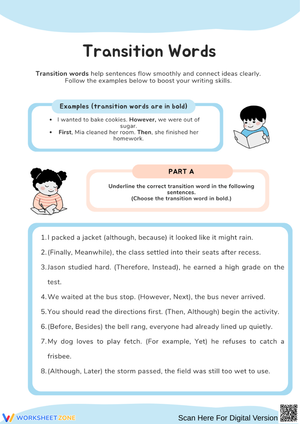
English learners benefit from worksheets that incorporate word banks, labeled transition lists, and model sentences directly on the organizer rather than on a separate reference sheet. For students explaining a process, having sequence words—first, next, as a result, finally—printed alongside the planner reduces the cognitive split between "what do I want to say" and "how do I say it in academic English." Students who struggle to begin drafting often make more progress when the first task is just the introduction paragraph, using a frame with a slot for the topic and a slot for the preview of main points.
Students who need a greater challenge can work with the same organizer under higher expectations: synthesize information from two or more sources, incorporate domain-specific vocabulary, or address a likely counterargument within the explanation. The open-ended final draft worksheet gives advanced writers room to make their own organizational decisions without section labels directing every move. Moving students from structured practice toward open drafting over several assignments is a gradual release model that this set supports without requiring two entirely different lesson plans.
Frequently Asked Questions
What text structures should 7th graders know for informational writing?
The four most important at this grade are sequence, compare-and-contrast, cause-and-effect, and problem-and-solution. Each fits different informational content: sequence for historical timelines and scientific processes, compare-and-contrast for analyzing two subjects side by side, cause-and-effect for science and social studies topics, and problem-and-solution for policy or advocacy writing. Students who can identify which structure matches their topic before they draft produce more coherent pieces than students who choose a structure at random or skip the question entirely.
How many worksheets does a 7th grade writing unit typically need?
A 10-day unit works well with six to eight distinct worksheets: one for topic selection, one or two for note-taking, one text structure organizer, one or two drafting supports, one revision checklist, and one editing sheet. Each worksheet handles a specific job in the sequence. Using fewer creates gaps where students lose direction; using more can slow the drafting phase to the point where students run out of momentum before finishing a draft.
Can these worksheets be used for writing in science or social studies?
Content-area classes are natural settings for this kind of writing. A cause-and-effect organizer works for explaining historical events or scientific phenomena. A problem-and-solution worksheet suits environmental science or civics writing. Some teachers on cross-curricular teams use the same organizers in both ELA and their content class, which reinforces the structural pattern without asking students to learn two different formats for essentially the same kind of writing task.
How do these resources fit into a full-year writing program?
Informational writing worksheets for 7th grade typically anchor one or two concentrated units per year, often running alongside content-area research projects or nonfiction reading units. At this grade, the skill builds on expository writing from fifth and sixth grade and prepares students for the more discipline-specific writing expectations of eighth grade and high school. The set works well as the primary writing resource for those units or as targeted review for students who are still developing their planning and organization skills mid-year.












 Interactive Worksheet Maker
 Quiz Maker
 Word Search Maker
 Crossword Puzzle Maker
 Word Scramble Generator
 Sentence Scramble Generator
 Handwriting Worksheet Generator
 Name Tracing Generator
 Fill In The Blank Generator